
Steam catapults? US Navy appears to be sticking with electromagnetics on carriers
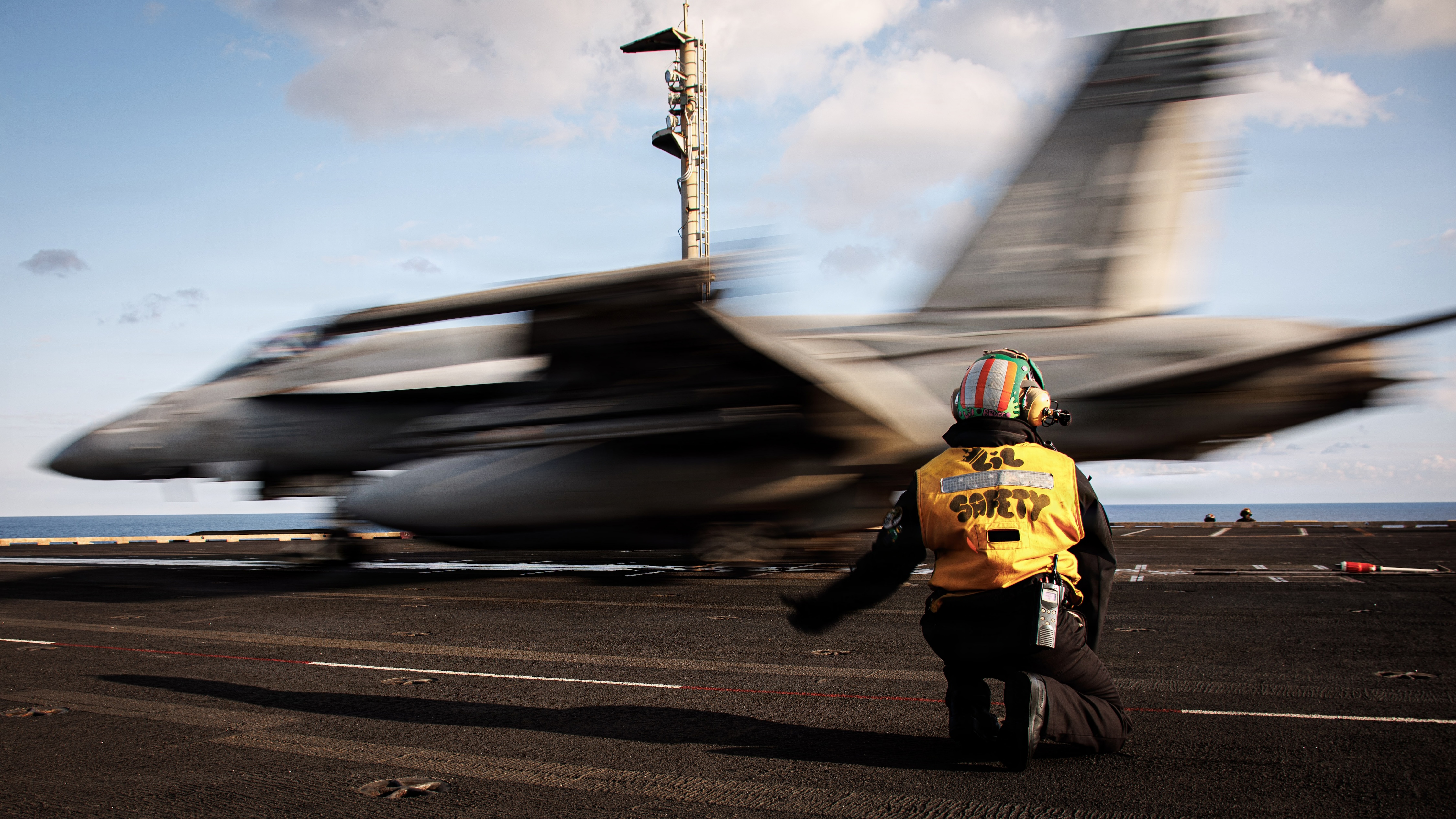
Despite U.S. President Donald Trump’s nostalgia for old-fashioned steam catapults, the U.S. Navy appears to be sticking with electromagnetics for its newest class of aircraft carriers.
The Navy recently awarded contracts for the Electromagnetic Aircraft Launch System, or EMALS, which uses electrically generated magnetic fields to launch aircraft from Ford-class carriers.
Kato Engineering announced a $49.3 million contract this week to support the energy storage subsystem of EMALS. The Navy also published a sources sought notice on Wednesday, seeking vendors to supply components such as EMALS recirculation pumps.
The Navy maintains that electromagnetic catapults provide smoother acceleration, can be adjusted to launch various types of aircraft such as drones, can be reset for faster launches and require less maintenance and personnel. China, meanwhile, is equipping its new Fujian-class carriers with electromagnetic catapults.
Trump resurrected the steam catapult versus EMALS conversation in August, when he ordered the Navy to replace EMALS with the older system on the USS Doris Miller, the next Ford-class carrier under construction.
In an August memo, Trump pointed at a Navy that has suffered from “a series of shipbuilding setbacks stemming from overly complex designs and iterative design change procedures, which have resulted in cost growth, delays, and cancellations.”
The president suggested mandating that the Navy submit “a plan on the required measures to replace the Electromagnetic Aircraft Launch System and Advanced Weapons Elevators with steam and hydraulic systems for the construction of CVN-81 [USS Doris Miller], including timelines and resourcing requirements.”
The White House’s order baffled naval experts. The Navy has not ordered a steam catapult in 20 years, with the last order placed for the USS George H. W. Bush, commissioned in 2009 as the final Nimitz-class carrier.
Finding a manufacturer for steam catapults, and then redesigning Ford-class carriers to accept them, would likely require sweeping manufacturing overhauls at considerable expense, critics of the order said.
Despite their planned phasing out, steam catapults are a proven technology. They were developed by Britain in the 1950s to replace the hydraulic catapults of World War II-era carriers and were later copied by the U.S.
“The decision was made in April 1952 that the steam catapult would probably be the most satisfactory type for a service catapult,” noted a 1954 article in the U.S. Naval Institute magazine Proceedings. “Arrangements were made for the manufacturing rights to the British catapult. British drawings were obtained and redrawn to U. S. standards and modified to fit U.S. naval requirements.”
Manufactured for 21st century carriers, EMALS “is designed to expand the operational capability of Ford-class carriers, providing the Navy with capability for launching all current and future carrier air wing platforms – lightweight unmanned to heavy strike fighters.
The rapid evolution of unmanned aircraft, which may soon become the backbone of carrier air wings, will likely require a more sophisticated launch system. Recent contracts suggest the U.S. Navy is planning accordingly.
The U.S. Navy continues to develop the Electromagnetic Aircraft Launch System (EMALS) for its aircraft carriers, despite President Trump's push to revert to steam catapults. Recent contracts have been awarded to support EMALS, which offers advantages in launching capabilities. Meanwhile, China is advancing its own carrier technology with electromagnetic catapults.
- U.S. Navy awarded contracts for EMALS development.
- Kato Engineering received a $49.3 million contract for EMALS support.
- Trump ordered the Navy to consider replacing EMALS with steam catapults for the USS Doris Miller.
- EMALS is designed for launching various aircraft types, including drones.
- China is equipping its Fujian-class carriers with electromagnetic catapults.