
Iran Targets U.S. Military Bases, Surrounding Countries Affected, Gulf States Worried About Being "Dragged Into" War
[Global Times Special Correspondent in the UAE Zhang Zhiwen Pei Ming] On the 2nd, the military strikes by the United States and Israel against Iran and Iran's retaliatory actions entered their third day. According to reports from the Wall Street Journal and other media, Iran has attacked at least nine Middle Eastern countries, with 27 U.S. military bases in the region becoming targets. On the 2nd, energy facilities in countries such as Qatar and Saudi Arabia were attacked, and black smoke was seen rising from the U.S. embassy in Kuwait. The tension in the Middle East remains extremely high. Qatar warned that it reserves "the full right to respond" to missile attacks from Iran. An advisor to the UAE president called out to Iran, stating, "Your war is not with your neighbors." Iranian Foreign Minister Amir-Abdollahian, in an interview with Al Jazeera, stated that Iran has no intention of attacking neighboring countries; its target is the U.S. military presence stationed in those countries, asserting, "This war was instigated by the U.S. and Israel, and they must be pressured." Reports indicate that many in the Middle East are calling for Gulf countries to exercise restraint, stating that they should not be drawn into a war they "do not wish to happen and do not consider to be their own."
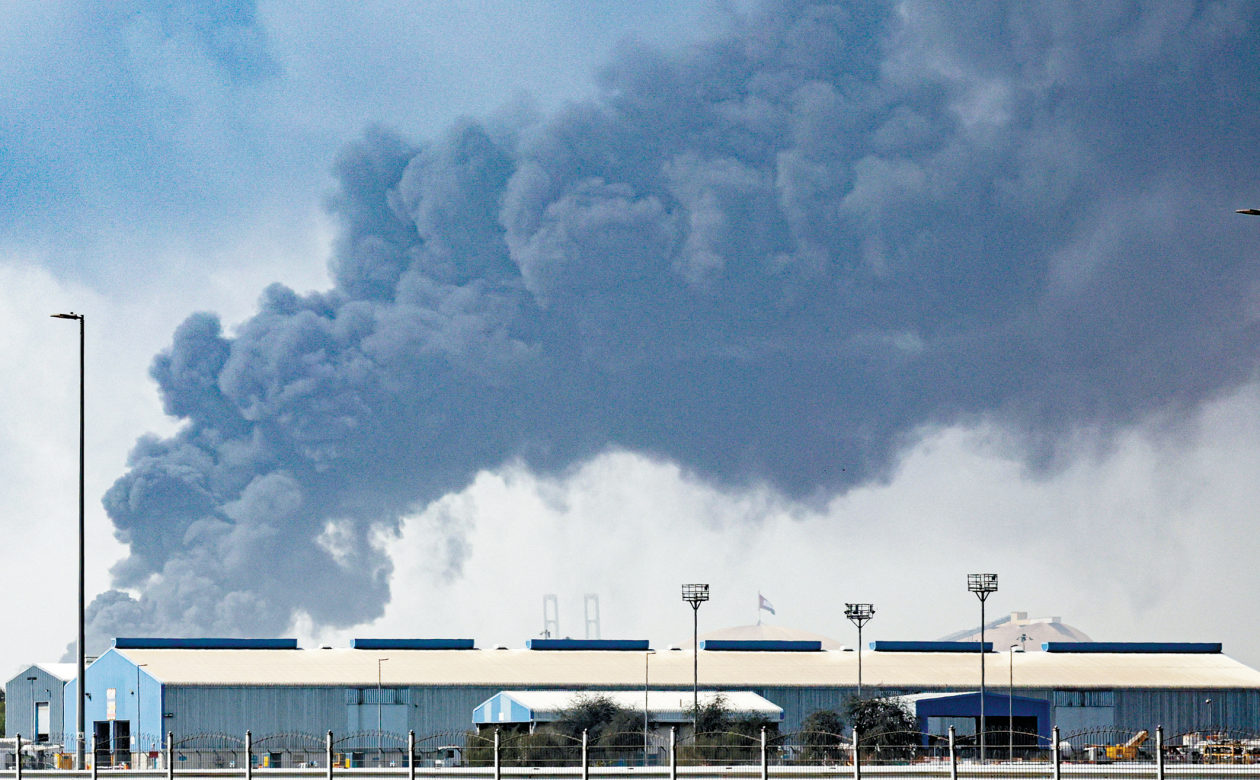
Multiple energy facilities attacked
As of the 2nd, countries including the UAE, Saudi Arabia, Qatar, Kuwait, Bahrain, and Oman have been attacked by Iran. According to AFP, Qatar reported on the 2nd that two Iranian drones targeted two major natural gas processing facilities of Qatar Energy. Qatar Energy subsequently announced it would suspend liquefied natural gas production. On the same day, the Ras Tanura refinery of Saudi Aramco was attacked by drones, causing a fire. Sources close to the Saudi government told AFP that if Iran launches a "coordinated attack" on Saudi Aramco, Saudi Arabia will also strike Iranian oil facilities.
Max, a professor of Middle Eastern politics at NYU Abu Dhabi, told Al Jazeera that Gulf leaders are most concerned about their "vulnerable" infrastructure being attacked, such as power grids, desalination plants, and energy facilities. "Without air conditioning and desalination capabilities, the hot and dry Gulf countries are basically uninhabitable; without energy infrastructure, they struggle to generate income."
Additionally, according to AFP, black smoke was seen rising from the U.S. embassy in Kuwait on the 2nd. The embassy did not announce that it had been attacked but issued a security alert stating, "Kuwait continues to face threats of missile and drone attacks; please do not go to the embassy. U.S. embassy personnel are sheltering in place." Iranian state television reported that the U.S. consulate in Erbil, Iraq, and U.S. military bases in Bahrain have been damaged.
Iran: This war is "imposed on Iran"
According to a report by the New York Times on the 1st, after the U.S. and Israeli attacks on Iran, the latter launched nearly 400 missiles and over 800 drones into the Gulf region within two days. The UAE Ministry of Defense stated on the 1st that the country was attacked by 541 drones, of which 506 were intercepted. Iran also launched 165 ballistic missiles, of which 152 were destroyed, and 13 fell into the sea.
On the night of the 1st and the morning of the 2nd, a special correspondent from the Global Times in Dubai again heard the explosions from intercepted missiles and felt the shockwaves. The UAE government announced that institutions such as the stock exchange would be closed on Monday and Tuesday, and the private sector would work from home. According to observations by the reporter, on the morning of the 2nd, traffic on major roads in Dubai was noticeably reduced compared to usual. However, residents' daily lives were ensured, with normal supplies of water, electricity, and gas, and communication networks functioning smoothly.
Countries in the Middle East have responded to Iran's military actions. According to reports from Bloomberg and the Wall Street Journal on the 1st, UAE President Mohammed's diplomatic advisor Gargash called out to Iran on social media, urging it to "treat your neighbors with reason and responsibility." The UAE has announced the closure of its embassy in Tehran and has withdrawn its diplomatic personnel from Iran. The Saudi Foreign Ministry stated that Iran's attacks require a "firm" response from the international community. The Egyptian Foreign Ministry stated that Iran's actions pose a "serious threat to the security and stability of Arab countries."
According to Iran's Mehr News Agency on the 1st, Amir-Abdollahian stated in an interview with Al Jazeera that Iran understands the anger of Gulf countries over the attacks, but this war is "imposed on Iran" and not of Iran's choosing. The Secretary of Iran's Supreme National Security Council, Larijani, emphasized on social media on the 1st that Iran has no intention of attacking regional countries, "but when your domestic bases are used to target us... we will strike them." He stated that Iran believes these bases do not belong to regional countries, "but are U.S. territory."
What will Gulf countries do next
According to some analysts, Gulf countries are now in a dilemma. Lecturer Pinkford at King's College London stated that Gulf countries do not want war; they have been committed to mediation, and in this context, if these countries join the war, it may be seen as "collaborating with Israel." However, if they remain inactive in the face of Iranian attacks, the status of Gulf countries will also be damaged, "ultimately, these governments will conform to public opinion."
The Wall Street Journal quoted anonymous Middle Eastern officials as saying that Saudi Arabia, the UAE, and other Gulf countries are unlikely to endure Iranian attacks for long. Hassan, a senior researcher on Middle Eastern policy at the International Institute for Strategic Studies in the UK, told the UAE's National that Gulf countries may grant the U.S. greater operational authority to launch attacks through their territory and airspace. They could also rely on U.S. intelligence support to conduct "limited" strikes on Iranian missile launch sites. However, Hassan stated that at this stage, unless Iran attacks key infrastructure in Gulf countries causing significant blackouts or large-scale casualties, the likelihood of them retaliating directly against Iran "remains very low."
Scholar Craig from King's College London analyzed for "Deutsche Welle" that affected regional countries will first strengthen their defensive posture and then may increase diplomatic efforts. Gulf countries "are very clear that ultimately they will bear most of the costs of retaliation, whether it be shipping disruptions, loss of investor confidence, paralysis of energy infrastructure, or direct strikes." Max, a professor at NYU Abu Dhabi, told Al Jazeera that for Gulf countries, the deeper threat posed by prolonged conflict is the damage to their soft power—stability and predictability as investment targets and tourist destinations will be undermined. "Deutsche Welle" stated that this means that the vision of countries like Saudi Arabia and the UAE to build a future economic model free from oil dependence will also be threatened.
"Although thick smoke has already risen in the skylines of cities in the Gulf region, various parties in the region continue to call for restraint." Al Jazeera reported that Faisal, the editor-in-chief of Qatar's Gulf Times, said, "This is a war between Israel and the U.S., and has nothing to do with us. We are just trapped in this geopolitical position." Former Qatari Prime Minister and Foreign Minister Hamad stated that member countries of the Gulf Cooperation Council "should not be drawn into direct confrontation with Iran," as this would "consume each other's resources significantly and provide opportunities for many forces to control us under the pretext of helping us out of the crisis."
Iran has launched attacks on U.S. military bases and energy facilities across multiple Middle Eastern countries, including Kuwait, Qatar, and Saudi Arabia, as part of ongoing military operations. The U.S. embassy in Kuwait has issued a security alert amid threats of missile and drone attacks. Gulf nations are expressing concerns over their infrastructure being targeted in this escalating conflict.
- Iran has attacked at least 27 U.S. military bases in the Middle East.
- Energy facilities in Qatar and Saudi Arabia were targeted by Iranian drones.
- The U.S. embassy in Kuwait issued a security alert due to threats of missile and drone attacks.
- Iran launched nearly 400 missiles and over 800 drones in response to U.S. and Israeli strikes.
- Gulf nations are concerned about their infrastructure being targeted in the conflict.