
Iran's Attack with Six Drones on Al-Rifaa Base in Bahrain in 2026 Tests the Gulf Air Umbrella
 Ahmed Al-Rashid
Iran's Attack with Six Drones on Riffa Base in Bahrain in 2026 Tests the Gulf Air Umbrella
On the morning of November 15, 2026, the Iranian Revolutionary Guard announced that it had launched six drones at a U.S. radar facility at Riffa Base in Bahrain, while Manama stated that its air defenses intercepted the attacks before reaching their targets. The damage has not been independently verified, and the U.S. military has not reported any responsibility or losses in its latest update. However, the significance of the incident does not hinge on whether the radar was hit; the choice of Bahrain places the U.S. naval command center in the Gulf within the equation of Iranian response, and once again reveals that possessing an interception system does not equate to having a guaranteed ability to protect every node in the network of bases.
Why Riffa and Not a Distant U.S. Facility
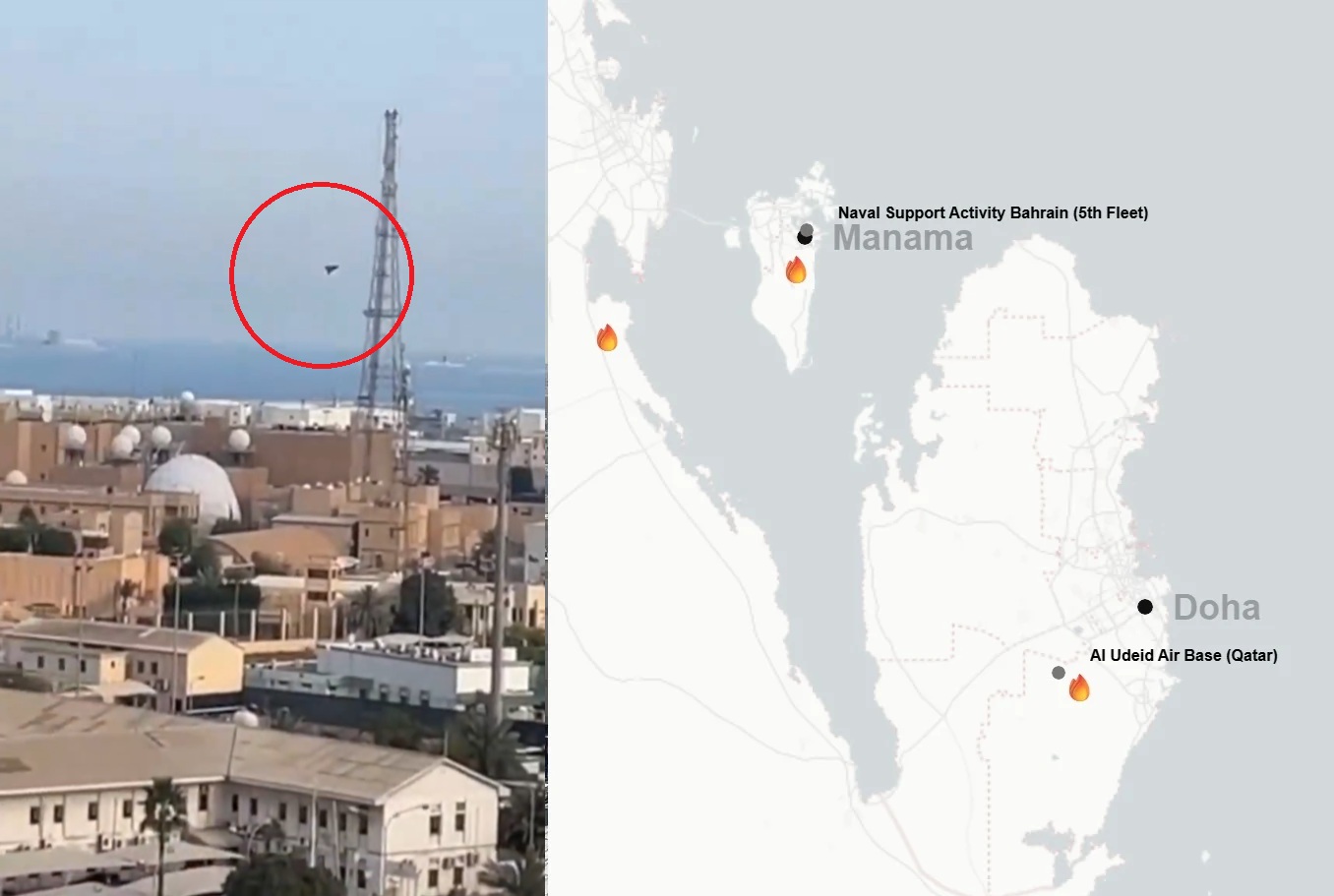
Bahrain is a small island, and thus any strike on a military site there carries both an operational and political dimension. The targeted base is linked to warning and surveillance capabilities, while the kingdom hosts a main headquarters for the U.S. Fifth Fleet. Practically, Iran does not need to destroy the command facility to achieve an effect; it is sufficient to force it to operate in a state of constant alert, or to push the Americans to distribute radars and communication centers, or to make civilian and military aviation coexist with repeated airspace closures.
Iran stated that the target was a radar facility at Riffa Base, while Bahrain claimed that several aerial attacks were thwarted. These are two partially converging narratives, but they do not answer the most important military question: Was the interception the result of an integrated Gulf network, or a local defense that dealt with a limited wave? So far, there is no public data on the type of drones, the number of intercept missiles used, or the trajectory of the attack. Therefore, it is necessary to avoid turning the announcement of the interception into a decisive victory, just as it should be avoided to consider it evidence of a successful breach.
Testing the Gulf Capability Triangle
I return here to the capability triangle that summarizes much of our discussions in the region: equipment, training, and institution. The equipment is present. Bahrain, like its neighbors, benefits from an American warning network and multi-layered air defense systems, and the American presence adds aircraft, radars, and ships capable of data sharing. However, equipment does not operate alone. A successful interception requires a crew that can distinguish between the drone and the decoy, clear rules of engagement, and uninterrupted communications when the base itself is under threat.
The institutional problem is deeper. Gulf countries purchase separate Western platforms and then expect to produce a unified system merely by linking screens. This is not enough. Effective air defense is a continuous cycle of sensing, decision-making, engagement, damage assessment, and reloading. If each country maintains a different aerial picture or waits for political permission before sharing information, then a cheap drone can consume an expensive interception missile or force the base to halt its operations without achieving a direct hit.
From Bahrain to Riyadh and the Strait of Hormuz
The Riffa attack occurred on a day when the Saudi-led coalition reported intercepting two ballistic missiles launched toward Riyadh, in addition to drones near eastern areas and near Medina. At the same time, maritime risks escalated following reports of tankers being attacked or colliding with unknown projectiles near the Strait of Hormuz, with some claims from the Revolutionary Guard remaining unverified. These are not separate fronts. Iran and its allies are pressing on a single network that includes bases, cities, oil ports, and maritime corridors.
The announcement of the entry of the aircraft carrier USS Theodore Roosevelt into the area of responsibility of U.S. Central Command, joining the carriers USS George H.W. Bush and USS George Washington, illustrates the extent of Gulf reliance on Washington. Three carrier strike groups provide the U.S. with deterrent, strike, and navigation protection capabilities, but they do not grant Bahrain or Saudi Arabia independence in managing the battle. A carrier at sea cannot be everywhere, nor can it compensate for shortages in stocks or weak local coordination.
The Political Message to Bahrain and Gulf States
Saudi Arabia, Qatar, Jordan, and Egypt condemned the attack, while the UAE described the assault as a violation of Bahrain's sovereignty. This diplomatic unity is important, but it still falls short of a defensive alliance that operates automatically. Bahrain wants to prove that hosting U.S. forces does not make it an exposed target, and Iran wants to convey that U.S. deterrent bases are not immune from pressure. Meanwhile, the rest of the Gulf capitals are watching whether the interception will remain an American function or transform into a regional capability that they can operate, maintain, and expand on their own.
Practically, the incident will push for more radars, shelters, interception drones, and possibly the purchase of additional missiles. However, buying more is the easiest part of the story. The harder part is joint training, unifying the air picture, managing munitions, and determining who has the decision to fire within minutes. In my estimation, the Gulf will continue to purchase the American umbrella because it lacks a quick alternative, while simultaneously continuing to talk about defensive independence. This is the contradiction that the Riffa drones have clearly revealed: countries that want immediate American protection, but do not want their military institutions to remain hostage to American protection.
Conclusion
It has not yet been proven that the November 15 attack hit Riffa Base, nor has it been proven that Gulf defenses thwarted everything that was planned. What is certain is that a Bahraini base housing American military infrastructure has become a public stage for mutual responses, and that the Gulf network is facing simultaneous pressure from the air, sea, and missiles. In modern wars, the strength of defense is not measured by the number of missiles purchased, but by the institution's ability to survive and operate after the first strike. And as any military personnel who has served in the region knows, a successful interception buys a minute; however, a long war is determined by the ability to repeat that thousands of times.
Sources
- The Guardian, coverage of the Bahrain attack on November 15, 2026.
- Gulf News, updates on the U.S.-Israeli-Iranian war on November 16, 2026.
- The National, updates on Gulf security and the Strait of Hormuz on November 16 and 17, 2026.
- GlobalSecurity, Iran War 2026 Day 262 Update, noting that some claims from the Revolutionary Guard have not been independently verified.
Iran launched six drones at a U.S. radar facility in Al-Rifaa, Bahrain, on November 15, 2026. Bahrain's air defenses reportedly intercepted the drones before they could reach their targets. This incident underscores the strategic significance of Bahrain as a U.S. military hub and highlights ongoing tensions in the region.
- Iran launched six drones at a U.S. radar facility in Bahrain.
- Bahrain's air defenses intercepted the attacks before reaching their targets.
- The incident highlights the vulnerability of U.S. military assets in the region.
- Iran's choice of target indicates a strategic military calculation.
- The attack occurred amidst rising tensions and military activities in the Gulf.