
Iran's Strikes on Kuwait and Bahrain in 2026 Reveal the Fragility of the American Umbrella in the Gulf
 Ahmed Al-Rashid
Iran's Strikes on Kuwait and Bahrain in 2026 Reveal the Fragility of the American Umbrella in the Gulf
On the morning of June 28, 2026, the war over Iran was no longer just a matter taking place over the waters of the Strait of Hormuz or on the southern Iranian coast. The announcement by the Iranian Revolutionary Guard of launching ballistic missiles and drones towards Ali Al-Salem Air Base in Kuwait and the U.S. Fifth Fleet facilities at Salman Port in Bahrain shifted the crisis to the heart of the Gulf security equation, which has been based for decades on a simple premise: the presence of American bases prevents war from reaching Gulf cities and ports.
This premise suffered a political blow before it was military. According to Al Jazeera, the Iranian attacks came after American strikes targeted sites in Sirik, Bandar Lengeh, and Qeshm Island, and the U.S. Central Command stated that ten Iranian military targets related to missiles, drones, and radars near the Strait of Hormuz were hit. The National described the scene as an exchange of accusations of violating the ceasefire, with the conflict expanding to ships in the strait and bases in the Gulf. Militarily, this is the kind of escalation that does not require an intention for a full-scale war to turn into one.
From Hormuz to American Bases
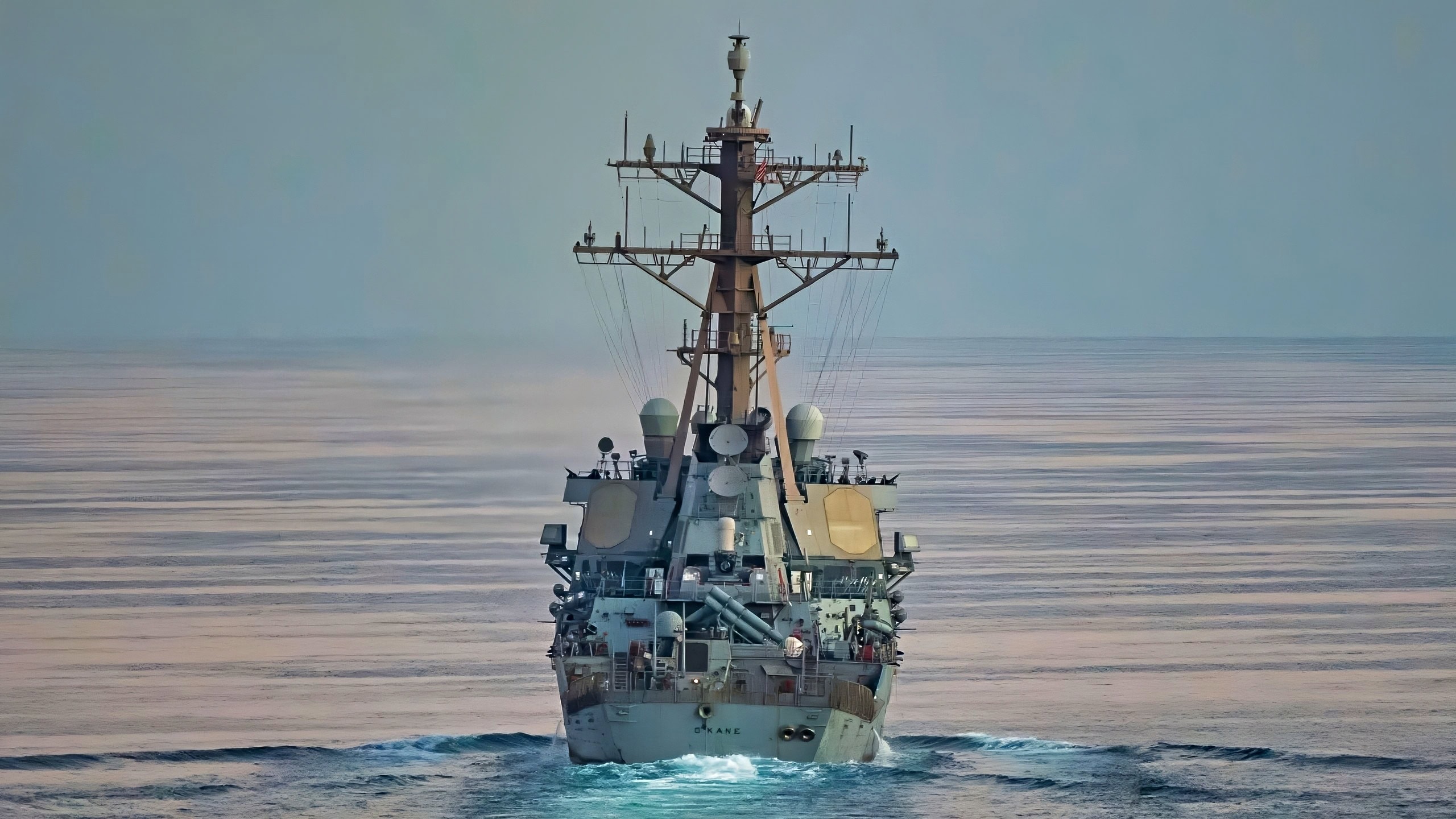
Detailing the targets is important. Ali Al-Salem Air Base in Kuwait is not just a local facility; it is an air hub used by U.S. forces to support operations in Iraq, Syria, and the Gulf. Salman Port in Bahrain is symbolically and practically linked to the presence of the Fifth Fleet, the maritime pillar of American deterrence in the region. When Tehran chooses these two names, it is not just telling Kuwait and Bahrain that they are in the line of fire, but also telling Washington that its rear network is vulnerable.
The previous American strikes, according to a statement from Central Command reported by Defense News, came after the targeting of the Ever Lovely ship by an attack drone while it was exiting the strait along the coast of Oman. Al Jazeera also reported on the Kiku tanker, which was carrying over two million barrels of oil and sustained damage to its bridge, with no injuries among the crew. These details mean that the theater is no longer divided between a safe sea and a safe Gulf coast. The sea, the bases, and energy corridors have become a single loop.
The Capabilities Used and the Intended Message
Iran did not need to launch a massive barrage to achieve a political impact. The combination of ballistic missiles and drones presents defenders with a classic problem in the Gulf: how to distinguish between a limited attack intended for embarrassment and a preparatory attack aimed at opening a breach? The ballistic missile compresses the time available for interception, and the drone compresses the cost of defense, and when both are launched within the same window, the real question is not whether Kuwait or Bahrain have radars and intercept missiles, but whether they have a command and control system capable of making a decision within minutes.
Here, the triangle of capability that I often refer to emerges: equipment, training, and institution. Gulf countries have purchased Patriot systems, long-range radars, and early warning aircraft over two decades, but they still rely at the critical moment on the American decision, on a shared aerial picture that they do not fully possess, and on rules of engagement that they do not write alone. Owning expensive equipment does not mean possessing defensive sovereignty. Any officer who has served in the region knows that a battery that does not integrate politically and operationally with its neighbors becomes a costly island.
Kuwait and Bahrain Between Sovereignty and Protection
Kuwait's condemnation of the attack as a blatant violation of sovereignty, and Bahrain's condemnation of it as undermining de-escalation opportunities, reflect a dilemma that Gulf capitals do not like. These countries host the American presence because they need it, but they pay the price of this presence when they become part of the Iranian response map. Protection here is not just an umbrella over the head; sometimes it becomes a bright signal over the target.
This does not mean that the alternative is clear. Kuwait cannot defend its airspace alone against a complex missile and drone attack if it is linked to a broad American-Iranian crisis. Bahrain, due to its geographic size and its connection to the Fifth Fleet, has a very limited defensive depth. Therefore, the calls from Oman, Qatar, and the UAE for restraint are not just diplomatic language. They are an acknowledgment that any miscalculation will make the entire Gulf pay the cost of a decision that was not made by all.
The Sixty-Day Memorandum Under Test
The American-Iranian agreement that sources have referred to as a sixty-day memorandum includes a sensitive clause regarding shipping corridors in the Strait of Hormuz. Article Five, as reported by Al Jazeera, discusses Iran making efforts to secure the passage of commercial ships and discussing the future management of the strait with Oman and other Gulf states. However, Tehran, through its Foreign Minister Abbas Araghchi, went further by stating that the strait will remain under Iran's full supervision and management for the next thirty days.
This is not a legal detail. If Gulf states practically accept that Iran determines the transit routes in Hormuz, they grant it a permanent negotiating card on a artery through which about 20 percent of the world's oil passes. If they reject this and rely solely on American power, they raise the likelihood of repeating what happened in Kuwait and Bahrain. Between the two options lies a narrow space for diplomacy, but it requires a real regional mechanism, not just condemnation statements after each strike.
Military Lessons for the Gulf
The first lesson is that Gulf air defense cannot remain narrowly national. Missiles or drones do not respect borders, and the warning time in the Gulf is short enough to make the immediate sharing of data a necessity, not a luxury. The second lesson is that protecting American bases should not mean exposing Gulf cities to danger without full participation in the decision. The base cannot be part of American deterrence while the host state remains outside the escalation equation.
The third lesson relates to arms purchases. The natural reaction will be to request more interceptors, more radars, and more counter-drone systems. This is understandable, but insufficient. If it is not accompanied by joint training, unified command, and realistic exercises on mixed attacks, we will return to the old Arab adage: weapons in the store do not win battles. The problem is not that the Gulf lacks money, but that it often buys reassurance in the form of systems, while true reassurance comes from institutions.
Conclusion
Iran's strikes on Kuwait and Bahrain do not necessarily prove that Tehran wants an open war, but they do prove that it is willing to use host countries of American forces as a calculated pressure tool. This places the Gulf in a clearer version of its old contradiction: it needs the United States to deter Iran, but it becomes a target when Washington uses force against Iran. One cannot buy a way out of this contradiction with just a new arms deal. The American umbrella is still necessary, but it is no longer sufficient; relying on it alone has become like standing under a strong roof in a house without walls.
Iran launched ballistic missiles and drones towards Ali Al-Salem Air Base in Kuwait and U.S. Fifth Fleet facilities in Bahrain on June 28, 2026, marking a significant escalation in regional tensions. This action followed U.S. strikes on Iranian military sites, highlighting the vulnerability of U.S. military presence in the Gulf. The Iranian Revolutionary Guard Corps executed the strikes, raising concerns about the security of Kuwait and Bahrain.
- Iran launched ballistic missiles and drones at U.S. military facilities in Kuwait and Bahrain on June 28, 2026.
- The attacks followed U.S. strikes on Iranian military sites.
- The Iranian Revolutionary Guard Corps was responsible for the attacks.
- The strikes indicate a significant escalation in regional tensions.
- Kuwait and Bahrain's sovereignty and security are under threat due to these actions.