
Iran's Strikes on Patriot and 10 Drones Over Kuwait Reveal Gulf Defense Gap 2026
 Ahmed Al-Rashid
Iran's Strikes on Patriot and 10 Drones Over Kuwait Reveal Gulf Defense Gap 2026
On the morning of July 9, 2026, the most important news was not that Washington and Tehran exchanged strikes again, but that the skies over Kuwait, Bahrain, and Qatar turned within hours into a real testing ground for the American deterrent system in the Gulf. Kuwait stated that its defenses engaged a cruise missile, three ballistic missiles, and ten drones, while Iran spoke of targeting Patriot batteries in Kuwait, an early warning site in Qatar, and an American fuel depot in Bahrain. These are not marginal details in a military statement; they are the map of weakness known to every officer who has served in the region.
According to Reuters via Al-Monitor, the Iranian strike came after a new American round targeting about 90 Iranian military sites, including air defenses, coastal surveillance capabilities, missile and drone storage, and maritime logistical infrastructure along the Iranian coast. The National clearly laid out the timeline: three tankers were attacked near the Strait of Hormuz since July 6, then the U.S. Central Command announced strikes on more than 80 targets in Iran, followed by Iran responding by targeting American sites in the Gulf, and Kuwait reported one person injured by shrapnel after intercepting aerial threats.
The Military Event Does Not Equal a Military Outcome
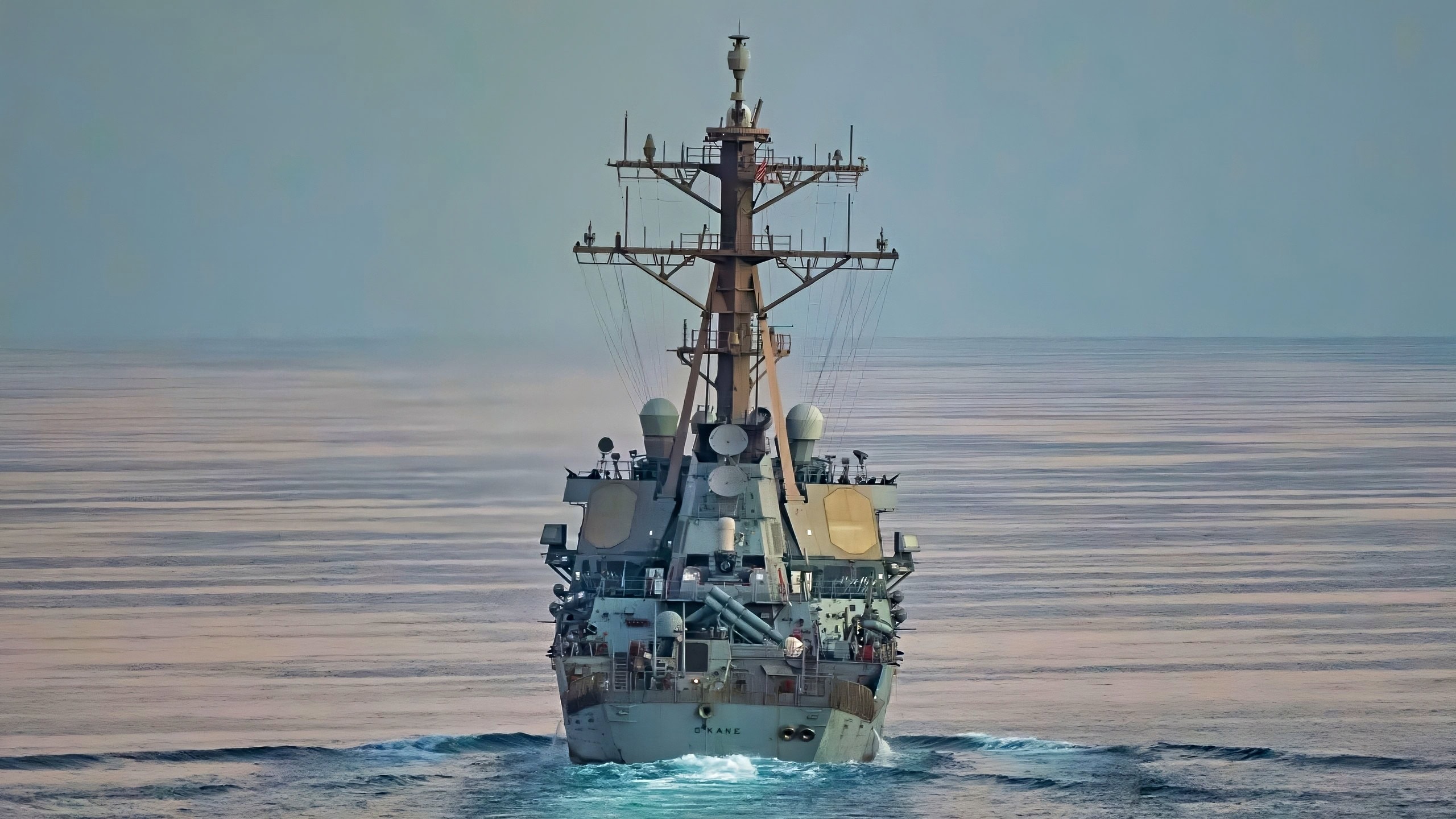
Practically speaking, Kuwait's success in engaging a cruise missile, three ballistic missiles, and ten drones does not mean that Gulf air defense has become impenetrable. The more accurate meaning is that Iran chose a mixed threat package sufficient to test the network without necessarily pushing it into a full-scale war. The cruise missile tests low radars, the ballistic missile pressures Patriot or THAAD if present in the sector, and the small drones confuse the rules of engagement and consume the more expensive interceptors.
Here, an old flaw in Gulf systems appears. The countries in the region have purchased the best radars and interceptors, but they have not always built a unified command and control apparatus at the same speed. A single battery can intercept a target, but defending an area extending from Kuwait to Qatar and Bahrain requires a shared aerial picture, quick engagement decisions, and coordination between national defenses, American bases, and ships at sea. This is the area of difference between possessing the weapon and possessing the capability.
Patriot Is Not a Political Shield
Iran did not say it struck a Kuwaiti or Qatari city; it said it targeted American infrastructure, including Patriot in Kuwait and an early warning site in Qatar. The message is calculated: Tehran wants to strike American protection within Gulf states without declaring direct war on those states. Politically, this gives it room for denial. Militarily, it puts Gulf capitals in front of the harder question: Does the American base on your territory make deterrence stronger or make your land part of the target bank?
Any military officer who has served in the region knows that Patriot is excellent when the warning and engagement network is clear, but it is not a magic wand. Modern versions can intercept tactical ballistic missiles, aircraft, and cruise missiles under suitable conditions, but each interception costs a significant amount, reveals the battery's location, and consumes a limited stockpile. If Iran launches ten cheap drones along with a cruise missile and a ballistic missile, it is not just looking for a hit; it is looking to force the opponent to choose between economy and certainty.
- Ballistic missiles pressure the high interception layer and require precise early warning.
- Cruise missiles need low radar coverage and short reaction time.
- Drones consume interceptor munitions and open psychological and media gaps even if they do not achieve significant hits.
- The simultaneous threat between Kuwait, Bahrain, and Qatar tests command and control, not just the batteries.
The Gulf Between American Protection and National Decision
Qatar called for a return to diplomacy and condemned the targeting of commercial navigation in the Strait of Hormuz. This position is understandable; it hosts the largest American base in the region and knows that every wave of escalation raises the cost of mediation for it. Kuwait, for its part, spoke in purely defensive terms: We engaged aerial targets, and there was one injury due to shrapnel. Bahrain activated its sirens. Three countries, three different political languages, but the military problem is one: there is no independent Gulf umbrella that can separate state security from American presence security.
This is not a moral critique of the alliance with Washington. In my view, the American presence is still necessary to deter Iran and prevent the Strait of Hormuz from becoming a permanent extortion gateway. But what is necessary is not sufficient. When American bases become a recurring Iranian target, the host state needs more than a reassuring statement. It needs evacuation plans, shelters, joint command, publicly declared rules of engagement, and civilian training on alerts, not just new purchase contracts from Raytheon or Lockheed Martin.
Why Iran Chose This Pattern
Iran has lost a lot since the start of the war on February 28, according to American and regional reports: strikes on its air defenses, coastal facilities, missile and drone storage, and logistical infrastructure. However, it retains enough to send a complex message. It cannot defeat the United States in a conventional war, but it can make every day of war costly for the Gulf, for energy markets, and for the American president who wants a political exit from the crisis.
Notably, the Iranian attack came at a moment when Donald Trump was saying that the ceasefire "is over" and then returned to affirm that things would end quickly. This wavering language encourages Tehran to adopt a brinkmanship policy. The Iranians read the American internal pressure and know that rising oil prices or halting traffic in Hormuz annoy Washington more than it annoys them in the short term. Therefore, they strike around the bases, not inside the heart of Gulf cities, and leave the door to negotiation open in one hand and the door to escalation open in the other.
The issue is not whether Gulf states can buy more Patriots or THAAD. The issue is whether they can turn these systems into a single decision network before the next round.
What Gulf Decision-Makers Should Watch
The first indicator is the stockpile of interceptor missiles. In any long crisis, the number of interceptions is more important than the number of batteries. The second indicator is the speed of data sharing between Gulf radars, American ships, and patrol aircraft. The third indicator is the location of bases and fuel and ammunition depots, as Iran has explicitly stated that it targeted an American fuel depot in Bahrain. Fuel is not a symbolic target; it is the lifeblood of aviation operations and maritime patrols.
The fourth indicator is political: Do Gulf states speak with one voice about air defense, or does each state continue to manage the crisis as if it were a separate incident? The wars in the region have taught us that the enemy does not respect administrative boundaries between operations rooms. If drones are launched from the Iranian coast or through proxies, they will not ask whether the radar is Kuwaiti, American, or Qatari.
In summary, the strikes of July 9 are not just the beginning of a new war, nor are they merely a temporary collapse of the ceasefire. They are an account of the Gulf's ability to protect itself while hosting a superpower on its territory. And as the old military saying goes: the shield that you do not know who leads becomes a burden at the first strike. Between reliance on America and the desire for defensive sovereignty, Gulf states are still paying the price of a half-solution.
Sources
- Reuters via Al-Monitor, July 9, 2026 report on Iran's targeting of American military infrastructure in the Gulf and American strikes on about 90 Iranian targets.
- The National, July 9, 2026 timeline of the collapse of the American-Iranian ceasefire and attacks on tankers and Gulf defenses.
- Statements attributed to the U.S. Central Command and official Iranian, Kuwaiti, and Qatari statements as reported in the open sources above.
On July 9, 2026, Iranian forces launched attacks targeting U.S. military assets in Kuwait, Qatar, and Bahrain, including Patriot missile batteries. Kuwait reported intercepting a cruise missile, three ballistic missiles, and ten drones. This escalation follows U.S. strikes on Iranian military sites, indicating a complex military engagement in the region.
- Iran targeted U.S. Patriot missile batteries in Kuwait and an early warning site in Qatar.
- Kuwait reported intercepting a cruise missile and three ballistic missiles along with ten drones.
- The attacks occurred after the U.S. targeted approximately 90 Iranian military sites.
- Kuwait reported one injury from debris during the interception of aerial threats.
- Iran's strategy aims to test U.S. defenses without declaring war on Gulf states.