
Israel Expands Artificial Intelligence in Merkava Barak in 2026 and Redefines Tank Survival in Urban Areas
 Ahmed Al-Rashid
Israel Expands Artificial Intelligence in Merkava Barak in 2026 and Redefines Tank Survival in Urban Areas
On September 29, 2026, European defense reports revealed that the Israeli army is expanding the use of artificial intelligence in Merkava tanks and Eitan vehicles following combat experience in Lebanon and the Gaza Strip. The news is not about a self-driving tank, but rather an attempt to reduce the time between detecting a threat, understanding it, and making a decision. This is an important point for every Arab army that purchases sensors and protection systems, only to discover in the field that the real problem is not a lack of imagery, but an abundance of images that the crew cannot sort through.
What is Changing in Merkava Barak
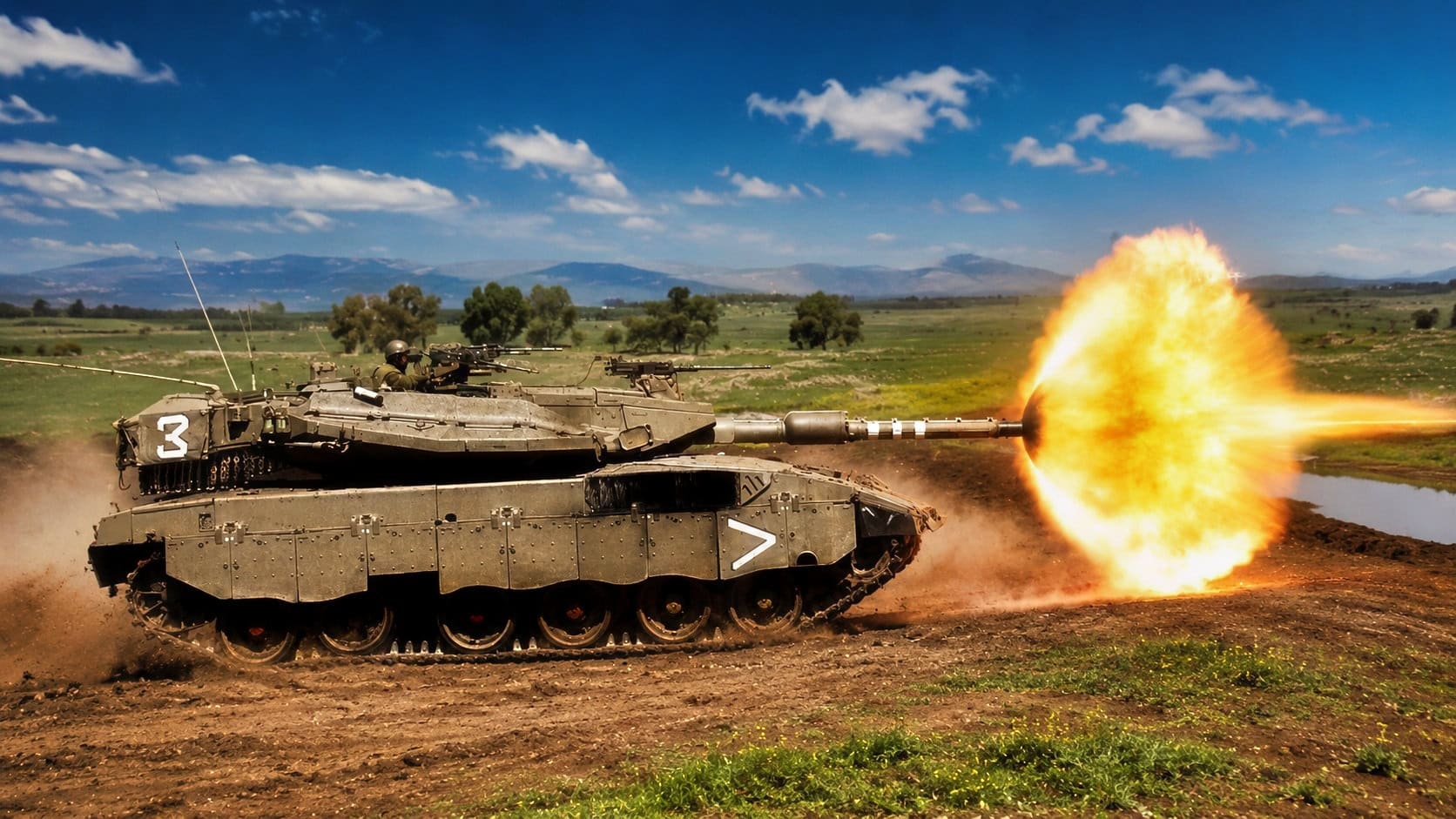
According to European Security & Defence and Europäische Sicherheit & Technik, the upgraded Merkava Barak uses automated processing of sensor data, assisting the crew in routine tasks, and prioritizing targets and threats. Most details are classified, so there are no reliable numbers to suggest that the system achieves full autonomy. It is more accurate to consider it an internal command and control layer that integrates thermal vision, cameras, protection system information, and communication, then presents the crew with a concise actionable picture.
This differs from simply adding a powerful computer to the tank. The military value emerges when the correct information reaches the commander before they have to manage multiple screens and communication devices simultaneously. In urban combat, a few seconds may be enough to determine whether a flash is an anti-tank missile or a reflection from a window, and whether the path ahead of the vehicle is a safe passage or an ambush.
Iron Vision: A View from Outside the Armor
Artificial intelligence integrates with the Iron Vision system, which provides the tank commander with a 360-degree panoramic view through a helmet and augmented reality interface. External cameras relay the scene to the commander, so they are not confined to traditional periscope views. Adding image analysis algorithms may help highlight a moving object, a potential launcher, or an obstacle in the path, but this does not eliminate the need for trained human judgment.
Practically, this capability addresses an old weakness in heavy tanks. The armor protects the crew but isolates them from the environment. The more protection there is, the more important the sensors that reconstruct the world outside become. However, digital vision may produce false confidence if the cameras are dirty, subjected to interference, or deceived by dummies, fires, and smoke. A tank that sees everything on the screen is not necessarily a tank that understands what it sees.
Navigation and Route Selection in an Urban Environment
The Israeli army is also working on an intelligent navigation system developed by the intelligence corps to suggest safer tactical routes. The system analyzes terrain, obstacles, movement paths, and potential threats, then provides recommendations to the crew, especially in cities and complex areas. Here, the issue goes beyond improving navigation; the route taken by the tank determines its exposure angle to projectiles, its ability to withdraw, and its communication with infantry.
However, route recommendations are not operational commands. The data on which the algorithm was trained may be incomplete, and the enemy can change the environment rapidly. A building collapses, a street closes, or a friendly unit moves without updating the network, all of which can turn a safe path a minute ago into a trap afterward. Therefore, the best use of artificial intelligence is to shorten the list of options, not to eliminate the commander’s responsibility. A soldier who knows the terrain remains essential even when the map becomes smart.
Trophy: From Intercepting Projectiles to Threat Sorting
Reports indicate that the Trophy active protection system is being enhanced with artificial intelligence capabilities and sensor data integration. The system is designed to detect, track, and engage guided anti-tank missiles, RPGs, and drones. In this field, the benefit is clear: the reaction time is short, and the crew cannot evaluate every single signal while under simultaneous attack.
However, intelligent integration does not create an impenetrable shield. Trophy may face attacks from multiple directions or cheap munitions or drones that deplete the intercepting ammunition. Additionally, the decision to engage in a populated area has political and humanitarian implications and cannot be fully delegated to a model that the crew does not understand. Artificial intelligence increases the system's speed, but it does not increase the depth of the ammunition store nor address maintenance weaknesses.
Eitan: Expanding the Experience to the Infantry Vehicle
The experience is not limited to the Merkava. The eight-wheeled Eitan vehicle is gaining functions in target acquisition and semi-autonomous route planning. This is important because Israel is not just testing artificial intelligence within a single tank, but is building a family of vehicles that share data and operate within a single formation. If the connection succeeds, the commander can see the threat detected by another vehicle before it enters their direct range.
However, the network itself becomes a vulnerability. Disrupting communications, jamming location determination, or injecting misleading information can turn the advantage of sharing into a burden. Therefore, true capability will be measured in an electronic silence setting, not in an open field with stable communication. A vehicle that can fight with local data when the network is down is more valuable than a vehicle that relies on a distant command center.
The Implications of the Experience for Arab Armies
The regional lesson is not that every country needs to buy Merkava, but that modernizing armored vehicles has become an institutional project. According to the capability triangle I always use, equipment is just one side, alongside training and institutions. Cameras, augmented reality helmets, and protection systems can be purchased, but without crews trained to interpret alerts and without a doctrine that defines the limits of delegation, artificial intelligence will remain an expensive interface.
Gulf countries have the resources to purchase advanced systems, but they often face the problem of reliance on the supplier for software, updates, and maintenance. If there is no local capability to test the algorithm, audit its records, and reject its erroneous recommendations, sovereignty over the vehicle will be nominal. Independence does not start from a local manufacturing slogan, but from the ability to repair the system and understand its limitations during war.
Conclusion
The experience of Merkava Barak and Eitan represents a transition from a tank that gathers sensors to a tank that organizes information and assists the crew in fighting under pressure. Its potential advantage in urban areas is reducing cognitive load, improving threat detection, and linking protection with navigation and targeting. However, the secrecy surrounding the software prevents overestimating its capabilities, and the algorithm does not compensate for training, discipline, ammunition, or maintenance.
The paradox is that artificial intelligence may make the tank faster in decision-making, but it makes the institution more dependent on data and software. Israel is trying to transform the experience of Lebanon and Gaza into a more aware armored force, while the hardest question for any Arab army remains the same: Can it operate this system when the network goes down, the sensor fails, and the decision becomes the responsibility of a young commander in an enemy city?
Sources
Israel is expanding the use of artificial intelligence in Merkava tanks and Eitan vehicles to enhance decision-making and threat assessment in urban combat. This development, reported on September 29, 2026, aims to improve the speed of threat recognition and response, integrating systems like Iron Vision for situational awareness and Trophy for active protection. The advancements reflect lessons learned from combat experiences in Lebanon and Gaza.
- Israel is enhancing AI capabilities in Merkava tanks and Eitan vehicles.
- The focus is on improving decision-making speed in urban combat scenarios.
- The Iron Vision system provides 360-degree situational awareness to tank commanders.
- The Trophy system is being upgraded with AI for better threat detection and response.
- The integration of AI aims to reduce cognitive load on crews during combat.