
After 40 days of combat, Navy destroyer returns home
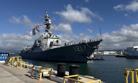
JOINT BASE PEARL HARBOR-HICKAM, Hawaii—Some 300 days after leaving Hawaii, the guided-missile destroyer Frank E. Petersen Jr. was welcomed home Monday with delighted cheers, jangling cowbells, handmade posters, and fresh flower leis.
The ship—part of the Abraham Lincoln carrier strike group—did 40 days of combat operations and spent six months in an active combat zone. It started its deployment in December with operations in the South China Sea, but in late January was redirected to the Middle East, shortly before President Donald Trump launched Operation Epic Fury.
The Petersen took part in the war’s initial strikes on Iran, firing Tomahawk missiles at land targets on Feb. 28. Then, as the strike group’s air and missile defense commander, the destroyer warded off more than 100 Iranian missiles and drones launched against its group and other ships in the region.
We made sure that we kept dozens of ships safe against a variety of different attacks—missile attacks, drone attacks,” said Capt. Casey Mahon, the ship’s commander.
The destroyer, commissioned in 2022, sailed more than 85,000 nautical miles during the deployment and conducted 45 replenishments at sea. At one point, the ship spent 106 days at sea between port calls, Mahon said.
It also was the first ship to enter the Strait of Hormuz after the end of major combat operations, he said, which was “quite a voyage.”
“Obviously there was stress we had to face when we did that…on the sea, under the sea, and in the air.”
Though some of the adversary technology the crew faced was new, he said, “air defense really hasn’t changed a lot of ways since World War II: You have a radar, you find the thing, you’ve got to track it.” Still, “how these things fly, how they do their missions are very different, and so the crew showed a lot of adaptability to that,” and the ship’s systems were also “very effective in that adaptability.”
The Petersen learned lessons both in “how to stay at sea for a long time” and in how to defend against new tactics, Mahon said, and has passed on those lessons to other ships that are in the region now.
“Like any good Navy ship, you know, you’re ready for that next mission,” Mahon said. “It wasn’t what we expected to happen on deployment, but for the crew, you know, whether you’re in the north Arabian Sea or the South China Sea, you’re at sea, and so we do the operations that we’re directed to do.”
Clutching ti leaf lei as she waited on the pier with her two children, Alysha Nishikawa said she was worried at times during the deployment, but she tried to “throw out positive energy” to her husband and reassure him that they were OK so he could continue to do his job.
Petty Officer 1st Class Ryhean Tucker, who was one of the first sailors to reunite with his family as the recipient of the “first kiss,” said the deployment was “stressful” and challenging. His wife, Taylor Tucker, said it was also challenging for her, taking care of their two children and moving from Virginia to Hawaii.
“It was a big job, but we did it,” she said.
USS Frank E. Petersen Jr. returned to Hawaii after 300 days at sea, completing 40 days of combat operations. The guided-missile destroyer participated in initial strikes on Iran and defended against over 100 missile and drone attacks. It operated in the South China Sea and the Middle East, sailing over 85,000 nautical miles during its deployment.
- USS Frank E. Petersen Jr. returned to Hawaii after 300 days at sea.
- The destroyer conducted 40 days of combat operations.
- It fired Tomahawk missiles at land targets in Iran.
- The ship defended against over 100 Iranian missiles and drones.
- The deployment included operations in the South China Sea and the Middle East.