
J-15 Training Photos Reveal New Signals: The Shortage of PLA Aircraft Carrier Pilots is Harder to Fill than New Ships
 Li Minghui
J-15 Training Photos Reveal New Signals: PLA Navy Carrier Pilot Shortage Harder to Address than New Ships
A seemingly inconspicuous photo released by the English version of the China Military Network in late June shows two J-15 carrier-based fighter jets belonging to a base of the PLA Naval Aviation University taxiing along the runway during a flight training session in early June. The photo itself does not provide more details or announce the service of a new model. However, for carrier aviation, the training location and unit are often more interesting than the few aircraft appearing in the image.
I prefer to view this photo as a production capacity issue rather than just a routine training news item. The Chinese Navy now has the Liaoning, Shandong, and the Fujian, which is currently undergoing sea trials. While hardware such as the hull, radar, and catapult systems are certainly important, the true combat capability of an aircraft carrier ultimately hinges on a very basic question: Are there enough pilots, enough deck support personnel, and a mature training cycle?
Why the Naval Aviation University?
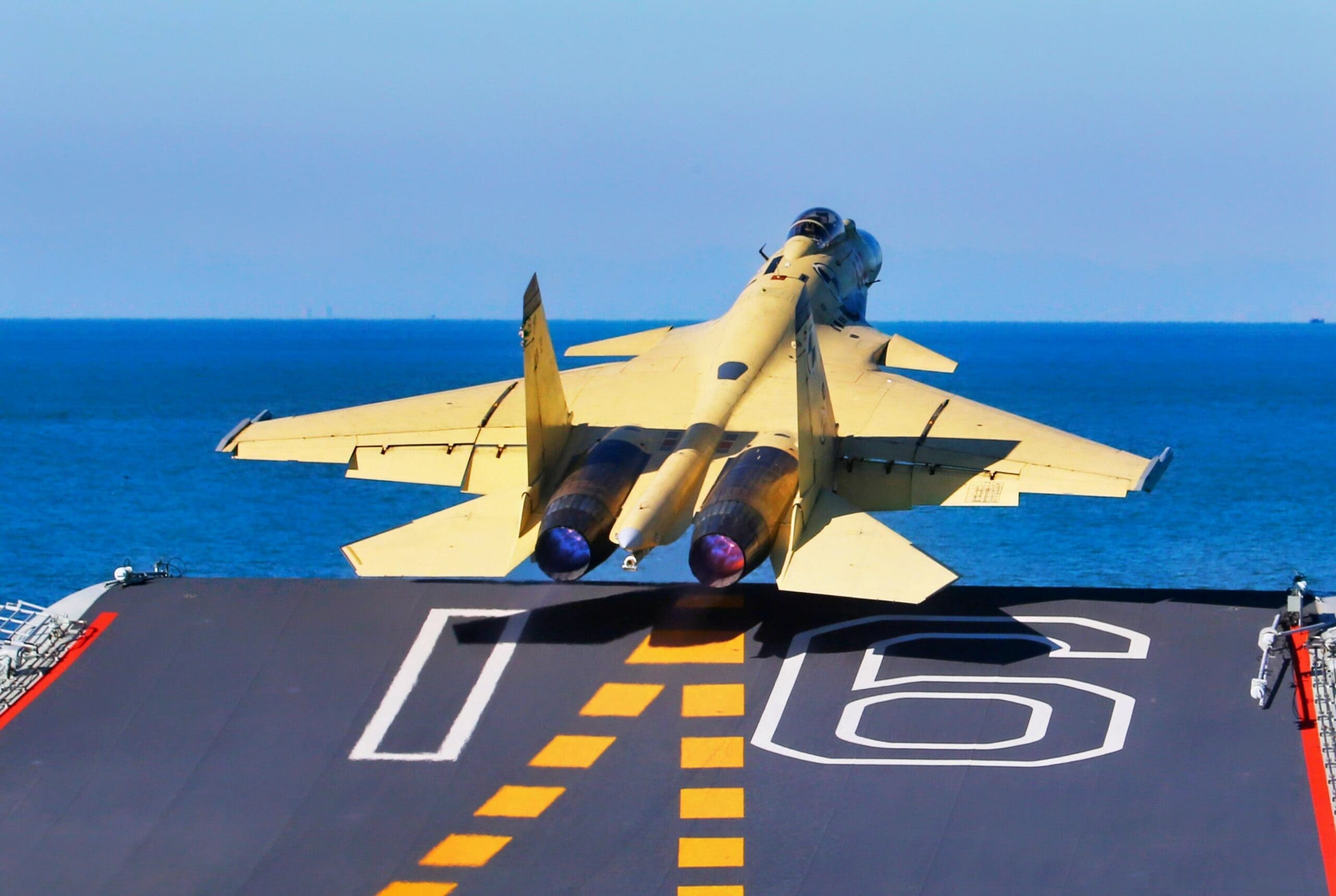
The explanation from the China Military Network specifically mentions that the J-15s come from a base of the Naval Aviation University, rather than a specific carrier task force. This point is easily overlooked. Training carrier-based pilots is not simply a matter of transitioning land-based fighter pilots to a different platform. Although the J-15 is derived from a heavy fighter system, carrier-based flying requires pilots to complete takeoffs and landings under greater psychological pressure, with shorter distances and smaller error margins. Training on land-based runways, simulating carrier landings, conducting land-based arrestments, and actual carrier operations form a long chain.
So what does this mean? It indicates that the PLA is gradually shifting the foundational training of carrier aviation from a "project-based" approach to a "production line" model. Here, "production line" is not a derogatory term; rather, it is precisely the capability that modern naval aviation needs most. The advantage of the U.S. Navy is not just the F/A-18E/F or F-35C themselves, but the institutional capability to consistently produce pilots, landing signal officers, maintenance personnel, munitions handlers, and deck crew every year. This is the invisible part that China needs to catch up on.
The J-15 is Not Yet Ready for Retirement
Outsiders often focus on the J-35, KJ-600, and the Fujian's electromagnetic catapult, as if the J-15 will soon become a transitional piece of equipment. This judgment is somewhat hasty. The basic model of the J-15, the two-seat variant, and the catapult-improved version that has garnered attention remain the most realistic training and combat backbone for the PLA's carrier aviation in the coming years. The reason is simple: even if new stealth carrier-based aircraft are deployed, it will take a long time to complete large-scale training, maintenance systems, and munitions compatibility.
From a technical perspective, the shortcomings of the J-15 are not mysterious. It is a heavy carrier-based aircraft, and its fuel and armament capacity are limited during ski-jump takeoffs, with significant maintenance pressures as well. However, its value lies in its large platform space, range, and payload potential, making it suitable for training pilots in energy management for heavy carrier-based aircraft. In simple terms, the J-15 is like a relatively fuel-consuming but sturdy training vehicle; if a novice can fly it steadily, their foundation will be stronger when transitioning to a catapult-equipped or stealth model in the future.
The Fujian is Not Just About One Ship
If the Fujian enters the service phase, the PLA Navy's carrier aviation will simultaneously face three types of missions: the Liaoning and Shandong will maintain combat patrols as ski-jump carriers, the Fujian will validate catapult launches and arrested recoveries, and land-based training units will continue to expand pilot supply. The real bottleneck may not be how many aircraft a single carrier can support, but whether the entire system can increase training sorties without sacrificing safety.
Here are a few pieces of publicly available information that can be viewed together:
- The China Military Network has recently released consecutive photos of J-15s, Type 055 destroyer supply training, and naval test ship formations, indicating that the frequency of the Navy's open-sea training is still increasing.
- The Southern Theater Air Force has also recently released images of J-10 aerial refueling training, reflecting that the PLA Air Force is strengthening its long-range sustained operational capabilities.
- Once the Fujian's electromagnetic catapult system matures, it will shift carrier-based aircraft training from a ski-jump logic to a high-intensity operational logic closer to that of the U.S. Navy's carriers.
When looking at these three pieces of information together, the focus is not on "how many high-definition photos there are," but rather on the fact that the PLA is addressing the most time-consuming aspects of carrier aviation: continuous training, cross-unit support, and complex system coordination. Carrier-based aircraft are not like missiles; they cannot achieve combat capability immediately after rolling off the production line. Each pilot requires a significant investment of flight hours, instructor resources, and support resources.
The Focus Should Not Be on the Two Aircraft in the Photo
I believe that in the coming year, when observing the combat capability of China's aircraft carriers, three indicators are more valuable than simply counting carrier-based aircraft. First, whether the Naval Aviation University is more frequently publicizing J-15 training, which represents whether the supply of pilots is expanding. Second, whether the Fujian has seen continuous combined training of catapult-equipped J-15s, J-35s, and KJ-600s, which indicates whether the new ship has entered the system validation phase. Third, whether the Liaoning and Shandong maintain a high training frequency during the Fujian's sea trials, which can reflect whether the existing carrier forces have been overdrawn of key personnel.
Regarding these indicators, there is still very little public information, so we can only make cautious speculations. However, one point can be judged: the PLA's aircraft carrier construction has moved past the stage of "whether there are aircraft carriers" and is entering the stage of "whether it can stably produce carrier aviation personnel." The real question worth pursuing is whether the J-15 training pipeline can accelerate within safety boundaries when the Fujian requires a complete set of pilots and deck crews for the catapult era. This answer is more critical than the next photo of a new ship.
Two J-15 fighter jets conducted a training exercise at a base affiliated with the People's Liberation Army Navy Aviation University in China in early June 2023. The report emphasizes the ongoing challenges in training sufficient carrier pilots to operate the increasing number of aircraft, including the new Fujian aircraft carrier. The J-15 is expected to continue playing a crucial role in the PLA Navy's operations for the coming years.
- Two J-15 fighter jets were observed during a training exercise in early June 2023.
- The training is conducted by the People's Liberation Army Navy Aviation University.
- The report highlights a shortage of carrier pilots compared to the number of new aircraft being introduced.
- The J-15 is expected to remain a key component of the PLA Navy's carrier operations for the foreseeable future.
- The Fujian aircraft carrier is set to enhance the training and operational capabilities of the PLA Navy.