
J-6W Drones Exceeding 500 Units Press Towards the Taiwan Strait, PLA Uses Old Aircraft to Rewrite Air Defense Consumption Accounts
 Li Minghui
Over 500 J-6W Drones Pressing Toward the Taiwan Strait: PLA Uses Old Aircraft to Rewrite Air Defense Consumption Accounts
A detail disclosed by Taiwanese media on May 18 is more noteworthy than the phrase "new type of drone." The latest quarterly report from Taiwan's Mainland Affairs Council states that the PLA has converted retired J-6 fighter jets into J-6W attack drones and deployed them at six air force bases near the Taiwan Strait, five of which are located in Fujian and one in Guangdong. J. Michael Dahm, a researcher at the Mitchell Institute in the U.S., estimates that over 200 have been deployed at the front, with the potential for more than 500 old J-6s to be converted. This number awaits further independent verification, but it explains an old question: why a plane with technology from the last century has not completely exited the PLA's radar.
A New Ledger for Old Aircraft
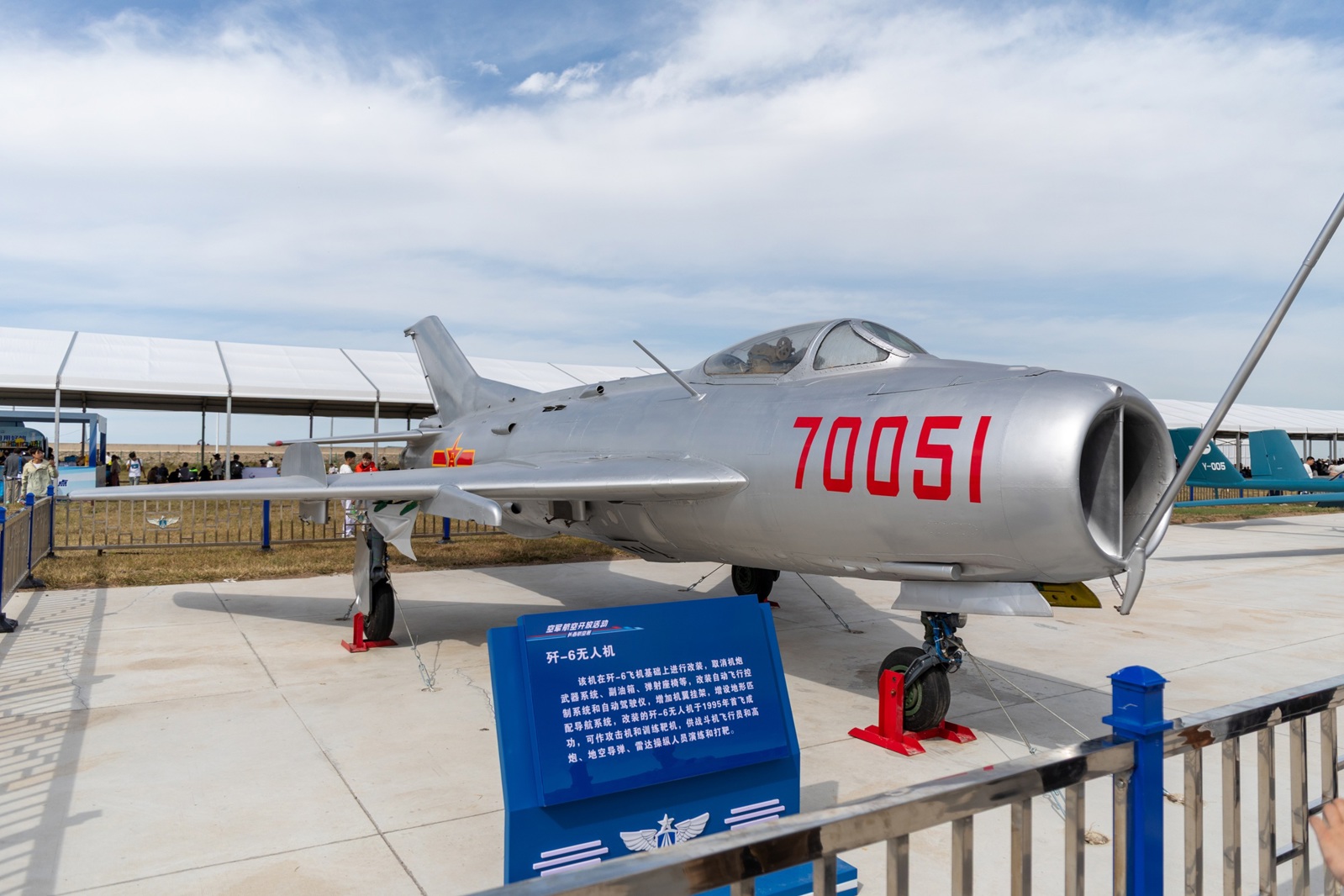
The J-6 is essentially China's version of the MiG-19, and its operational value is no longer suitable for direct confrontation with F-16Vs, Mirage 2000s, or air defense missile systems. However, once converted into a drone, the evaluation criteria change. It does not require a pilot, does not need to maintain a complete life cycle, and does not have to undertake high-end platform tasks that are reusable. In simple terms, it has transformed from a "backward fighter jet" into a "disposable asset with jet propulsion and a larger radar cross-section."
This type of platform is most likely to undertake three types of missions: first, to lure Taiwan's air defense radars into operation, exposing their positions; second, to consume Sky Bow, Patriot, or shipborne air defense munitions; and third, to operate in sync with manned aircraft like the J-16, creating a mixed air situation of real and false targets. Taiwanese media cited reports stating that satellite imagery shows the J-6W deployed alongside the J-16, which is quite interesting. The J-16 is responsible for carrying weapons, sensors, and electronic warfare capabilities, while the J-6W is tasked with dragging the opponent's air defense systems into a high-consumption rhythm; the two are not in a performance comparison relationship but rather a cost-sharing relationship.
Forward Deployment and Inland Reserves
The report mentions that hundreds of old aircraft are stored at Baofeng Airport in Henan as a backup inventory that can be transferred to the front lines. If this assessment holds, the PLA is not designing a one-time drone strike but rather a flexible logistics model of "forward deployment and inland reserves." The forward bases only need to maintain a certain number of platforms that can take off quickly, while the inland inventory provides continuous replenishment. This approach aligns with the consumption logic in modern drone warfare: the key is not just how many are launched in the first wave, but whether the second and third waves can follow up.
- Forward bases: 5 in Fujian, 1 in Guangdong, close to the Taiwan Strait, shortening the deployment distance.
- Deployed scale: External estimates suggest over 200 aircraft, sufficient to create pressure for air defense identification and interception.
- Potential inventory: Over 500 old J-6s can be converted, with actual availability still to be confirmed.
- Coordinating platforms: The J-16 may undertake suppression, standoff strikes, and air cover missions.
What Taiwan Really Worries About Is Not the J-6 Itself
The single-unit performance of the J-6W is not mysterious. Its avionics, stealth, payload, and autonomous capabilities cannot compare with next-generation reconnaissance-strike integrated drones. The issue lies in the economic calculations of the air defense system. Using an expensive interceptor missile to target a retired aircraft converted into a drone may be tactically correct, but economically it may not be comfortable. If these targets are accompanied by cruise missiles, small drones, electronic jamming, and J-16 standoff munitions, Taiwan's air defense forces will have to determine within minutes which must be intercepted, which can be ignored, and which are decoys.
The Taiwanese Executive Yuan originally proposed a budget of NT$335 billion for unmanned vehicles and countermeasures, which included the procurement of 211,990 various types of drones, 1,320 suicide drones, as well as mixed hard and soft counter-drone systems and 635 portable counter-drone devices. However, the special military procurement budget passed by the Legislative Yuan was significantly reduced, and funding for related unmanned systems was deleted or transferred to annual budget disputes. I believe this is the crux of the news: Beijing is turning old assets into consumable munitions, while Taipei is still debating which pocket the money for the counter-drone system will come from.
The Southwest Islands Are Also on the Same Map
On the same day, SCMP reported that PLA state media criticized Japan for deploying satellite-assisted drones and long-range strike forces on the Southwest Islands, calling it "a shield in name, but a spear in reality." Japan plans to introduce the approximately 1,600-kilometer range "Tomahawk" cruise missiles and develop domestically produced long-range weapons with a range of up to 1,500 kilometers. When viewed alongside the J-6W, the Taiwan Strait is no longer simply a Taiwan air defense issue, but a joint consumption problem involving the East China Sea, the Ryukyu direction, and the inner side of the first island chain.
A detail that is easily overlooked is that platforms like the J-6W do not necessarily have to hit targets to be considered effective. As long as they cause the opponent to prematurely expend interceptors, expose radars, delay aircraft takeoff, or even force Japan and the U.S. military to allocate more sensor resources to low-value targets, their mission is already half accomplished. The real unanswered question is whether the PLA's speed in converting old aircraft into drones has already surpassed Taiwan's speed in scaling up its counter-drone systems.
This article synthesizes reports from Taiwan News, Taipei Times, and Liberty Times on the quarterly report from Taiwan's Mainland Affairs Council, as well as SCMP's background report on Japan's drone and long-range strike deployments on the Southwest Islands. The specific deployment numbers and availability of the J-6W still require more independent satellite imagery confirmation.
The People's Liberation Army has deployed over 500 modified J-6W drones near the Taiwan Strait, with more than 200 already operational at six air bases in Fujian and Guangdong. These drones are designed to exhaust Taiwan's air defense systems by drawing fire and revealing radar positions. The PLA's logistics model includes a reserve of old aircraft for rapid deployment, while Taiwan faces budget constraints in developing counter-drone systems.
- PLA has modified over 500 retired J-6 fighters into J-6W drones.
- Deployment includes 200+ drones at six air bases near the Taiwan Strait.
- The drones are intended to exhaust Taiwan's air defense systems.
- The PLA has a flexible logistics model with inland reserves of old aircraft.
- Taiwan's defense budget for counter-drone systems has been significantly reduced.