
Japan buys upgraded Link 16 terminals for its E-767 radar planes
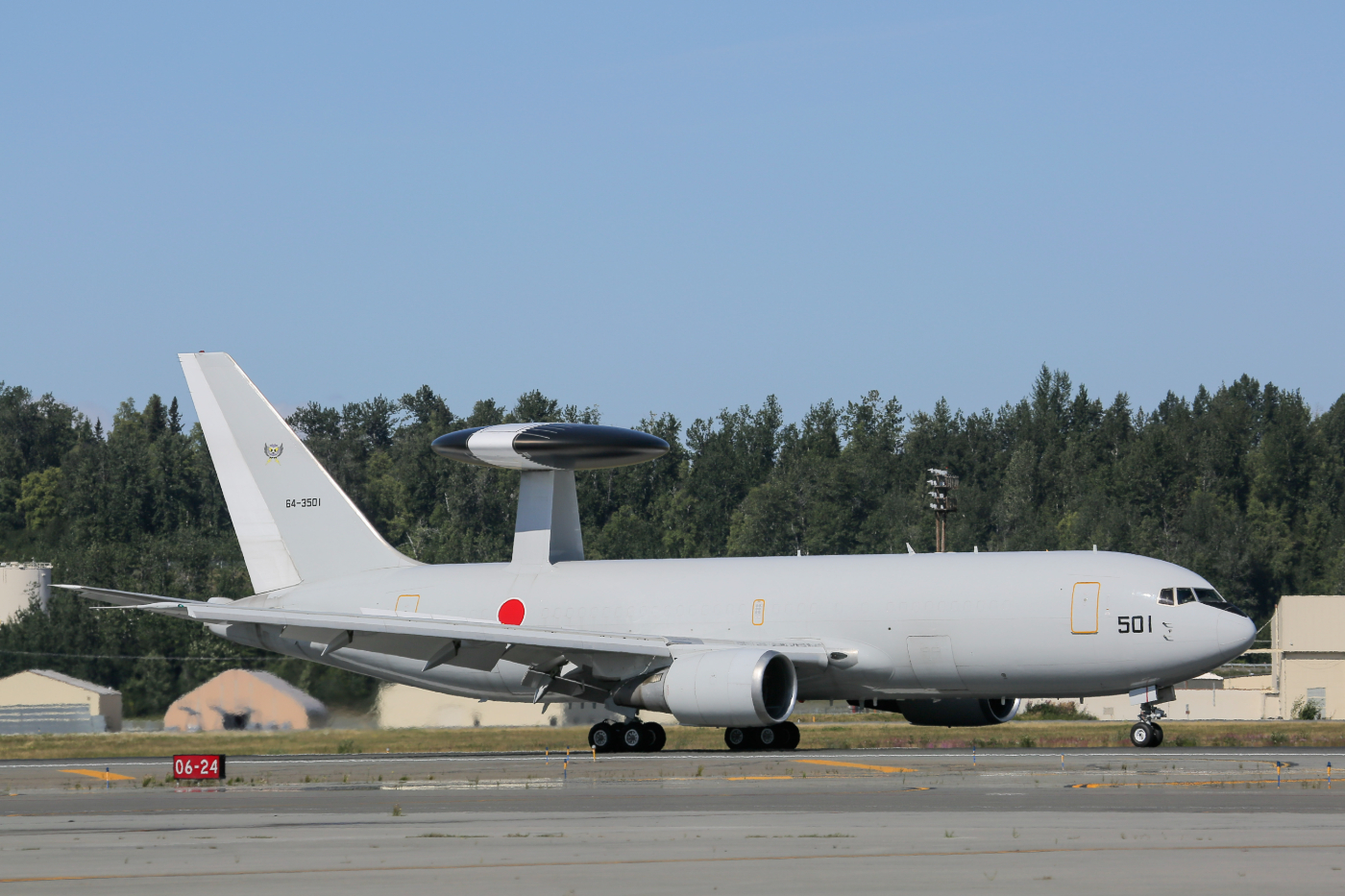
Japan’s E-767 airborne warning and control aircraft will get new Link 16 datalink terminals under a $14.9 million contract modification the U.S. Air Force awarded to Georgia Tech Applied Research Corp., the U.S. Department of War announced on Nov. 12.
The award falls under what the Air Force calls the “Multifunctional Information Distribution System Joint Tactical Radio System Upgrade (MJU) Program” and covers “delivery of MJU terminals for integration into E-767 aircraft,” according to the announcement. The contract “involves foreign military sales (FMS) to Japan,” with $14.3 million in Japanese funds committed at award. The work will be done in Atlanta, and the total contract value now stands at about $54.8 million. The Air Force Life Cycle Management Center at Hanscom Air Force Base, Massachusetts, is handling the contract.
The announcement didn’t say how many terminals Japan ordered or which company builds them. It also didn’t say who will install the radios, or when the first modified E-767 will fly.
If the E-767s receive the four-network version of the terminal now fielded by U.S. forces, crews could follow considerably more Link 16 traffic at once than older terminals allow. For an aircraft whose job is to build an air picture and pass it to fighters and ground controllers, that could ease one of the tighter limits on the mission.
Georgia Tech Applied Research Corp. holds contracts for the Georgia Tech Research Institute, or GTRI, the university’s applied research division. GTRI has already put MIDS JTRS into one AWACS fleet. Under the U.S. Air Force’s Communications Network Upgrade, its engineers replaced the legacy JTIDS Class II terminals on the E-3G Sentry with MIDS JTRS. The two radios use very different interfaces, so GTRI had to design new hardware to connect the radio to the rest of the aircraft.
The team “basically gutted the cabinet that contained the legacy radio,” Christian Michelson, a GTRI principal research engineer and co-principal investigator on the project, said in a 2023 institute article.
The engineers had little access to the jets at Tinker Air Force Base, Oklahoma. They built a system integration laboratory in Atlanta that reproduced the E-3’s interfaces, then designed and tested the new electronics there before assembling installation kits. The finished interface system has more than 25,000 components. GTRI then trained the Boeing technicians who installed the kits, partly through a virtual reality course.
Not every E-3 was identical, either. Decades of modifications meant some aircraft needed custom cabling, according to GTRI. The E-767 pairs the E-3’s radar and mission system with a different airframe and has its own upgrade history, and the Air Force hasn’t said whether the Japanese program follows the same approach.
MIDS JTRS grew out of the MIDS Low Volume Terminal, a Link 16 radio developed jointly by the United States, France, Germany, Italy and Spain. The JTRS version keeps the older terminal’s box size and connectors but runs on software and adds channels. One channel carries Link 16 together with TACAN, the military’s air navigation aid. The other three are reserved for future waveforms. The terminal entered service in 2012, and the four-network version was declared fully operational in September 2021. The U.S. Navy-run MIDS program now supplies Link 16 terminals to 58 nations and NATO.
Link 16 works by splitting time into short slots. Each terminal transmits in the slots assigned to it, and different groups of users can share the same slot on separate numbered networks. A legacy terminal listens to one of those networks per slot. A terminal with Concurrent Multi-Netting listens to four. As a point of comparison, L3Harris says its four-network terminal can receive four times as much as a legacy Link 16 radio.
That capability has proven difficult to test. The Pentagon’s Director, Operational Test and Evaluation reported in 2019 that the four-network mode hadn’t been properly stressed, because the test network wasn’t designed for it and too few equipped radios took part. An adequate test, the office said, would require “MIDS CMN-4-equipped command and control host platforms.” The E-767 is one such platform.
Two companies build the terminals: L3Harris and Data Link Solutions, a joint venture of BAE Systems and Collins Aerospace. In December 2024, Data Link Solutions won a U.S. Navy contract worth up to $1 billion for MIDS JTRS production and modernization. The Japanese award describes Georgia Tech’s work only as terminal delivery. It doesn’t say whether that means radios from one of the two manufacturers, GTRI-built integration hardware, or both.
Boeing delivered Japan’s four E-767s in 1998 and 1999, and they entered service in 2000 with the Japan Air Self-Defense Force’s 602nd Squadron at Hamamatsu Air Base. The aircraft carries the E-3’s AN/APY-2 radar on a 767-200ER airframe, which offers more cabin space than the 707 used by the U.S. fleet.
Japan has upgraded the jets several times since. Boeing won a $108 million radar improvement contract for the fleet in 2006. In September 2013, the Defense Security Cooperation Agency notified Congress of a possible $950 million mission computing upgrade, saying it would make Japan’s AWACS fleet “more compatible with the U.S.”
Boeing later flew the first Japanese E-767 to San Antonio for that work. The first modernized aircraft returned to Japan in June 2023. According to the Air Force Life Cycle Management Center, the upgrade “is similar to a U.S. Air Force E-3 AWACS upgrade” and is valued at $870 million in total. In March 2025, Boeing received an $84.6 million modification to continue installation and checkout on the fleet through Dec. 23, 2028.
Georgia Tech’s terminal work “is expected to be completed by Sept. 30, 2028,” the announcement said.
Content preview only. Full article available at source. View Full Article
Japan's E-767 airborne warning and control aircraft will receive upgraded Link 16 datalink terminals under a $14.9 million contract modification awarded by the U.S. Air Force on Nov. 12, 2023. The work will be conducted by Georgia Tech Applied Research Corp. in Atlanta, with completion expected by Sept. 30, 2028. This upgrade aims to enhance the aircraft's operational capabilities by allowing it to handle more Link 16 traffic simultaneously.
- Japan awarded a $14.9 million contract modification for Link 16 terminals for E-767 aircraft.
- The contract involves foreign military sales to Japan.
- The work will be done by Georgia Tech Applied Research Corp. in Atlanta.
- The total contract value is approximately $54.8 million.
- The upgrade is expected to enhance the E-767's capabilities significantly.