
Japan's 10th Mogami Frigate Fixes Crews Before Missiles
 Marcus Chen
Japan's 10th Mogami Frigate Fixes Crews Before Missiles
JS Nagara entered service on June 29 with about 90 sailors and 16 vertical launch cells. That is the useful way to read Japan's 10th Mogami-class frigate: not as another gray hull in Kure, but as a manpower solution carrying a modest missile load.
Naval News reported that Nagara, pennant number FFM-10, was commissioned into the Japan Maritime Self-Defense Force after delivery by Mitsubishi Heavy Industries. The ship cost about 52.3 billion yen, roughly $323 million, and joins a class that Japan plans to build out to 12 Mogami frigates by fiscal 2027, followed by 12 upgraded New FFM ships by fiscal 2032.
That puts a real number on Tokyo's answer to China's naval expansion. Japan is not trying to match the People's Liberation Army Navy hull for hull. It is trying to keep enough combatants at sea with fewer people, then make those ships useful inside the missile geography of the first island chain.
The Math Starts With Sailors
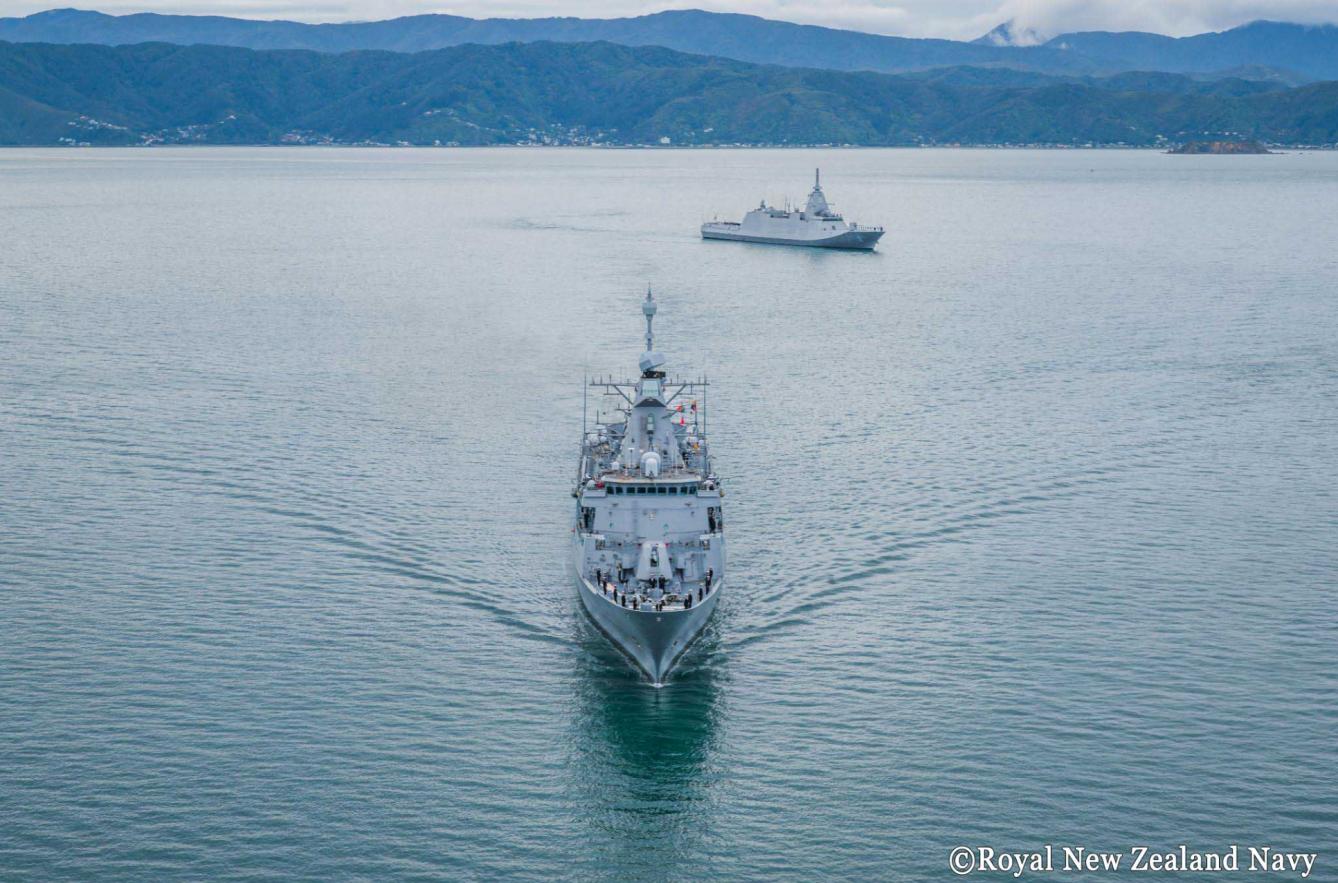
The most important specification is not displacement. It is crew size. A conventional JMSDF destroyer often needs about 200 personnel. A Mogami-class frigate operates with about 90. Ten ships therefore require about 900 sailors instead of roughly 2,000 for a similarly sized group of older destroyer-type crews.
That 1,100-sailor difference matters more than a brochure range or a radar name. Japan's military problem is not only China. It is demography. A force that cannot recruit and retain enough sailors cannot sustain presence around the Ryukyus, the Philippine Sea, and the approaches to Taiwan. Automation on the Mogami class is therefore not a gimmick. It is the enabling technology for sortie generation.
The class uses integrated ship-handling systems, digital navigation, and a highly automated combat information center. Naval News cited a bridge watch of four sailors under normal operations and one-person maneuvering during berthing under favorable conditions. Anyone who has stood watch on a surface combatant knows that shaving watch sections is not glamorous. It is what determines whether the ship can keep operating when maintenance, training, and fatigue start eating the schedule.
The Missile Load Is Still Thin
Nagara also shows the limit of Japan's approach. From the seventh Mogami onward, the ships enter service with 16 Mk 41 vertical launching system cells. Earlier ships are expected to receive their VLS after commissioning. Sixteen cells are useful. They are not a deep magazine.
Ten Mogami-class frigates with 16 cells each equal 160 VLS cells if all are fitted. Twelve ships would mean 192 cells. The planned 24-ship FFM force by 2032, assuming the same baseline cell count for a simple comparison, would represent 384 cells. That sounds large until it is spread across anti-air warfare, anti-submarine weapons, self-defense missiles, training allocations, maintenance downtime, and the need to keep ships in different parts of the theater.
A single Chinese saturation attack does not have to sink every Japanese ship to create a problem. It only has to force escorts to spend scarce interceptors faster than replenishment and reload can keep up. Surface combatants in the first island chain face a magazine problem before they face a courage problem.
The Mogami carries other useful weapons: a 127 mm Mk 45 gun, SeaRAM, Type 17 anti-ship missiles in two four-tube launchers, multifunction radar, anti-mine sonar, and towed-array anti-submarine sensors. Unmanned underwater and surface vehicles are planned later. That is a balanced patrol and escort package. It is not an arsenal ship.
Where Nagara Fits In a Taiwan Scenario
In a Taiwan contingency, Japan's frigates would not be charging alone toward the Taiwan Strait. Their more realistic job would be sea control and sea denial around the Nansei Islands, escorting logistics, hunting submarines, protecting mine countermeasure operations, and complicating Chinese movement through the Miyako Strait and other exits from the East China Sea.
That mission set rewards numbers and persistence. A 5,500-ton full-load frigate with a reduced crew can be present more often than a larger ship that absorbs scarce sailors. Japan does not need every Mogami to be a miniature Aegis destroyer. It needs enough of them ready, networked, and armed to force the PLAN to allocate submarines, aircraft, and missiles against many moving targets.
The geography gives Japan an advantage, but only if the fleet can stay in the fight. From Okinawa to Miyako to Yonaguni, the island chain is not a wall. It is a series of gates. A frigate force that can patrol those gates, share targeting data, screen higher-value units, and work with U.S. and Australian forces is useful even with a limited VLS count.
Allies Are Watching the Same Design
The export angle is not incidental. Australia selected the New FFM in 2025 for its general purpose frigate program, with 11 ships planned and the first three to be built in Japan. New Zealand has shortlisted the upgraded Mogami design alongside the UK's Type 31 for its future frigate requirement.
If those decisions hold, Japan's frigate program becomes more than a national procurement line. It becomes a template for allied navies that need more hulls without doubling crews. That is exactly the problem facing middle-power navies in the Pacific. Everyone wants more presence. Few have enough sailors, shipyard capacity, or missile inventory to get it cheaply.
But there is a warning here for Canberra and Wellington. The Mogami logic works only if buyers accept what the ship is. It is a lean, automated, multi-mission frigate optimized for patrol, escort, anti-submarine work, mine warfare support, and distributed presence. If allied governments buy it and then demand destroyer-level missile density, the cost and crew advantages start to disappear.
The Real Judgment
Nagara's commissioning is good news for Japan, but not because it transforms the naval balance by itself. One more frigate does not solve the China problem. Ten Mogamis do not close the missile gap. Even 24 FFM-series ships by 2032 will need enough interceptors, anti-ship missiles, trained crews, maintenance capacity, and wartime reload plans to matter after the first week.
What Japan has done is more disciplined than that. It has accepted that the first constraint is people, then built a ship around that constraint. That is how serious navies think.
The uncomfortable part is the next step. Japan is building hulls that it can crew. Now it has to prove it can arm, reload, repair, and network them at the pace a Taiwan crisis would demand. Nagara fixes part of the fleet arithmetic. The missile arithmetic is still open.
Japan's 10th Mogami-class frigate, JS Nagara, was commissioned into the Japan Maritime Self-Defense Force on June 29, featuring a crew of 90 and 16 vertical launch cells. This frigate is part of Japan's strategy to enhance naval capabilities while addressing personnel shortages. The ship's limited missile capacity raises concerns about its effectiveness in potential conflicts, particularly in the context of China's naval expansion.
- JS Nagara was commissioned on June 29 with 90 sailors and 16 vertical launch cells.
- Japan plans to build 12 Mogami-class frigates by fiscal 2027.
- The frigate is designed to operate with a reduced crew size compared to older destroyers.
- The ship carries a limited missile load, which raises concerns about its operational capacity.
- Japan's naval strategy focuses on maintaining presence with fewer personnel.