
Japan's 2026 Defense White Paper Says F-35s Need Drones Against China
 Marcus Chen
Japan's 2026 Defense White Paper Says F-35s Need Drones Against China
Japan plans to buy 147 F-35 fighters. That number looks impressive until the problem becomes a Taiwan contingency measured in sorties, attrition, runway repair time, missile reloads and unmanned systems that can be lost without losing pilots.
Tokyo's 2026 defense white paper, released on Tuesday, is important because it moves Japan's official threat picture closer to the operational reality already visible in Ukraine and the Red Sea. According to AP reporting on the document, Japan now says combat drones are essential to adapting to modern warfare as regional tension rises. The Japan Times reported that the same white paper frames the China challenge as something requiring Japan's "overall national strength," not just another line item inside the Ministry of Defense budget.
That is the right diagnosis. The harder question is whether Japan's force structure is changing fast enough.
The White Paper Gets The Threat Right
Japan is not dealing with a single-front problem. Chinese naval and air activity around the Nansei island chain, including waters near the Senkakus, is now routine enough that the Japan Air Self-Defense Force has to treat it as a standing demand, not an episodic crisis. North Korea continues to test missiles across flight profiles that shorten warning time. Russia's Pacific Fleet and long-range aviation remain a northern pressure point, and Tokyo has been increasingly explicit about the risk of China-Russia military coordination.
The white paper's language matters because Japan has often described these problems in careful diplomatic terms while slowly building a much sharper military toolkit. The 2022 National Security Strategy already committed Tokyo to counterstrike capabilities. The 2023-2027 defense buildup program set a five-year spending target of about 43 trillion yen and put Japan on a path toward defense spending near 2 percent of GDP. That is a large political shift for a country that spent decades treating 1 percent as a ceiling.
But anyone who has served on a destroyer knows that budgets do not intercept missiles. Magazines, sensors, datalinks, trained crews and repair capacity do. Japan's new white paper is useful because it points toward the systems that determine whether a force can keep fighting after the first week.
The F-35 Fleet Is Necessary But Not Sufficient
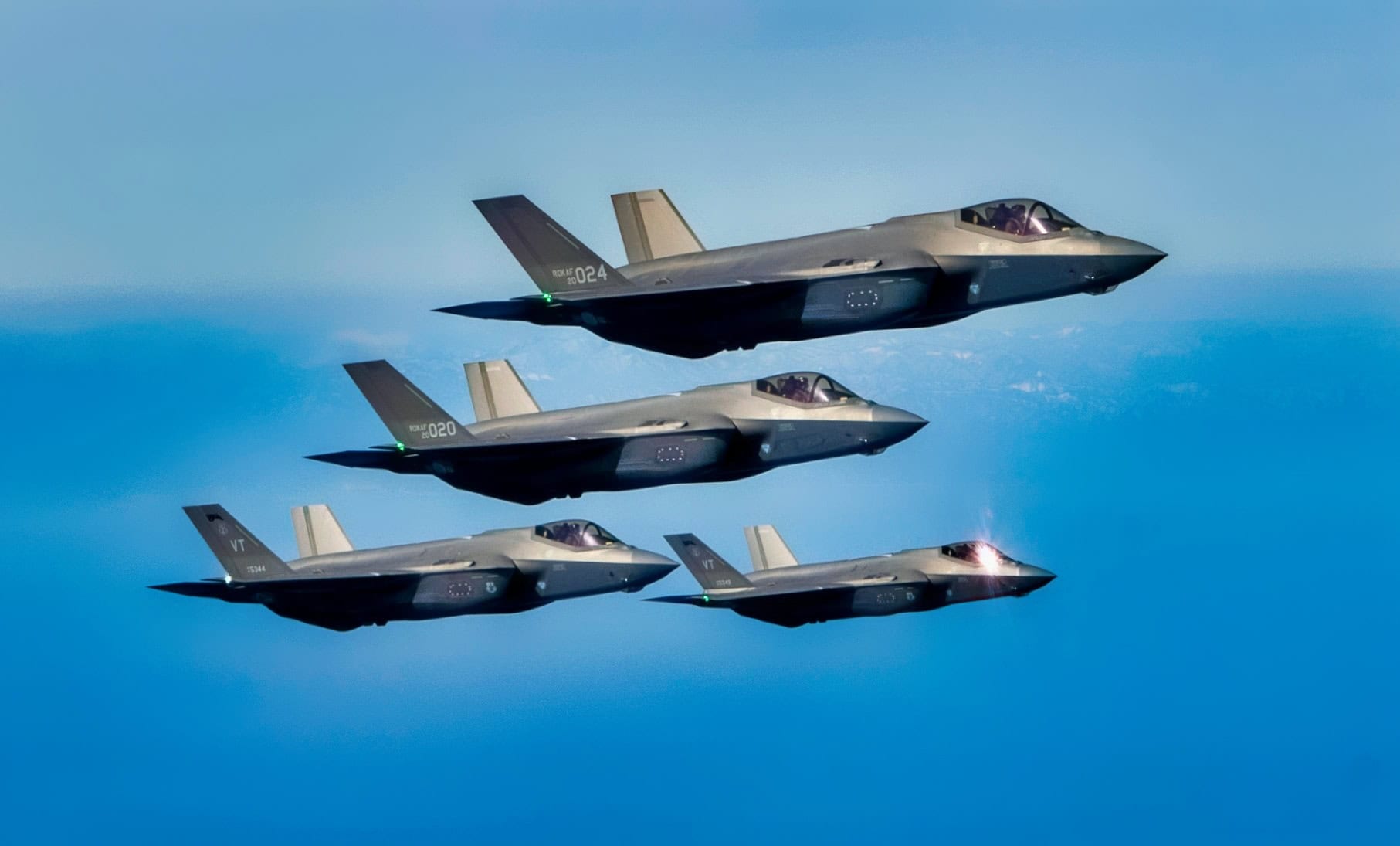
Japan's F-35 plan remains one of the most important airpower investments in Asia. The planned fleet of 105 F-35A conventional takeoff aircraft and 42 F-35B short takeoff and vertical landing aircraft gives Tokyo stealth, sensor fusion and a way to operate from the converted Izumo-class ships. In theory, this helps Japan cover the southwestern islands and complicates Chinese planning in the East China Sea.
The problem is basing. An F-35 is only useful if it can launch, recover, refuel, rearm and receive mission data. Chinese missile forces are built precisely to stress those functions. The People's Liberation Army Rocket Force does not need to destroy every Japanese aircraft. It needs to crater runways, hit fuel storage, disrupt command nodes and force dispersal before US and Japanese airpower can settle into a sortie rhythm.
That is where drones change the math. Uncrewed aircraft can provide decoys, electronic attack, maritime surveillance, strike options and attritable mass. They can also soak up enemy interceptors. A $2 million drone that forces the adversary to spend a high-end surface-to-air missile is not a loss in the same way a downed fifth-generation fighter is a loss.
Japan has started moving in this direction, but its procurement culture still favors exquisite platforms and carefully managed programs. That bias made sense when Japan was buying top-tier interceptors, Aegis destroyers and submarines for a relatively controlled defense posture. It makes less sense in a fight where both sides will be consuming missiles, drones and spare parts at a rate peacetime acquisition offices rarely model honestly.
Counterstrike Without Magazine Depth Is A Slogan
Tokyo's counterstrike plan is another example. Japan is acquiring Tomahawk land-attack missiles from the United States and developing extended-range Type 12 surface-to-ship missiles, with public Japanese plans pointing toward ranges that could reach roughly 1,000 kilometers for improved variants. That gives Japan a new ability to hold at risk ships, launchers and command facilities that threaten the home islands.
The military value is real. The danger is over-reading it.
A few hundred long-range missiles do not create deterrence by themselves. They create a first salvo and maybe a second one, depending on survivability, targeting and reloads. The PLA can present Japan with far more targets than Japan can economically service with premium missiles alone. Mobile launchers, air-defense sites, coastal radar, amphibious shipping, logistics nodes and command vehicles all compete for the same limited weapons.
That is why the drone language in the 2026 white paper is not a technology footnote. It is the missing middle between expensive manned platforms and scarce long-range missiles. Japan needs uncrewed systems that can find targets, confuse defenses, relay data, strike lightly defended assets and die cheaply. Without that layer, counterstrike becomes a boutique capability attached to a force that may still be too brittle.
China Will Read The Industrial Signal
Beijing will not be surprised by Japan calling China its central defense challenge. That has been obvious for years. What China will measure is whether Japan can turn warning into production.
The useful comparison is not just Japan versus China in annual defense spending. It is shipyard throughput, missile output, drone manufacturing capacity, reserve mobilization and civil infrastructure hardening. China has the advantage of scale. Japan has advantages in technology, alliance access, undersea warfare, geography and industrial precision. The question is whether Tokyo can convert those advantages into wartime endurance.
The United States matters here, but it cannot solve Japan's inventory problem. In a Taiwan scenario, US forces would be drawing from the same missile stocks and repair networks needed by Japan, Taiwan, Guam and forward-deployed naval forces. Washington can reinforce Japan; it cannot substitute for Japanese depth.
Japan's white paper is therefore more than an annual threat assessment. It is an admission that the fight Japan is preparing for would be fast, distributed and punishing. F-35s, Aegis destroyers and submarines remain central. But the next increment of credibility will come from less glamorous items: runway repair kits, hardened fuel storage, mobile launchers, cheap drones, counter-drone systems, spare engines, reload crews and magazines deep enough to matter after day three.
The lesson is blunt: Japan is buying some of the right high-end weapons, but China is building a campaign problem. Those are not the same thing.
The 2026 white paper shows Tokyo understands the direction of travel. Now it has to prove it can buy at the speed of the threat, not at the speed of a normal procurement cycle.
Japan plans to enhance its defense capabilities by integrating drones with its fleet of 147 F-35 fighters to counter threats from China. The 2026 defense white paper emphasizes the importance of combat drones and outlines a significant increase in defense spending, aiming for nearly 2% of GDP. Japan's military strategy is evolving to address multi-front challenges, including threats from North Korea and potential China-Russia coordination.
- Japan plans to buy 147 F-35 fighters.
- The 2026 defense white paper emphasizes the need for combat drones.
- Japan's defense spending is set to approach 2% of GDP.
- China is identified as Japan's central defense challenge.
- Japan is acquiring Tomahawk missiles and developing extended-range Type 12 missiles.