

Summary and Key Points: Japan’s Taigei-class is built around lithium-ion batteries instead of the Stirling air-independent propulsion engines Sweden’s Kockums supplied, after the last two Sōryū boats proved the batteries out.
Taigei-Class Submarines Explained
The Taigei-class submarine is a conventional diesel-electric attack submarine developed for the Japan Maritime Self-Defense Force (JMSDF). Designed to replace the already formidable Sōryū-class, the Taigei-class is Japan’s most modern and advanced attack submarine.
With new propulsion technology and sophisticated onboard sensors, the ships are strong contenders for the world’s most advanced and capable conventional attack submarines.
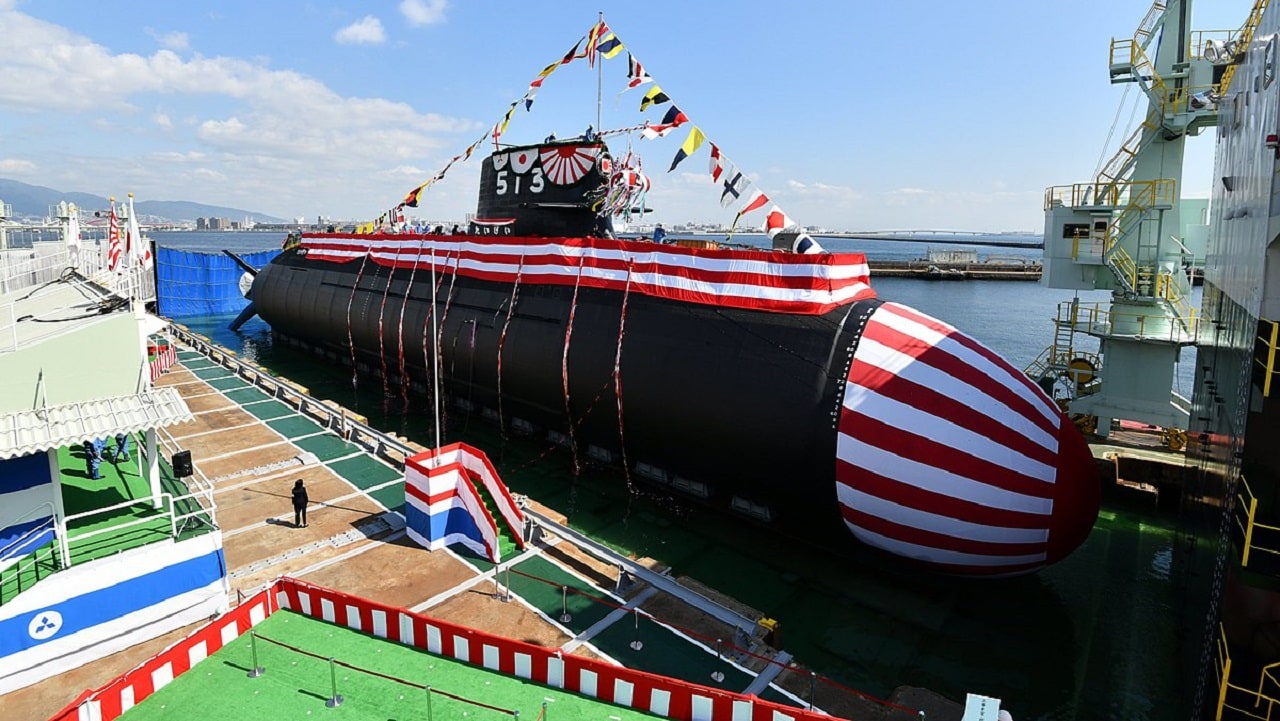
Taigei-Class. Image Credit – Creative Commons.
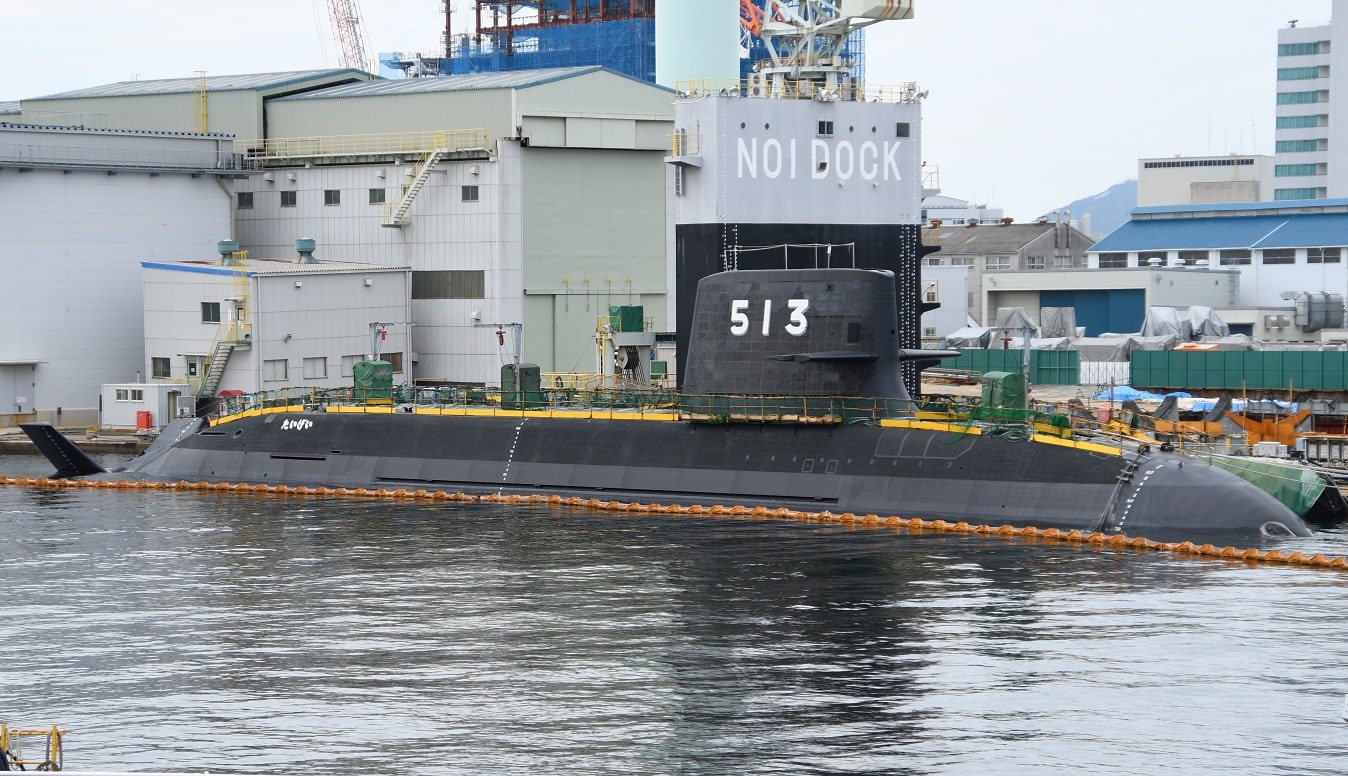
Taigei-class. Image Credit: Creative Commons.
The lead ship, Taigei, was commissioned in 2022, with a new ship commissioned each year after that.
The JMSDF plans to procure a fleet of ten Taigei-class vessels to maintain its undersea deterrence and counterbalance the growing Chinese Navy (PLAN).
Initial Studies and Development
As the Sōryū-class was being built, the Japanese Ministry of Defense (MoD) was already planning its replacement.
From 2004 through 2017, the MoD conducted multiple studies to develop the technology for its next-generation submarines.
In 2006, researchers examined possible shock-resistant submarine structures to reduce noise from onboard equipment while also improving the ship’s structure and survivability.
In 2009, the government evaluated new power-generation and snorkel systems to develop a propulsion system that could generate more power without compromising stealth.
Further studies in 2012 examined a new design that could incorporate the latest technologies without increasing the vessel’s size or cost.
In 2017, researchers evaluated a silent drive system focused on power storage and efficiency without compromising stealth.
These multiple research initiatives paved the groundwork for the Taigei-class.
The final two Sōryū-class submarines, Ōryū and Tōryū, served as testbeds for many technologies that later made their way onto the Taigei-class.
One of these technologies was the new lithium-ion battery propulsion system, which replaced the Sterling Air Independent Propulsion (AIP) system (more on that later).
After the two ships’ success, Japan built on the lessons learned and developed an entirely new submarine class optimized around the new battery propulsion.
This class evolved into the Taigei-class.
The JMSDF ordered the lead ship, Taigei, from Mitsubishi Heavy Industries in 2017. In 2018, Mitsubishi Heavy Industries Kobe laid her down.
The submarine was launched in 2020 and commissioned in 2022. Since then, Japan has commissioned a new Taigei-class ship every year.
Design and Specs
Externally, the Taigei-class resembles the Sōryū-class.
Both share the same hull shape and measure 275’7 feet (84 meters) in length, with a beam of 29’10 feet (9.1 meters).
However, with a surfaced displacement of 3,000 tons, the Taigei-class is 100 tons lighter than its predecessors.
Internally, the two ships differ significantly.
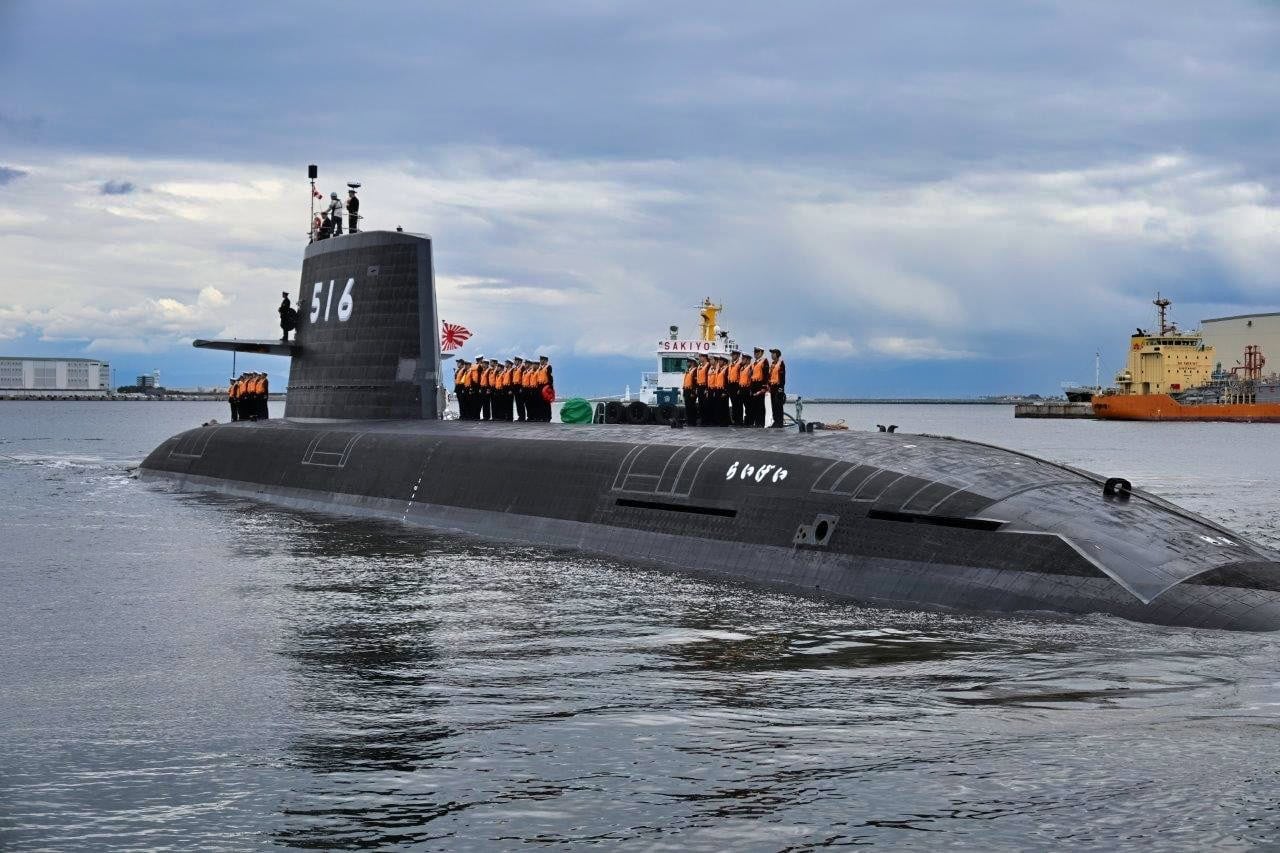
Taigei-Class Submarine. Image Credit: Creative Commons/JSDF.
Like most modern submarines, the Taigei-classusesg a high-tensile steel pressure hull surrounded by an outer hydrodynamic casing.
The pressure hull serves as the structure’s backbone, protecting the crew and machinery from the high pressures of deep-water diving.
The hull uses a conventional teardrop design and an X-shaped rudder to improve hydrodynamic performance and reduce cavitation.
The Taigei-class was designed first and foremost to reduce its acoustic signature.
Machinery aboard a submarine tends to vibrate, which can generate significant noise and compromise its stealth profile.
To that end, most submarines, including the Taigei-class, use a method called raft mounting.
In a raft mounting system, the ship’s machinery is installed on a secondary platform isolated from the hull by shock absorbers and vibration-damping materials.
Engineered suspension systems hold the ship’s equipment aloft and absorb vibrations.
Vibrations generated by the machinery are transferred through multiple layers of vibration-isolating structures, reducing noise outside the ship.
While many of the Taigei-class’s stealth systems are classified, the ships appear to use external anechoic tiles to absorb radar waves, along with carefully engineered propeller blades to reduce cavitation and noise.
Ditching AIP for Lithium-Ion Batteries
One of the biggest differences between the Sōryū- and Taigei-classes is the change from AIP to a lithium-ion battery propulsion system.
Typical diesel-electric propulsion systems require fresh air to operate, so conventional submarines must surface or use special snorkel systems to take in air.
The trade-off is that conventional submarines can’t stay submerged as long as nuclear submarines and, in a precarious situation, may have to compromise their positions.
AIP systems seek to bypass these limitations.
The Sōryū-class uses a diesel-electric engine supplemented by four Stirling AIP engines built by Kockums in Sweden.
The Stirling engine burns diesel fuel and liquid oxygen, extending the ship’s undersea endurance.
The engines can power the ship or charge the lead-acid batteries.
While AIP extends a conventional submarine’s endurance, the JMSDF found it comes at a cost.
AIP systems generate significantly less energy than typical diesel-electric propulsion, limiting speed and increasing battery charge times.
As a result, the Japanese experimented with a new lithium-ion battery system on the final two Sōryū-class submarines.
The result was better underwater endurance and performance than their AIP counterparts, without sacrificing their stealth profile.
Additionally, lithium-ion batteries offer almost twice the energy storage of lead-acid batteries, and removing the AIP engines let the Japanese add more batteries, further increasing their undersea endurance.
The JMSDF was so satisfied with the lithium-ion system that it implemented a similar system aboard the Taigei-class. ships.
Onboard Systems and Armament
Like most submarines, the Taigei-class incorporates a sophisticated suite of onboard sensors and battle management systems.
One noticeable difference from the Sōryū-class is that the Taigei-class has an elongated sail to accommodate newer onboard systems and parascopes.
The ships possess the advanced ZQQ-8 sonar system featuring bow-mounted, flank-mounted, and towed arrays.
Unfortunately, the ship’s sensor and electronic equipment specifications are heavily classified. The ships reportedly utilize new parascopes and optical equipment.
They likely also include electronic and acoustic decoys along with torpedo countermeasures.
The ships carry 533 mm torpedo tubes.
These tubes can launch a variety of munitions, allowing the Taigei-class to engage both enemy submarines and surface ships.
Their primary armament is the Type-89 heavyweight torpedo.
The Type-89 is a wire-guided torpedo that features both active and passive homing systems.
They have a stated range of around 27 nautical miles (50 km) and can travel at 55 knots.
The Taigei-class can also deploy the UGM-84L Sub-Harpoon Block II anti-ship missile.
The ship-launched Harpoon has a range of around 67 nautical miles (142 km) and carries a 488-pound warhead.
According to some reports, Japan plans to arm the Taigei-class with Type 12 anti-ship cruise missiles, which have a range of around 108 nautical miles (200 km).
Keeping an Eye on China
With China close to Japan, the JMSDF faces a complex security environment.
Over the past decades, the PLAN has expanded its naval capabilities at breakneck speeds.
Its submarine production has surged, and its shipbuilding industry is one of the strongest on the planet.
Furthermore, Sino-Japanese relations have deteriorated in recent years, driven by mutual rearmament and territorial disputes over the Senkaku/Diaoyu Islands.
China’s aggression towards its neighbors, particularly Taiwan and the Philippines, has also necessitated a stronger naval response from Japan.
In this environment, the Taigei-class is needed to deter any hostile activity near its territorial waters.
The JMSDF currently operates a fleet of 22 diesel-electric submarines.
In contrast, the PLAN operates around 48 diesel-electric submarines, not counting the roughly 60 nuclear-powered attack submarines in its inventory.
This outlook is troubling for Japan.
However, unlike China, Japan’s submarine force is legally limited.
In 1954, after the American occupation, the government passed the Self-Defense Forces Law, which created the JMSDF but imposed strict limits on its fleet size, particularly for submarines.
Japan cannot legally expand its fleet far beyond its current size without overturning the Self-Defense Forces Law, which poses a significant political risk.
As a result, Japan maintains a small but technologically advanced submarine fleet.
However, in recent years, China has been closing the technological gap with the introduction of some of its latest submarines.
I think we can sum up the Taigei-class in one word: Powerhouse.
About the Author: Isaac Seitz
Isaac Seitz, a Defense Columnist, graduated from Patrick Henry College’s Strategic Intelligence and National Security program. He has also studied Russian at Middlebury Language Schools and has worked as an intelligence Analyst in the private sector.