
JNIM strikes 4 positions in Mali — Washington tests a military option in 2026
 Marie Dubois
JNIM strikes 4 positions in Mali — Washington tests a military option in 2026
In Gao, Anefis, Aguelhok, and Sévaré, the day began before dawn with gunfire, pick-up movements, and conflicting rumors. According to available information, jihadists and Tuareg separatist fighters launched coordinated attacks against several Malian military positions, while gunfire was reported near a prison on the outskirts of Bamako. The exact details of the casualties remain uncertain. It is precisely this uncertainty that matters.
In a theater like Mali, an attack does not need to permanently take a city to produce a strategic effect. It is enough for it to force the general staff to look simultaneously to the north, to the center, and to the capital. The message is simple: the military power can still hold Bamako, but it no longer always chooses the location or the tempo of the fight.
An offensive designed to stretch the Malian army
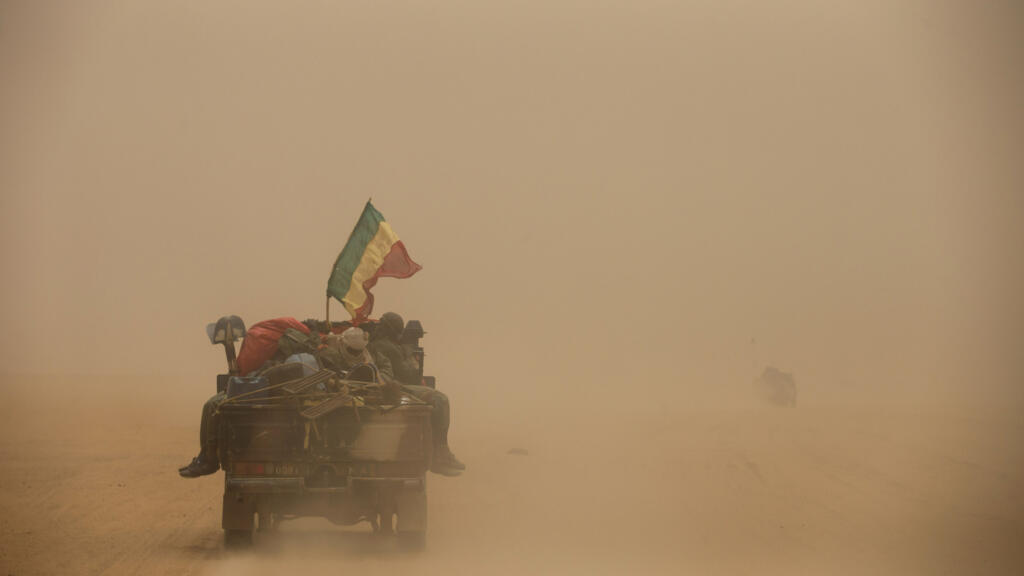
The geography of the attack says a lot. Gao is the military gateway to northeastern Mali. Anefis controls a useful passage between Kidal and Gao. Aguelhok, further north, remains associated with the routes of the Tuareg rebellion and the old lines of contact. Sévaré, near Mopti, is a logistical hub for the center of the country. Putting these points in the same sequence, even with limited means, forces the Malian armed forces to think in terms of a network rather than isolated garrisons.
From experience, this is one of the most difficult exercises for an army under pressure: protecting camps, escorting convoys, securing routes, and reassuring the capital at the same time. Armored vehicles can roll on dry laterite, but they consume a lot, break down quickly, and become predictable. Helicopters and planes can strike, but they do not hold a crossroads after the departure of the aircraft. On the ground, permanence costs more than firepower.
The Support Group for Islam and Muslims, better known by its Arabic acronym JNIM or GSIM, has understood this logic for a long time. Its advantage is not only ideological. It is logistical, fiscal, and human. It knows where to tax a truck, where to threaten a village chief, where to cut a telephone line, where to make a column run for six hours to strike elsewhere.
Washington watches, Bamako denies
This military sequence comes at a time when the American press reports that the Trump administration is exploring military options against JNIM in Mali. Trendsnafrica, citing the Washington Post, reminds us that the Al-Qaeda-linked group operates in Mali, Burkina Faso, Niger, and beyond, under the authority of Iyad Ag Ghali, designated a terrorist by the United States. The Malian Minister of Foreign Affairs, Abdoulaye Diop, publicly rejected the idea of an American intervention, stating that no confirmation or official American statement supported this information.
The denial is understandable. Since the departure of Barkhane and the break with a large part of Western partners, the Malian junta has built its legitimacy on two pillars: regained sovereignty and the promise of superior military effectiveness. Acknowledging that Washington might discuss strikes, intelligence, or operational assistance would open a breach in this narrative.
But denying an option does not make it disappear. The Americans do not need a massive return to the Sahel to weigh in. A few intelligence assets, aerial surveillance capability, targeted strikes, or discreet support to regional partners would be enough to alter JNIM's calculations. The problem for Washington is that any visible action in Mali would go through a regime close to Moscow and already engaged with the Russian Africa Corps. The target would be jihadist; the political terrain would be mined.
Russia offers symbolism, not always depth
The Russian bet in Mali is based on an appealing idea for the juntas: fewer political lessons, more brute force. Initially, this language speaks to the officers. It promises instructors, equipment, close protection, sometimes offensive operations without the public constraints of the West. But a counter-insurgency cannot be won solely with foreign detachments and victorious communiqués.
Mali needs reliable local intermediaries, human intelligence, mobile justice, economic security, and discipline in the garrisons. If villages associate the state with arbitrary arrests, ransoms, or reprisals, JNIM does not need to win hearts. It is enough for it to appear as the least immediate risk.
Recent attacks also show that the war is no longer just a peripheral affair. When gunfire is reported near Bamako, even without lasting control, the psychological effect is disproportionate. Sahelian capitals live at a distance: as long as the violence remains several hundred kilometers away, power can present it as an external front. When it reaches the outskirts of the capital, it becomes a matter of political survival.
The operational trap of American options
An American option against JNIM could produce tactical results. The United States knows how to find, track, and strike jihadist leaders when the intelligence conditions are met. But Mali in 2026 is neither the Iraqi theater nor eastern Syria. The lines between jihadist groups, community networks, trafficking, former rebels, and pro-government forces are less readable from a screen.
A successful strike can kill a leader. A misunderstood strike can provide JNIM with a recruitment narrative: Bamako would have replaced Paris with Washington, while keeping Moscow in the courtyard. For a junta that has made sovereignty its political uniform, this would be dangerous. For Washington, cooperating with Bamako without strengthening Russian dependence would be equally difficult.
The best reading is therefore not that of an imminent American return to Mali. It is that of a battlefield that has become too important to ignore. JNIM threatens cities, mines, trade routes, and the military regimes of the Sahel States Alliance. It forces foreign capitals to look again at a region they had wanted to distance themselves from after the French failure.
What to watch now
- The ability of the Malian army to quickly reopen the Gao-Anefis and Gao-Sévaré routes after the attacks.
- JNIM's statements, distinguishing propaganda claims from confirmed casualties.
- The Russian reaction, especially if Bamako requests more intelligence or air support.
- American signals: not the grand statements, but the movements of drones, advisors, and legal authorizations.
In the Sahel, the decisive question is not who promises to help Bamako. It is who can hold a road after sunset.
The next fragile point is probably not a capital. It is a secondary axis, between two garrisons, where a convoy must choose between waiting for an escort or traveling alone. If JNIM manages to make this hesitation a routine, then the Malian junta will have lost something more important than a position: it will have lost the initiative.
Main sources
- Trendsnafrica, "Mali Denies US Intervention in Fight Against Jihadist Group", July 25, 2026.
- Trendsnafrica, "Jihadists Launch Attacks on Major Military Positions in Mali", July 2026.
- Google News index, recent headlines from Washington Post, France 24, BBC, Africa Defense Forum, and The Africa Report on Mali and the Sahel, consulted on July 26, 2026.
JNIM launched coordinated attacks on military positions in Gao, Anefis, Aguelhok, and Sévaré in July 2026, creating pressure on the Malian military. Concurrently, the U.S. administration is exploring military options against JNIM, despite Mali's denial of any U.S. intervention. The attacks highlight the strategic challenges faced by Malian forces as they manage multiple threats.
- JNIM launched coordinated attacks on military positions in Mali.
- Attacks occurred in Gao, Anefis, Aguelhok, and Sévaré.
- Malian military is under pressure to respond to multiple threats simultaneously.
- U.S. administration is considering military options against JNIM in Mali.
- Malian Foreign Minister denied U.S. intervention claims.