
JNIM strikes Dioura in Mali — over 100 soldiers killed, the Africa Corps exposed in 2026
 S.W
S.WJNIM strikes Dioura in Mali — over 100 soldiers killed, Africa Corps exposed in 2026
Dioura, in central Mali, has become the focal point of a crisis that had previously been moving across maps in just a few hours. On September 10, an attack attributed to the Group for Support of Islam and Muslims (JNIM, or GSIM) struck a position of the Malian army. The numbers remain disputed, but sources agree on a heavy defeat. Reuters reports that more than 100 Malian soldiers were killed in the September attacks, according to sources close to the matter. The JNIM claims to have killed 150 men and captured 93 others in Dioura. This latter estimate is a claim, not a confirmed toll.
An isolated camp, an exposed force
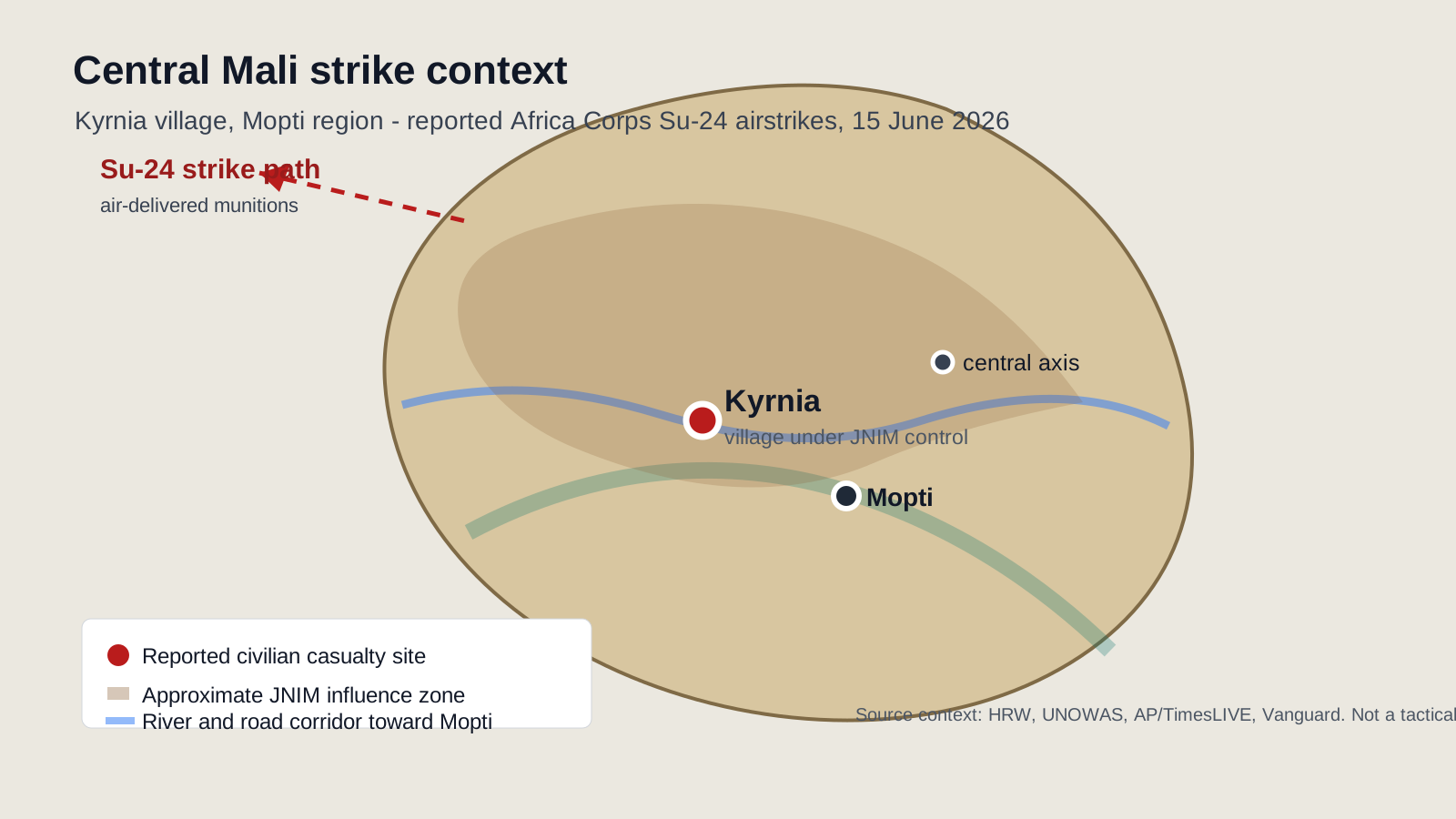
On the ground, geography matters more than press releases. In central Mali, outposts are separated by long tracks, river corridors, and villages where state control is intermittent. A garrison can hold its enclosure and lose the road that connects it to the next base. For JNIM fighters, this discontinuity creates a series of small local battles, with the possibility of quickly concentrating men against a poorly supplied position.
The jihadist movement has released videos purportedly showing captured soldiers. Specialized sources, including Zagazola, have relayed the claim of 150 dead and 93 prisoners. Sahel Intelligence later reported that the Malian army was launching operations after the attack. The delay is telling: Bamako can regain the initiative in the media space before restoring a lasting presence on the routes around Dioura.
The Russian partner does not replace operational depth
The peculiarity of this sequence is the presence, in the accounts of regional sources, of elements of the Russian Africa Corps alongside Malian forces. The Russian deployment gives the junta a political argument: Mali would no longer be dependent on France and would have a protector capable of striking jihadist sanctuaries. However, an external partner does not automatically create a logistics chain, experienced non-commissioned officers, or a fine knowledge of the tracks.
A foreign force can provide intelligence, instructors, fire support, and a reaction capability. It cannot be present at every post, at every market, on every river crossing. This is the classic weakness of setups that rely on fire superiority to compensate for the absence of territorial coverage. The fall or neutralization of an advanced position then transforms a tactical advantage into a political crisis.
The most important figure may not be the losses, but the number of prisoners. Capturing soldiers gives the JNIM intelligence, propaganda images, and leverage over the morale of nearby garrisons.
A military victory that goes beyond Dioura
The JNIM does not need to hold Dioura permanently to exploit the attack. It is enough for them to show that the army and its Russian allies can be pinned down, outflanked, or forced to abandon a position. In an operational theater where distances are measured in hours of track rather than kilometers of paved road, each withdrawal enlarges the gray area. Transporters change routes, markets close earlier, and village chiefs negotiate with whoever can return tomorrow.
The group's communication follows a precise military logic. Images of prisoners serve not only for recruitment. They can deter local auxiliaries, encourage defections, and make it seem that a nearby garrison is already doomed. On the Malian side, the response announced by the army will therefore need to be measured against concrete indicators: reopening of routes, regular resupply of posts, return of administrations, and protection of civilians. A one-off airstrike is not enough.
The risk for Bamako and Moscow
This battle primarily tests the political contract between the Malian junta and Moscow. Bamako has presented the French withdrawal as the condition for its security sovereignty. The failure at Dioura allows the JNIM to turn this narrative around: the problem would not be the identity of the foreign partner, but the inability to hold the ground after an operation. Moscow can respond with more drones and strikes, but each civilian casualty or each position regained and then lost will reduce the political yield of this escalation.
One must remain cautious. The available tolls are incomplete, the videos do not always allow for the identification of the place or date, and no independent source has confirmed every figure put forward by the JNIM. This does not change the operational diagnosis: an attack resulting in more than 100 deaths according to sources cited by Reuters represents a major shock, even if the final toll is lower than the claims.
The next fault line
The question is not whether Bamako can retake Dioura for a few days. The real question is whether the Malian army can hold the roads and villages after its columns pass through. If the answer remains negative, the JNIM will likely seek to repeat the model on other isolated garrisons in central Mali, alternating ambushes, pressure on civilians, and camp attacks.
On the ground, the next alert will not necessarily come from a large city. It will come from a cut track, a convoy that does not arrive, and a post whose radio goes silent. This is how a defeat at Dioura can become a campaign.
Sources
- Reuters, September 21, 2026, toll of Malian losses in the September attacks.
- Zagazola, September 18, 2026, claim from the JNIM regarding Dioura.
- Sahel Intelligence, September 21, 2026, operations announced by the Malian army after the attack.
- Al Jazeera, September 22, 2026, context of the Malian security crisis.
On September 10, 2026, JNIM launched an attack on a Malian army position in Dioura, resulting in over 100 soldiers killed. JNIM claimed to have killed 150 soldiers and captured 93. The attack underscores the vulnerability of isolated military positions in central Mali and raises questions about the effectiveness of Malian forces and their Russian allies in maintaining control.
- Over 100 Malian soldiers killed in the attack on September 10, 2026.
- JNIM claims to have killed 150 soldiers and captured 93 others.
- The attack highlights the vulnerability of isolated Malian army positions.
- Russian forces are reportedly present alongside Malian troops.
- The situation in Dioura reflects broader operational challenges for the Malian army.