
PGZ, increasing production mainly for Poland while looking at export beyond 2030
Polska Grupa Zbrojeniowa (PGZ), the Polish Armament Group, is definitely the largest player in the Polish defence industry ecosystem. A state-controlled industrial group, it is made of 50-60 subordinated companies, half of them related to defence production
Considering the whole group, around half of the PGZ companies are not related to defence, manpower is over 23,000 personnel, 1,500 dedicated to research and development, working in over 100 sites. The defence business is divided in seven business domains; armoured vehicles and artillery, platforms and wheeled vehicles, electronics and anti-air systems, ammunition and missile technology, navy, air and finally soldier and uniformed services equipment. R&D, development, strategy, sales, export and other functions are part of the overhead.
 click on image to enlarge
Defence spending is significantly increasing in most countries, and this is even more true in Poland where it is close to 5% of the gross domestic product. Visiting MSPO as part of a study tour on the Polish Defence Industry organised by Polska Agencja Inwestycji i Handlu (PAIH), the Polish Investment and Trade Agency [1], EDR On-Line Jan Grabowski, the Vice-President of the PGZ Management Board.
“The Polish Republic is the largest beneficiary of the SAFE (Security Action For Europe) programme, a European Union initiative, with over 44 billion Euro,” Mr. Grabowski underlined, 90% of that sum being spent in the Polish defence industry. SAFE is funding 69 projects in Poland, most of them going to PGZ companies. This funds are added to the national funding, and all this led to a stability in defence funding unknown until now. “This is the first time in the history of Polish defence industry that funding has been planned for the next four to five years. And this is the budget that has been confirmed.”
 click on image to enlarge
While not all the European funding is going to PGZ, being the largest player, the Group obviously gets the biggest share of the cake. “PGZ group companies are the biggest beneficiaries of the contract signed by the Polish Ministry of Defence. For example, we signed contracts worth 15 billion euros for the armoured vehicles which include the Borsuk infantry fighting vehicle, the Krab 155 mm self-propelled howitzer, which is doing a great job now in Ukraine, the Krab 120 mm turreted mortar, and command and logistics vehicles.
High consumption of artillery ammunition is one of the key lessons learned from Ukraine. “We are of course delivering 155 mm artillery ammunition, and everybody knows that this is an essential product and that we need to increase our production capacity. We are currently building new facilities and we have already ordered new production lines,” Mr. Grabowski said. Through the SAFE programme Poland is acquiring ammunition worth between 1.5 and 3.5 million Euro. EDR On-Line understood that at PGZ some 5 or 6 different companies are involved in 155 mm rounds production; Mesko produces shells in Kraśnik and Bi-Modular Charge System in Pionki with Eurenco, Dezamet is responsible for artillery fuses and 155mm round filling in Nowa Dęba, Nitrochem produces nitrocellulose, ZPS Gamrat produces base-bleed and gas-generator units to extend artillery shell range, while Belma contributes electromechanical components. In the second half of 2024 Mesko acquired a complex in Kraśnik, some 100 km south-east of Warsaw where it is building a new facility that will allow to reach a 150,000 155 mm shells per year production capacity, the completion of that project being planned for late 2027.
 click on image to enlarge
Beside increasing its in-house production capacity, the PGZ group is also seeking cooperation with other European players in the 155 mm artillery ammunition field. Since the early 2020s it is cooperating with ZVS Holding, which supplies critical 155 mm ammunition components, pyrotechnic subassemblies, and fuse components to Dezamet. Several cooperation agreements were inked recently. “We signed the joint venture with the French Eurenco to produce energetic products. We also signed a strategic cooperation agreement with BAE Systems of Great Britain, with whom we will jointly produce ammunition for Poland, Great Britain, and export markets. But of course, this takes time.” During MSPO PGZ signed a Memorandum of Understanding and a Letter of Intent with MKE from Turkey which includes cooperation on 155 mm artillery ammunition, an area for which MKE has a considerable experience. “That said, in the future we want to become independent for 155mm ammunition, but for now, there’s European cooperation.”
 click on image to enlarge
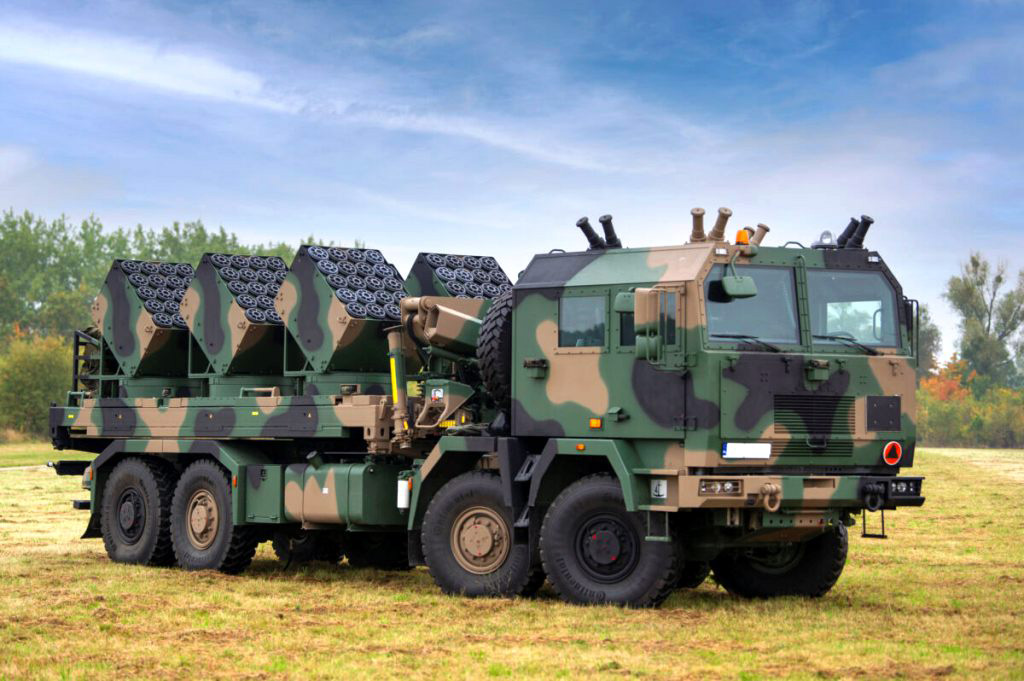
Another aspect that was highlighted in the conflict in Ukraine is mine warfare. Mines have played a role in limiting the movement of armored vehicles on the battlefield, and this has led to a resurgence of mine-laying systems in Western countries. “We at PGZ Group have in our inventory the Baobab-K, which is in use in the Polish Land Forces,” Mr. Grabowski explained, Poland having assigned 500 million Euro from SAFE for this programme. He also added that Greece has shown some interest in the system, while the company also spoke to Arab countries and India on that same topic.
Another PGZ product which is raising interest on the international market is the Piorun very-short-range air defence man-portable missile, with its 6.5 km range and 4,000 metres ceiling. It is produced by Mesko in Skarżysko-Kamienna, a location 125 km south of Warsaw. “It is our shining star, and thanks to the conflict in Ukraine it became very popular as it has show it get’s the job done,” the Vice-President of the PGZ Management Board told us.
 click on image to enlarge
“We have already signed agreements of course with Poland but also at export with Belgium, Lithuania, Latvia, the Netherlands and Norway, and French Special Forces have also shown interest,” he added. The production contract signed in late August 2026 with the Polish Armaments Agency and worth 8 billion PLN, around 1.86 billion Euro, was to provide Poland, Lithuania, Latvia and Norway with “several thousand missiles and several hundred [Piorun] systems” and was funded under the SAFE scheme. According to company sources the Piorun was one of the first items delivered by Poland to Ukraine at the beginning of the Russian invasion, and it was the main reason Russia halted helicopter operations inside Ukraine.
Currently 80-85% of the overall PGZ Group defence production is aimed at Polish Armed Forces; this will remain true until 2030, and thanks to the SAFE programme delivery times will be pretty short. However, in the long run, the Group will have to increase its share of export.
 click on image to enlarge
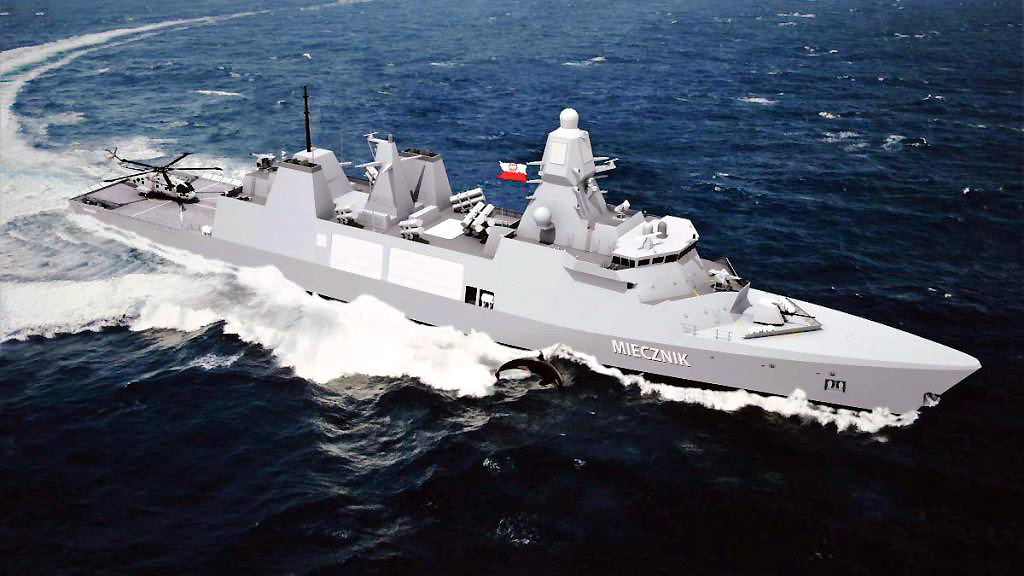
“We know very well that PGZ cannot remain completely alone in the market. That’s why we’re currently cooperating with Eurenco and BAE Systems. We have a partnership with MBDA, and we will be producing the MBDA UK CAMM missile here in Poland. That’s why we are developing the short-range air defence system, up to 25 km, together with MBDA UK. We also have cooperation in the maritime thanks to our partnership with Babcock International Holdings of the UK, and we are producing [2] under license three Miecznik-class frigates for the Polish Navy at our shipyard in Gdynia, in northern Poland. But we’re doing this, of course, from the UK, from Babcock,” Mr. Grabowski. On this project PGZ cooperates with several companies, such as Lockheed Martin, MBDA, Thales, Thales UK, and Thales Neverlands.
 click on image to enlarge
“After 2030 we aim at increasing our export business in countries such as India, the Kingdom of Saudi Arabia (KSA), and other Arab countries. we are already doing transfer of technology (TOT) in KSA, to allow our products to be manufactured locally. We already tested our Rosomak 8×8 armoured vehicle in KSA, and we are also talking about the Baobab-K mine-scattering system. Coming to India, we believe that it should be possible to produce or at least perform final integration of our products jointly with the local industry.” EDR On-Line understood that PGZ is also considering promoting abroad systems developed in cooperation with other European companies, such as the CAMM-based GBAD system, leveraging Polish Group products such as in that case the radar.
The need for short-time deliveries brought Poland to acquire from nations capable to provide key systems, such as artillery self-propelled howitzers and main battle tanks, at very short notice, the main one being South Korea which exported to Poland its K9 howitzers and K2 MBTs. The contract did not involve any TOT, however PGZ is now aiming at obtaining an MRO (Maintenance, Repair, Overhaul) contract for those systems, something which usually comes automatically when acquiring systems from the US. With other countries it is a two-way street, for example Poland selected Swedish submarines, and the Swedish Navy will get a rescue ship from Poland.
Looking to the future, cooperation remains a cornerstone for Jan Grabowski. “We need much greater cooperation, ‘Stronger together’ is a very popular hashtag in Poland, and I think that’s our motto for the export market. As an example, he mentioned the SAN (System Anti-Dronowy), the counter-UAS system financed through SAFE, which is worth 15 billion PLN, around 3.4 billion Euro, for which PGZ is the prime contractor. “SAN features gun has turrets from Kongsberg of Norway, armed with Leonardo X-Gun from Italy, from Italy, the radar is provided by Weibel from Denmark, from Weibel, and it also involves several private Polish companies.
[1] PAIH is the first point of contact for exporters and investors operating in dozens of markets globally. It provides free consulting to grow and promote Polish businesses. Among its missions, PAIH supports Polish companies in promoting their brands on export markets.
[2] The first Miecznik-class frigate, named Wicher, which is based on Babcock’s Arrowhead 140 design, was launched in Gdynia on 13 August 2026.
Photos courtesy PGZ
Content preview only. Full article available at source. View Full Article
Polska Grupa Zbrojeniowa (PGZ) is increasing its defense production capacity in Poland, aiming to produce 150,000 155 mm artillery shells annually by late 2027. The group has signed contracts worth 15 billion euros for various military vehicles and is actively seeking international partnerships for ammunition production. Poland's defense spending is nearing 5% of its GDP, with significant funding from the SAFE program.
- PGZ employs over 23,000 personnel, with 1,500 in R&D.
- Poland's defense spending is close to 5% of GDP.
- PGZ signed contracts worth 15 billion euros for armored vehicles.
- PGZ aims to produce 150,000 155 mm shells per year by late 2027.
- PGZ is seeking international cooperation for artillery ammunition production.