
July 2026 Turns Crimea into a Fuel Island After Strikes on Oil Refineries and Tankers
 Dmitri Volkov
July 2026 Turns Crimea into a Fuel Island After Strikes on Oil Refineries and Tankers
Nineteen fuel tankers, one cargo ship, and one ferry in 72 hours — this arithmetic seems more modest than reports of hundreds of drones, but for the Russian military machine in Crimea, it could be more painful. According to the Ukrainian Drone Forces and the Security Service of Ukraine (SBU), nine Russian fuel tankers were hit in the Sea of Azov on the night of July 7 to 8, and in the preceding three days, the total number of attacked vessels reached two dozen. Almost simultaneously, the Ukrainian General Staff reported strikes on the Saratov Oil Refinery, the TAIF-NK plant in Nizhnekamsk, the Transneft-Ural facility in Bashkortostan, and the Borisoglebsk airfield, where Su-34, Su-35S, and Su-30M aircraft were stationed. If these reports are even partially accurate, we are not witnessing a series of beautiful raids, but an attempt to disrupt the fuel geometry of the Russian southern theater.
Crimean Logistics Returns to the Sea
The key detail is not the fact of the strikes on the tankers themselves, but the reason these tankers have become important. Ukrainian Navy representative Dmitry Pletenchuk stated on July 8 that Russia is increasingly using maritime fuel transportation between the ports of Mariupol, Berdyansk, and occupied Crimea, as strikes on land routes limit the use of the M-14 route from Rostov to Crimea. This means that the Russian supply system for the peninsula is taking a step back to a more vulnerable model: instead of a deep land line with distributed nodes, it is forced to rely on a maritime link that is visible, slow, and poorly protected from cheap maritime drones.
From a military perspective, this resembles not a blockade in the classical sense, but a gradual increase in the cost of every liter of fuel. Crimea will not stop receiving gasoline and diesel tomorrow morning. But if delivery through the Sea of Azov requires more trips, a more cautious schedule, additional security measures, and repairs for damaged vessels, then the cost of military supply rises. In the Soviet logistics school, such a situation would be called a disruption of supply stability, and this is much more serious than a single loss of transport. A tank can be replaced, but replacing the rhythm of supply for the front and aviation is more difficult.
Saratov Oil Refinery and Long-Range Strikes on the War Economy
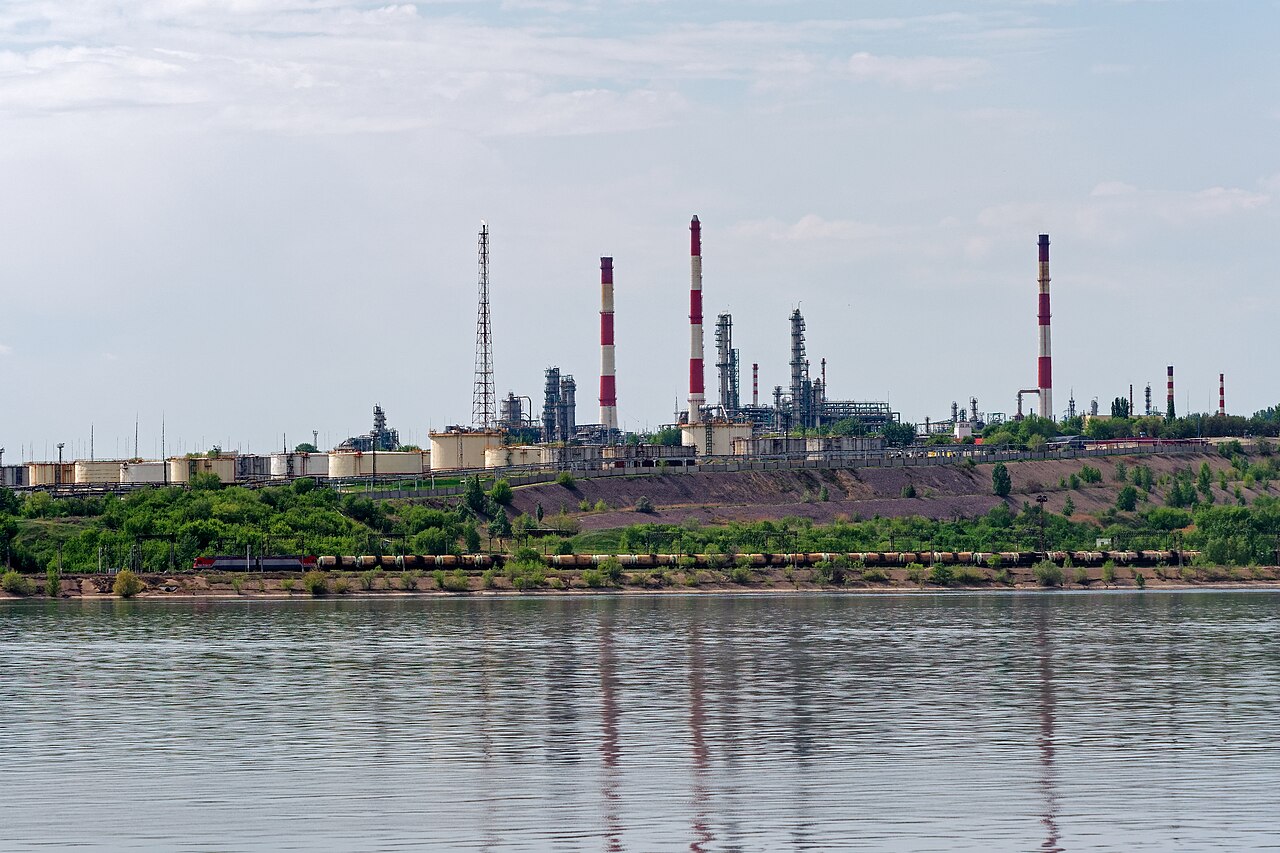
The Saratov Oil Refinery, according to Ukrainian data, has an annual capacity of about 7 million tons of petroleum products and produces gasoline, diesel, and aviation fuel. TAIF-NK in Nizhnekamsk has a capacity of over 8 million tons. The Cherkasskaya LPDS facility in Bashkortostan is connected to the Transneft-Ural network and, according to the SBU, pumps nearly 2 million tons of light petroleum products annually. Even if the damage at each facility is limited, the cumulative effect is different: Ukraine is striking not at a single plant, but at the entire chain of processing — storage — transportation — delivery to the theater.
The Russian side traditionally labels such attacks as terrorist or minimizes the damage with formulas about drone debris. But the economic logic here is stubborn. Oil refining does not tolerate irregularity. The shutdown of one unit, a fire near the tank farm, a temporary closure of an airfield, or the redeployment of air defense to an industrial site creates a cascade of costs. In peacetime accounting, this is expressed in repairs, insurance, and lost margins. In military accounting — in delays of fuel for aviation, limitations on maneuvering reserves, and increased dependence on longer routes.
Russia's Air Defense Overloaded Not by Quantity, but by Geography
Particularly indicative is the strike on Nizhnekamsk, approximately 1115 km from the Ukrainian border, and on the facility in Bashkortostan, about 1500 km away. The Russian air defense was created as a layered system to protect directions, capitals, positional areas of the Strategic Missile Forces (RVSN), and important military facilities. It was not designed to cover dozens of oil refineries, compressor stations, airfields, and ports from mass, relatively cheap drones on a daily basis. In this sense, the Ukrainian campaign exploits not a technological miracle, but an old problem of vast territory: Russia is too large to equally protect everything that has now become a military target.
Russian military bloggers, as noted by ISW on July 8, are already accusing federal authorities of failing to create a coherent system to protect private industry and critical infrastructure. This is an important political detail. When complaints come not only from Kyiv or Western capitals but from within its own patriotic camp, it indicates a recognition of institutional failure. The state demands that business work for the war but cannot guarantee its protection. In the late Soviet tradition, this was called mobilization discipline; in modern Russia, it increasingly resembles mobilization asymmetry.
Borisoglebsk and the Aviation Cost of Fuel
The strike on Borisoglebsk airfield completes the picture. According to Ukrainian sources and satellite observations, Su-35s, Mi-8 helicopters, training Yak-130s, and Mi-26s could have been at the airfield; the facility itself is used for deploying combat aviation and training crews. Even if the aircraft are not destroyed, the very necessity of dispersal, runway repairs, increased security, and changes to flight schedules impacts efficiency. For Russia, aviation remains one of the main ways to compensate for the lack of maneuver on the ground: guided bombs, Kh-31P missiles, Su-34s, and Su-35Ss have become part of the daily pressure on Ukrainian defense. Therefore, strikes on fuel and airfields should be viewed together, not as two separate pieces of news.
In this context, the statement from the Main Intelligence Directorate (HUR) that Russia produces 60–65 Iskander missiles per month takes on additional meaning. Moscow retains the ability to deliver heavy missile strikes, and Ukrainian air defense still suffers from a shortage of Patriot interceptors against ballistic targets. But the strategic sustainability of the missile campaign depends not only on the number of missiles. It depends on fuel, airfield infrastructure, transportation, repairs, and the ability of air defense to cover the rear. Ukraine seems to be targeting these weak links.
What This Changes in Summer 2026
The result should not be exaggerated. The Russian army will not lose fuel due to one week of strikes, and Crimea will not become an isolated island in the literal sense. Russia still has railways, road routes, reserves, backup schemes, and a habit of tolerating inefficiency. But this is where a more subtle problem begins: modern war of attrition is won not only by destroying battalions but also by systematically increasing the cost of their existence. If every ton of fuel for Crimea requires more vessels, more air defense, more repairs, and more organizational chaos, the front receives less flexibility.
For Russian military doctrine, this is an unpleasant lesson. Since 2014, Crimea has been viewed as a fortified foothold and a symbol of strategic return. In 2026, it is increasingly becoming a logistics asset with high maintenance costs. There is no romance in this, but war rarely confirms romantic myths. If Ukraine maintains the pace of strikes on oil refining, ports, and airfields, the Russian southern theater will not collapse, but it will become less elastic. And a less elastic army often responds not with maneuver but with brute force — expensive, slow, and predictable.
The conclusion is simple: the July strikes do not prove Russia's weakness as a state, but they reveal the weakness of the Russian model of protecting an extensive military economy. This weakness will not be noticeable in one spectacular explosion, but in the accumulation of delays, deficits, and forced decisions.
Ukrainian forces struck nine Russian fuel tankers in the Azov Sea and targeted oil refineries in Saratov and Nizhnekamsk from July 7-8, 2026. These actions disrupted fuel logistics, forcing Russia to rely more on vulnerable maritime transport. The strikes indicate a strategic shift in Ukraine's approach to degrading Russian military supply lines, increasing operational costs for the Russian military in Crimea and the southern theater.
- Ukrainian forces struck nine Russian fuel tankers in the Azov Sea on July 7-8, 2026.
- Strikes targeted oil refineries in Saratov and Nizhnekamsk, affecting fuel supply chains.
- Russian logistics in Crimea are becoming more vulnerable due to reliance on maritime transport.
- The strikes are part of a broader strategy to increase the cost of fuel supply for Russian military operations.
- Russian air defense systems are overwhelmed by the geographic spread of targets.