
KAMANDAG 10 Puts Four Marine Forces in the Philippines but Lift Remains Thin
 Marcus Chen
KAMANDAG 10 Puts Four Marine Forces in the Philippines but Lift Remains Thin
More than 2,000 troops are moving through the Philippine archipelago in KAMANDAG 10. That number matters less than the map. The exercise runs from June 15 to July 1 across Northern Luzon, Central Luzon, Palawan, Tawi-Tawi, Cavite and Metro Manila, with U.S., Philippine, Japanese and South Korean forces training in the same maritime problem set. For China, the message is obvious: a Taiwan or South China Sea crisis is no longer a bilateral U.S.-Philippine drill scenario.
But the harder question is not whether four marine forces can assemble for an exercise. They can. The harder question is whether they can move, supply and protect enough combat power across that island chain once Chinese missiles, aircraft, coast guard cutters and cyber units are trying to break the network.
That is where KAMANDAG 10 is useful. It shows real alliance progress, and it also shows the remaining gap.
The Exercise Is About Terrain, Not Ceremony
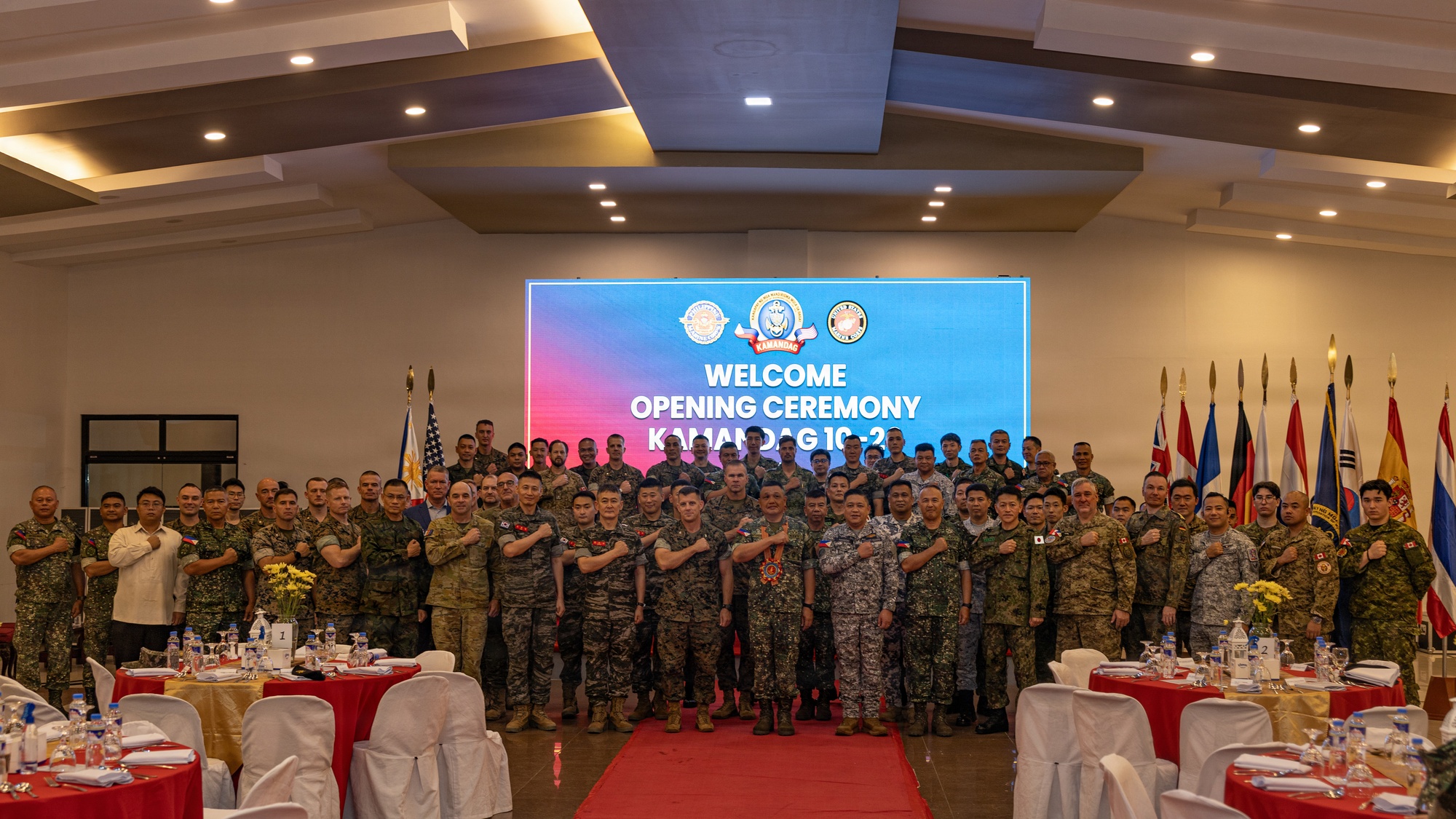
USNI News reported that Marine Rotational Force-Darwin, Marine Rotational Force-Southeast Asia and the 3rd Marine Littoral Regiment are participating alongside the Philippine Marine Corps, the Japan Ground Self-Defense Force and the Republic of Korea Marine Corps. The official Marine Corps release adds the important detail: training includes maritime key terrain security, maritime strike, counter-landing operations, airfield seizure and defense, island seizure and defense, seaborne maneuver, amphibious raids, military free-fall and close air support integration.
That list is not generic exercise language. It is a checklist for the geography China would have to manage in a Luzon Strait or South China Sea fight. Northern Luzon looks toward Taiwan and the Bashi Channel. Palawan points into the South China Sea. Tawi-Tawi sits near the Sulu and Celebes approaches. Cavite and Metro Manila are command, logistics and political nodes. If the United States and the Philippines are trying to make the archipelago a set of mutually supporting maritime positions, those are the places where the math starts.
The April posture testimony from Assistant Secretary John Noh made the same operational point in bureaucratic language. The Department of War said it is putting HIMARS, NMESIS and Typhon into the Philippines for longer periods, while investing more than $300 million in Enhanced Defense Cooperation Agreement infrastructure, including $144 million in fiscal 2026. KAMANDAG is the training layer on top of that basing layer.
Four Flags Do Not Solve the Mobility Problem
The presence of Japan and South Korea is politically significant. Japan brings a serious ground force and direct interest in the Southwest Islands. South Korea brings a marine corps with real amphibious competence and a defense industry that Washington increasingly wants inside theater sustainment. Observers from Australia, Bahrain, Canada, France, Germany, the Netherlands, Spain and Thailand widen the audience.
Still, anyone who has served around amphibious shipping knows the limiting factor is usually not infantry. It is lift, connectors, fuel, maintenance and protected communications. A marine company sitting on a Philippine island is useful only if it can be resupplied after the first 72 hours. A missile battery is useful only if the targeting chain survives and the reloads can reach it. An airfield defense drill is useful only if engineers can repair craters and aircraft can operate under threat.
KAMANDAG 10 includes contested logistics, which is the right focus. The problem is scale. Two thousand personnel spread across six geographic areas produce valuable repetitions, but not a wartime distribution system. In a real fight, Chinese forces would not need to invade every island. They would try to isolate the useful ones, jam the links, threaten supply craft and force commanders to choose which nodes get fuel and ammunition first.
Interoperability is not an aspiration; it is an operational imperative.
That line from Philippine Marine Brig. Gen. Bob Apostol is correct. It is also incomplete. Interoperability is necessary, but it does not create sealift, magazines or air defense coverage by itself.
China Should Read This as a Network Test
Beijing will describe KAMANDAG 10 as provocation. That misses the more interesting military signal. The exercise is not designed to march on the mainland or even to retake a seized reef. It is designed to make China pay more to control the seas and air around the Philippines.
The 3rd Marine Littoral Regiment exists for that reason. Its design is built around small, distributed units that can sense, shoot and move inside a contested maritime zone. NMESIS gives the Marine Corps a ground-launched Naval Strike Missile. HIMARS adds mobile fires. Typhon, when present, extends the conversation into longer-range anti-ship and land-attack options. None of these systems is decisive alone. Together, if they can be dispersed and sustained, they complicate Chinese planning.
That last clause is doing a lot of work. Distributed forces consume logistics faster than PowerPoint suggests. Each node needs batteries, spare parts, water, fuel, antennas, camouflage, medical support and a way out. The more islands used, the more routes must be protected. The Philippines offers depth, but depth becomes a burden if the coalition cannot move across it under pressure.
The Alliance Is Ahead of the Hardware
The best news in KAMANDAG 10 is that the alliance habits are catching up with the threat. The U.S.-Philippine Mutual Defense Treaty is 75 years old, but the current exercise looks nothing like Cold War base access. It is about Philippine territorial defense, coastal defense and archipelagic denial. That aligns much better with Manila's Comprehensive Archipelagic Defense Concept than older counterterrorism and humanitarian drills did.
Japan and South Korea joining the operating picture also changes the politics of a crisis. If their forces are already accustomed to training in the Philippines, it becomes easier for Tokyo and Seoul to provide logistics, repair, intelligence or rear-area support without improvising from zero. That matters even if neither government wants to advertise a Taiwan contingency role.
The bad news is that exercises can outrun the procurement system. The United States still has too few amphibious ships for every combatant commander asking for Marine forces. The Navy's repair base remains tight. Missile production is still the pacing item for many denial concepts. Philippine bases need hardened storage, fuel resilience, runway repair capacity and air defense in quantities that a $300 million infrastructure line only begins to address.
So KAMANDAG 10 is not a victory lap. It is a rehearsal for a coalition that is learning the right problem before it has bought all the tools.
The Real Measure Comes After July 1
When the exercise ends, the question is not whether the opening ceremony looked multinational. The question is what stays behind: access procedures, communications plans, fuel contracts, pier surveys, target-sharing rules, maintenance relationships and prepositioned stocks. Those are the pieces that decide whether a June exercise becomes a wartime option.
China will count ships and aircraft. Washington and Manila should count days of supply. If a distributed force in Northern Luzon or Palawan cannot stay alive and armed long enough to affect Chinese timelines, it is a tripwire with better branding.
KAMANDAG 10 is a real step toward a harder first island chain. It also proves how much work remains. Four marine forces can train together in the Philippines. Sustaining them under fire is the part that still has to be made real.
KAMANDAG 10 involves over 2000 troops from the U.S., Philippines, Japan, and South Korea conducting joint military exercises across Northern and Central Luzon, Palawan, Tawi-Tawi, Cavite, and Metro Manila from June 15 to July 1. The exercises focus on maritime security, logistics, and operational capabilities in a contested environment, signaling a united front against potential Chinese aggression in the region.
- Over 2000 troops are participating in KAMANDAG 10 exercises.
- The exercise runs from June 15 to July 1 across multiple locations in the Philippines.
- U.S., Philippine, Japanese, and South Korean forces are involved in joint training.
- The exercise focuses on maritime security and logistics in a contested environment.
- China perceives the exercise as a provocation and a test of its maritime control capabilities.