
Kuwait Purchases Counter UAS Platforms Worth $1.98 Billion After Studying Drones in the Gulf 2026
 Ahmed Al-Rashid
Kuwait Purchases Counter UAS Platforms Worth $1.98 Billion After Studying Drones in the Gulf 2026
On June 5, 2026, Kuwait did not request a new fighter jet or a flashy missile system; instead, it asked Washington for a package of counter-unmanned aerial systems worth $1.98 billion. This figure, if read with military calm rather than the enthusiasm of defense contractors, indicates that the threat occupying Gulf capitals today is not just the large ballistic missile, but the small drone that comes in at low altitude, forcing the defender to spend more than the attacker.
The U.S. State Department notification mentions Roadrunner-Munition and Anvil-Kinetic platforms from Anduril, launch boxes, Lattice command and control networks, long-range and mobile Sentry towers, Pulsar electromagnetic warfare systems, tactical operations centers, and training and logistical and software support. This is not just a single electronic rifle deal, but an attempt to build a complete layer against drones around sensitive bases, facilities, and ports.
A Small Deal on the Surface but Revealing a Larger Shift
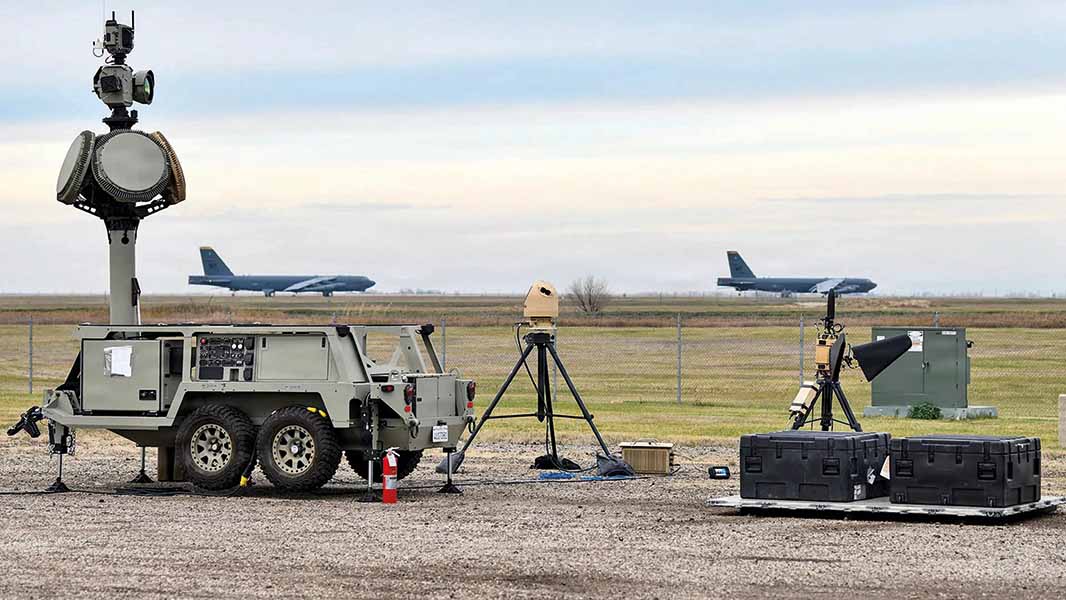
Practically, the value of $1.98 billion for counter-drone systems is not a marginal detail in the budget of a relatively small country like Kuwait. It is an acknowledgment that Gulf air defense has shifted from the question of intercepting missiles to the question of managing low airspace. In modern attrition warfare, the attacker does not always need a precise missile costing millions of dollars. A swarm of cheap drones or loitering munitions launched from varying distances is enough to force the defender to activate their radars, exhaust their crews, and reveal their defense pattern.
Notably, the package combines kinetic kill and electronic kill. Anvil-Kinetic means a physical interception of the target, while Pulsar goes into jamming and electromagnetic control. This mix is important because the Gulf has learned, sometimes the hard way, that an expensive intercept missile is not an appropriate answer to every cheap target. A military officer who has served in the region knows that protecting an oil facility or airbase is not achieved with a single system at the gate; it is achieved through a series of alerts, discrimination, decision-making, engagement, and then repositioning.
Kuwait is Not Just Buying Equipment but Buying Decision Time
Kuwait is situated in a narrow space between Iraq, Iran, and the northern coast of the Gulf. In this geography, the warning time is short, and distinguishing between a transiting target and an actual threat is not a theoretical exercise. Therefore, the presence of long-range, mobile, and maritime sensor towers becomes part of the equation for the survival of facilities, not just a technical upgrade. The value of any counter-drone system is not measured by the number of platforms alone, but by the number of seconds it gives the responsible officer before the light on the screen turns into an explosion on the ground.
From this perspective, I read the deal as part of a broader Kuwaiti transformation. On June 15, Washington also approved support for the sustainability of Kuwaiti KC-130J aircraft worth $235.9 million, which includes spare parts, repairs, training, and technical support for five years. The combination of the C-UAS deal and the air sustainability deal says something important: Kuwait is not just looking to purchase a new platform, but to keep the existing infrastructure operational under pressure. This is a point that many overlook in discussions about Arab armament, where the initial image of the new system distracts from the question of maintenance and readiness.
American Contractor Anduril Enters the Gulf Through the Door of Cheap Warfare
The choice of Anduril as the prime contractor is significant, no less than the type of systems. The company represents a new American generation that sells software, tactical artificial intelligence, and sensor networks as much as it sells hardware. Lattice is not just a command and control screen; it is an attempt to integrate sensors and fires into a faster decision loop. In the Gulf environment, where American bases, national facilities, ports, and energy are intertwined, linking images and sensors becomes more important than the number of vehicles in the military parade.
But here lies the paradox that procurement officials do not like to hear. The smarter the network becomes, the greater the need for continuous training, strict cybersecurity, and command and control that does not falter at the first bureaucratic dispute between military police, air forces, and the national guard. The U.S. State Department notification states that Kuwait will not have difficulty integrating the equipment within its military police forces. This may be true from an American supply perspective, but real integration is not just signing a receipt. Integration means that the system works at night, under jamming, with false targets, and with a clear engagement decision that does not wait for a delayed political call.
From Patriot to Roadrunner, Layers of Gulf Defense are Changing
In January, Washington approved a $9 billion deal for Saudi Arabia to purchase 730 PAC-3 MSE missiles. In March, defense reports discussed American packages exceeding $16.5 billion to support air defense in the UAE, Kuwait, and Jordan, from long-range radars to counter-drone systems and munitions. These figures draw a clear map: the Gulf is building overlapping defense layers because the threat from Iran and its allies no longer passes through a single channel.
However, possessing layers does not automatically mean having integrated defense. Gulf countries have a long history of purchasing systems as separate islands: Patriot here, THAAD there, radar from one company, command system from another, and rules of engagement written in a language not understood by everyone who will press the button at three in the morning. True capability is demonstrated when the radar sees the target, the system discriminates it, the commander knows who has the right to engage, and then seconds are not wasted between an American operations room, a national operations room, and a police operations room.
The Triad of Capability That the Invoice Does Not Buy
I return here to the triangle of capability that I often repeat: equipment, training, and institution. In this deal, Kuwait is purchasing relatively advanced equipment, along with training and technical support. But the institution is the hardest part. Will the C-UAS systems be part of a unified national network or will they remain confined to certain facilities? Will they share their data with air defense, naval forces, and border protection? Will real joint exercises be conducted with the American forces present in the country, or will the exercises remain carefully arranged so that gaps do not appear?
The military value of the deal will be limited if Kuwait treats it as a local umbrella to protect selected points. However, if it is used to build a culture of alertness and response against drones, it may be more important than larger deals. The small drone does not defeat the state because it is powerful; it defeats it because the state is slow to see what is small and slow to determine who responds to it.
Conclusion
Kuwait's deal with Anduril is not a side note in the arms market. It is a sign that the war in the Gulf is moving toward a gray area between traditional air defense, internal security, and electronic warfare. This shift suits Kuwait because it does not need to showcase power as much as it needs to protect energy corridors, bases, and ports in a narrow geographical space.
However, the structural tension remains: Gulf states want greater defensive independence, but they are buying this independence through American networks, American contractors, and American software. It is as if they are saying they want to hold the sky in their hands, but they still need another hand to operate the switches. In defense, as in the desert, whoever buys the well does not guarantee water if they do not know how to manage it.
Kuwait is purchasing Counter UAS platforms worth $1.98 billion from the U.S. to bolster its defense against drone threats. This acquisition, which includes systems from Anduril, signifies a strategic shift in Kuwait's military capabilities, focusing on low-altitude airspace management. Additionally, Kuwait is seeking support for its KC-130J aircraft, indicating a broader effort to maintain operational readiness in a challenging regional landscape.
- Kuwait is purchasing Counter UAS platforms for $1.98 billion.
- The deal includes various advanced systems from Anduril.
- This procurement reflects a shift in defense strategy towards low-altitude airspace management.
- Kuwait is also seeking support for its KC-130J aircraft.
- The purchase aims to enhance defense against drone threats in a complex regional environment.