
Latest Review of PLA Amphibious Exercises 2026: 360-Kilometer Civilian Ship Mobilization Changes Taiwan Strait Logistics
 Li Minghui
Latest Review of PLA Amphibious Exercises 2026: 360-Kilometer Civilian Ship Mobilization Changes Taiwan Strait Logistics
On June 15, CIMSEC published an analysis by Wang Jason, Marvin Bernardo, Wu Peizhen, and Andrew Erickson, which re-examines a large-scale amphibious comprehensive exercise conducted by the PLA in August 2025 along the southeastern coast. This topic may not seem like breaking news, but it has an easily overlooked value: public satellite images and AIS trajectories reveal the "logistical framework" of the PLA's amphibious training.
In the past, discussions about amphibious operations in the Taiwan Strait often focused on one question: Are the 071, 075, and 076 gray ships sufficient? The author believes this question is incomplete. What is truly interesting is that the PLA is integrating roll-on/roll-off ships, landing craft, floating bridges, port unloading, and near-shore obstacle disposal into a process. In simple terms, landing is no longer just the action of "ships reaching the beach," but a complete industrialized transportation issue from civilian ports and commercial ship scheduling to beachhead resupply.
Civilian Ships Are Not a Patch, But Part of the Solution
According to CIMSEC's review, this exercise included synchronized amphibious operations at multiple locations, civilian landing craft directly storming the beach, floating bridges, roll-on/roll-off ships offloading amphibious vehicles, and port unloading. The China Maritime Report #52 released by the U.S. Naval War College's China Maritime Studies Institute in April also mentioned that the exercise area spanned approximately 360 kilometers north to south, roughly equivalent to the distance from Taipei to Kaohsiung along Taiwan's western coast.
This 360 kilometers is crucial. Single-point landings test assault capabilities, while multi-point distributed landings test scheduling, communication, and sustained resupply capabilities. The role of roll-on/roll-off ships here is like a temporary industrial assembly line: they may not be more resilient than warships, but they are numerous, operate reasonably during peacetime, and can be dispersed across smaller ports, significantly increasing the identification costs before a crisis.
076 Is Eye-Catching, But Not the Only Answer
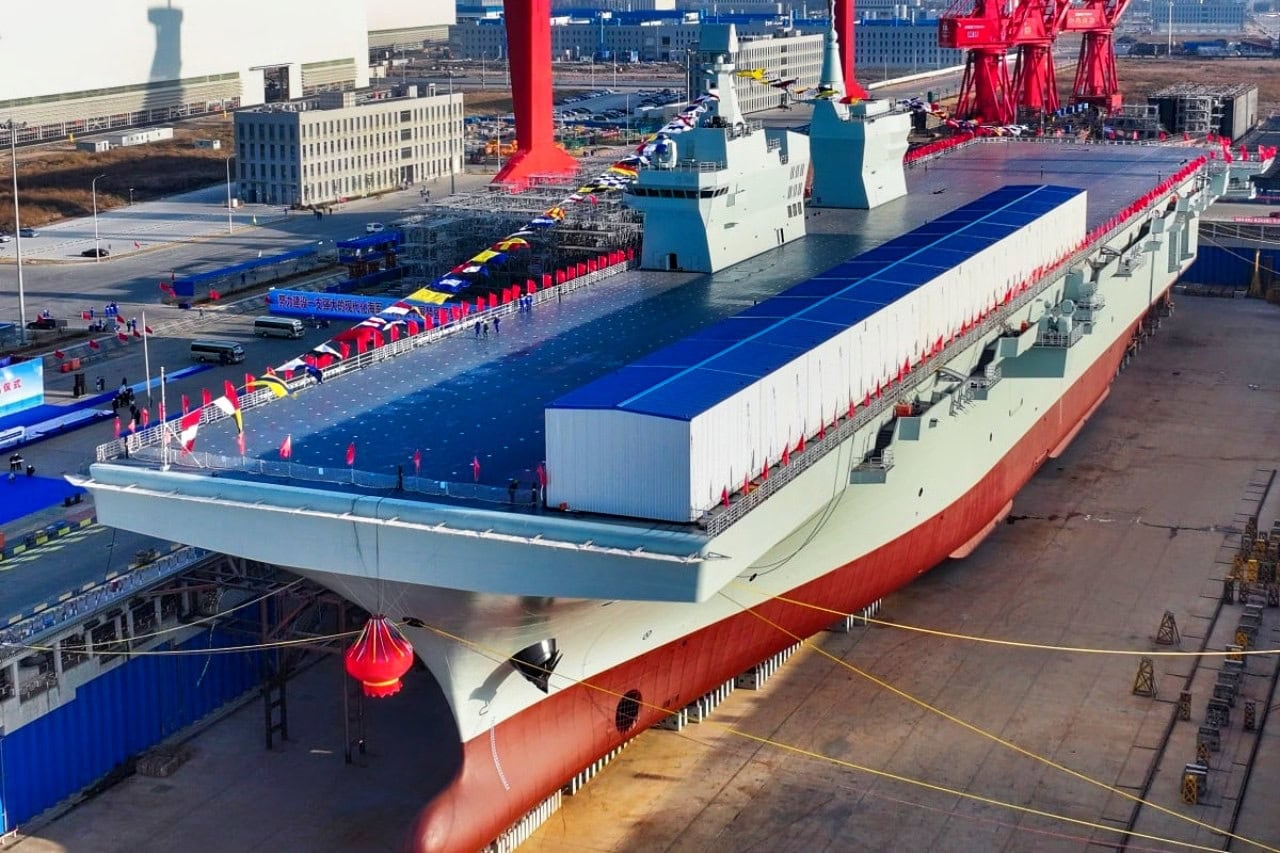
CSIS estimated the flight deck of the Type 076 amphibious assault ship to be about 260 meters by 52 meters, with an area exceeding 13,500 square meters, clearly larger than the Type 075 and also larger than the U.S. "America" class and Japan's "Izumo" class helicopter carriers. This indicates that China's shipbuilding industry is catching up in high-end amphibious aviation platforms. However, focusing solely on the 076 can lead to a misjudgment of the PLA's true thinking.
The 076 addresses issues of vertical delivery, drones, and maritime air support; civilian ships and floating bridges address the issues of tonnage, vehicles, fuel, ammunition, and engineering materials coming ashore. The former is like the tip of a spear, while the latter is like a magazine and ammunition belt. Without the latter, the former, no matter how impressive, quickly becomes an isolated display.
More Realistic Training Also Exposes Shortcomings
Another detail of this exercise is the near-shore aquaculture facilities and beach obstacles. The western coast of Taiwan has numerous aquaculture zones, mudflats, and port facilities, which naturally create challenges for amphibious vehicles, landing craft, and temporary bridges. The report suggests that PLA vehicles circumvented or crossed these obstacles at multiple locations, indicating that training is beginning to approach a realistic coastal environment rather than staged on ideal beaches.
However, I do not believe this has proven that the PLA possesses mature landing capabilities in the Taiwan Strait. Public information shows that the exercise was still conducted under relatively favorable sea conditions and controlled environments. The truly difficult parts have not been fully demonstrated: adverse weather, strong electromagnetic interference, port blockades, floating bridges being interrupted by long-range fire, and coordination issues between civilian ship crews and military command chains. The greatest fear in amphibious operations is not whether the first batch of vehicles can land, but whether they can continue to deliver fuel, ammunition, repair vehicles, and evacuate casualties the next day.
Focus of Taiwan Strait Observations Should Change
In observing the PLA going forward, we should not only count how many 075 and 076 ships have been launched, but also look for three types of signals.
- First, whether roll-on/roll-off ships, landing craft, and deck cargo ships are being used in combination at more locations and under more complex sea conditions.
- Second, whether floating bridges, civilian ports, and field unloading points have formed a fixed process.
- Third, whether the exercise range continues to be close to the distance, rhythm, and geographical structure of Taiwan's western coast.
This is not to say that war is imminent. On the contrary, those with a technical focus should avoid interpreting every exercise as a countdown. A more accurate assessment is that the PLA is gradually rewriting the question of "Can we land?" to "Can we disperse, conceal, and continuously sustain a force on the shore?" What remains unanswered is how resilient this seemingly low-visibility logistics system can remain if an adversary preemptively incorporates civilian ports, roll-on/roll-off fleets, and temporary logistics nodes into their strike chain.
The People's Liberation Army (PLA) conducted a large-scale amphibious training exercise on June 15, 2026, along the Taiwan Strait, utilizing civilian vessels for logistics and troop deployment. The exercise spanned approximately 360 kilometers, demonstrating the PLA's focus on enhancing its amphibious operational capabilities. Key elements included overcoming coastal obstacles and employing floating bridges for troop movement.
- The PLA conducted a large-scale amphibious training exercise on June 15, 2026.
- The exercise spanned approximately 360 kilometers along the Taiwan Strait.
- Civilian vessels were utilized for troop deployment and logistics.
- The training involved overcoming coastal obstacles and utilizing floating bridges.
- The exercise aimed to enhance the PLA's amphibious operational capabilities.