
Chinese Coast Guard's 5 Vessels Assert Jurisdiction East of Taiwan, Adding New Pressure to Japan's Anti-Submarine Network
 Tanaka Takashi
Five Chinese Coast Guard Vessels Assert Jurisdiction in Eastern Taiwan, Adding New Pressure to Japan's Anti-Submarine Network
The details of the radio communications released by the Taiwan Coast Guard on June 9 are difficult to dismiss as mere maritime police activities. It is reported that five Chinese Coast Guard vessels and government ships involved in maritime and surveying activities questioned commercial vessels about their departure points, destinations, and crew information in the eastern waters of Taiwan. The Taiwanese side views this as a performance of "jurisdiction" under the pretext of discussions between Japan and the Philippines, and has deployed patrol vessels in advance to monitor the situation.
What draws the author's attention is that seabed surveying activities are reported to be occurring simultaneously. Actions by the Coast Guard on the surface are more visible. However, continuously understanding the seabed topography, water temperature, salinity, and ocean currents in the eastern waters of Taiwan is related to submarine navigation, ambush, and anti-submarine detection. From the perspective of the Japan Maritime Self-Defense Force, this is both an act of "raising a flag" and a means of measuring the acoustic environment.
Significance of the Eastern Waters in Anti-Submarine Operations
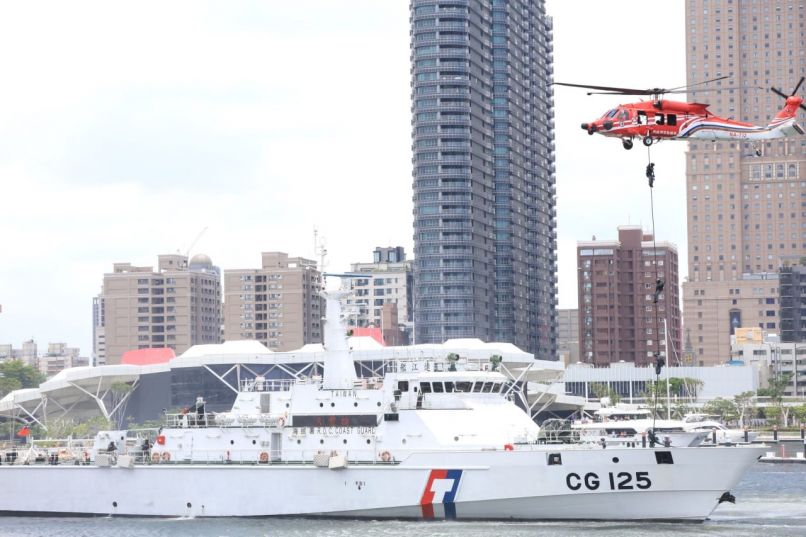
The strait to the west of Taiwan is shallow and tends to attract political and military attention. However, the eastern waters of Taiwan have a different value, as the continental shelf suddenly deepens, considering the possibility of U.S. and allied submarines approaching or retreating. If China accumulates data in this area using research and maritime vessels, it represents a quieter form of A2/AD (Anti-Access/Area Denial) that differs from aircraft carriers and missiles.
Reports from Reuters indicate that Chinese research vessels have repeatedly conducted seabed surveys around Taiwan, Guam, and the Indian Ocean from 2024 to 2025. The AEI's update on the China-Taiwan situation on June 12 also organized that activities of ocean survey vessels in the eastern waters of Taiwan could lead to an understanding of seabed topography, sensor installations, and support for submarine operations. The actions of the five vessels this time can be seen as a manifestation of this long-term trend taking on the form of Coast Guard and maritime law enforcement.
Japan's Concerns Extend Beyond Taiwan's Crisis
When considering the defense of the Nansei Islands, discussions in Japan often center around the Type 12 surface-to-ship guided missile, troop deployments to the islands, and dispersed operations with the U.S. Marine Corps. Of course, firepower is necessary. However, if seabed data in the eastern waters of Taiwan is accumulated by China, the issue goes beyond just missile range. There is a possibility that the "map" of the underwater environment could be established in advance by the opposing side outside the surveillance lines connecting the Miyako Strait, Yonaguni Island, Ishigaki Island, and Okinawa Island.
The Japan Maritime Self-Defense Force conducts anti-submarine patrols by combining P-1 patrol aircraft, P-3C aircraft, helicopters aboard escort ships, and submarine units. However, maintaining a constant density in the vast Western Pacific is not easy. If China uses survey vessels, Coast Guard ships, and research institutions separately, blurring the lines between peacetime ocean surveys and military preparations, Japan will need to refine its response criteria for "activities that are not illegal but dangerous."
Blind Spots in Alliance Operations
For the U.S. military, the eastern waters of Taiwan are part of the operational space connecting Guam, the Philippines, and Japan. In late June, joint exercises such as Resolute Dragon 26 and Valiant Shield 2026 are scheduled, focusing on dispersed operations from the Nansei Islands to Kyushu and Guam. If China's collection of ocean data overlaps with this, it will become a competition between the mobility demonstrated in exercises and the ocean information accumulated by the opposing side during peacetime.
What Japan should prioritize is not just a simple increase in the number of vessels. It is the establishment of a system to integrate vessel identification, ocean observation, acoustic data, and AIS abnormal behavior information held separately by the Japan Coast Guard, the Maritime Self-Defense Force, the U.S. military, and Taiwanese authorities, within a politically manageable framework. While there are constraints on formal military cooperation with Taiwan, there remains room for collaboration under the pretext of commercial vessel safety, seabed cable protection, and transparency in ocean surveys.
Conclusion
The actions of the five Chinese Coast Guard vessels are not a flashy military exercise. Therefore, they should not be underestimated. If they are asserting jurisdiction in the eastern waters of Taiwan while simultaneously surveying the seabed, it could be a preparation for future blockades or submarine warfare.
The real risk is not that China suddenly takes control of this maritime area. It is that, while Japan and the U.S. judge that "it is still peacetime," the operational environment underwater gradually becomes more favorable to China.
Major Information Sources
Five Chinese Coast Guard vessels operated in Taiwan's eastern waters on June 9, 2026, asserting jurisdiction and conducting underwater surveys. The vessels questioned commercial ships about their details, which Taiwan interpreted as a strategic maneuver related to regional discussions. These actions may enhance China's maritime intelligence and support future military operations in the area.
- Five Chinese Coast Guard vessels operated in Taiwan's eastern waters.
- The vessels questioned commercial ships about their origin, destination, and crew information.
- Simultaneous underwater survey activities were reported in the area.
- Taiwan viewed these actions as a display of jurisdiction related to discussions between Japan and the Philippines.
- The activities may support future submarine operations and A2/AD strategies.