
Latvia gets its first HUNTER infantry fighting vehicle
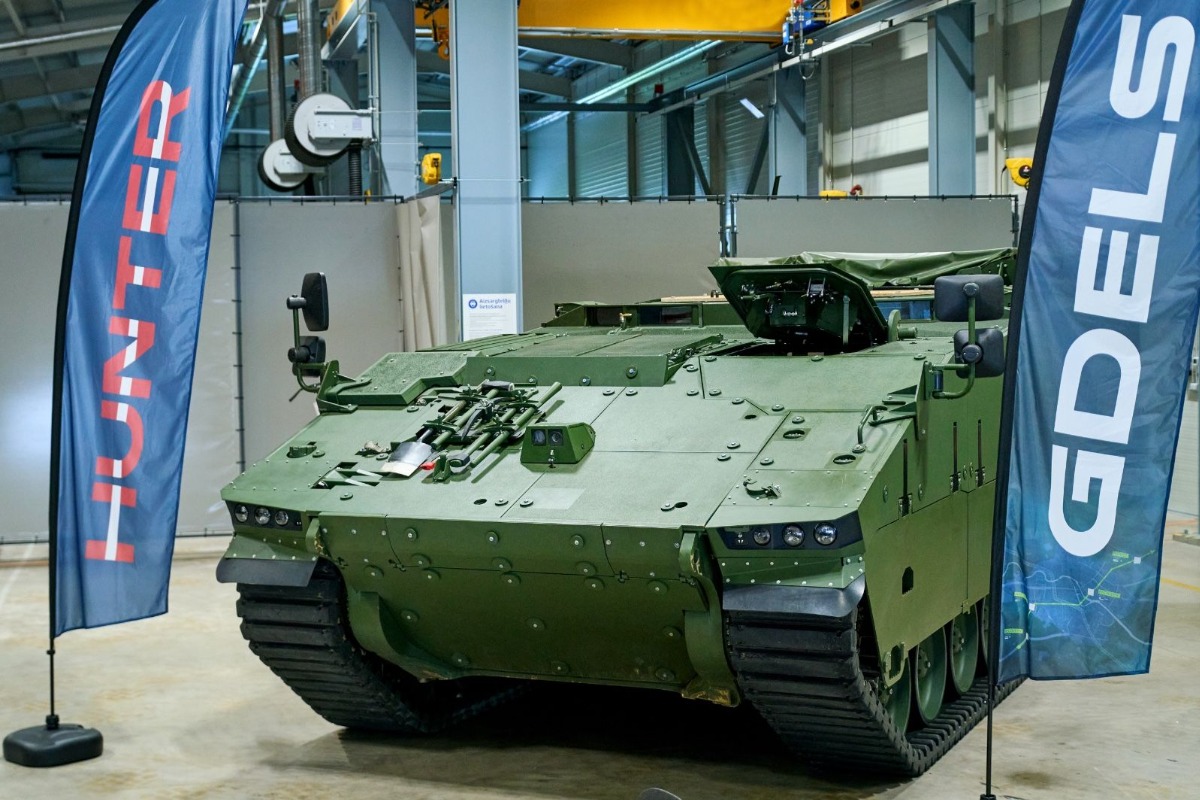
Latvia has received its first HUNTER infantry fighting vehicle, just twelve months after signing the contract, marking a delivery pace that stands in sharp contrast to the multi-year waits that have characterized many European armored vehicle programs as NATO’s eastern flank nations race to rebuild their ground combat capability.
General Dynamics European Land Systems, the European subsidiary of the American defense giant General Dynamics, announced the delivery of the first HUNTER vehicle to Latvia, confirming the arrival comes alongside a technology and know-how transfer to a Latvian industrial partner that will enable in-country assembly of subsequent vehicles. The announcement was made by GDELS Vice President Alejandro Page, who also serves as Managing Director of GDELS Santa Bárbara Sistemas, the Spanish manufacturing arm of the program.
The HUNTER is a tracked infantry fighting vehicle based on the ASCOD platform, a combat-proven design developed jointly by Austria and Spain that has been in service with the Austrian Army as the Ulan and the British Army as the Warrior successor candidate, as well as with the Spanish Army as the Pizarro. Latvia selected the ASCOD after an international competition, choosing a tracked IFV rather than an 8×8 wheeled platform. In-country assembly and maintenance in Latvia will be handled through Defence Partnership Latvia, a Patria-majority joint venture, giving the Latvian defense industrial base a direct role in the program rather than simply receiving finished vehicles from abroad. Latvia ordered 84 HUNTER infantry fighting vehicles in two batches of 42, the first contracted in January 2025 and the second in June 2025.
The Baltic state of 1.8 million people shares a land border with Russia to the east and Belarus to the south, and has been among the most vocal advocates within NATO for accelerating alliance reinforcement and host-nation force development since Russia’s full-scale invasion of Ukraine in February 2022. Latvia hosts a NATO Enhanced Forward Presence battlegroup led by Canada, and the Latvian National Armed Forces have been expanding and modernizing at a pace that would have seemed politically impossible before 2022. The HUNTER program fits directly into that expansion: a modern tracked IFV gives Latvian infantry units the protected mobility and firepower to operate alongside NATO reinforcing forces in the combined arms environments for which the alliance is now explicitly training.
The twelve-month timeline from contract signature to first vehicle delivery is the headline of this announcement. European armored vehicle programs have historically taken years from contract to first delivery, with programs like the German Puma infantry fighting vehicle experiencing qualification delays that stretched production timelines by years beyond original schedules. The HUNTER delivery timeline suggests GDELS prioritized manufacturing readiness and supply chain preparation before contract signature, and it reflects the broader European defense industry shift toward compressing delivery timelines as customer urgency has increased sharply since 2022.
The in-country assembly element adds a dimension that goes beyond the immediate delivery. Latvia receiving technology and know-how transfer through Defence Partnership Latvia means subsequent vehicles will be assembled in Latvia rather than shipped complete from Spain. That arrangement serves multiple purposes simultaneously: it develops Latvian domestic defense industrial capacity that the country currently lacks in armored vehicles, it creates skilled employment and a local maintenance and sustainment capability that reduces long-term dependence on the prime contractor, and it generates political support within Latvia for the program by distributing economic benefit domestically. For a small NATO nation building its industrial base from a low starting point, an in-country assembly arrangement on an 84-vehicle program is a meaningful step toward the kind of defense industrial resilience that NATO has been encouraging member states to develop.
Latvia’s Minister of Defence, speaking at the delivery ceremony, framed the program explicitly in those terms. The HUNTER program “strengthens both national defense and local industry, going hand in hand to build resilience,” the minister said. That formulation, linking military capability to industrial capacity in a single sentence, reflects a strategic understanding that has become standard in Baltic defense planning: being able to field modern equipment matters, but so does being able to maintain, repair, and eventually replace it without depending entirely on supply chains that run through other countries.
“The effectiveness of industrial cooperation with allies in today’s security environment,” is how Alejandro Page, GDELS VP and Managing Director of Santa Bárbara Sistemas, characterized the significance of the delivery, linking the Latvian program to a broader model of allied industrial partnership that GDELS has been developing across multiple European markets.
Content preview only. Full article available at source. View Full Article
Latvia received its first HUNTER infantry fighting vehicle, marking a significant step in enhancing its military capabilities. The delivery occurred twelve months after the contract was signed, with a total order of 84 vehicles planned in two batches. The HUNTER, based on the ASCOD platform, will be assembled in Latvia, contributing to the local defense industrial base and reducing dependence on foreign supply chains.
- Latvia received its first HUNTER infantry fighting vehicle.
- The delivery occurred twelve months after signing the contract.
- Latvia ordered a total of 84 HUNTER vehicles in two batches.
- The HUNTER is based on the ASCOD platform, developed by Austria and Spain.
- In-country assembly will be handled by Defence Partnership Latvia.