
Latvia's HUNTER-ASCOD receives drone defense and shows Europe's missing NATO logic in 2026
 Dr. Klaus Weber
Latvia's HUNTER-ASCOD Receives Drone Defense and Highlights Europe's Missing NATO Logic in 2026
84 infantry fighting vehicles are a serious number for a small frontline state army. However, the fact that Latvia is only now testing in the field, just weeks before the first delivery of its new HUNTER vehicles, which drone defense actually belongs on this platform, is the truly revealing news. The demonstration in Ādaži on August 27 does not show that Europe has solved the drone problem. Rather, it shows how the solution is actually being developed today: improvised at the brigade level, with a Spanish platform, retrofitted sensors, and the quiet realization that an armored vehicle in 2026 can hardly be considered a fully-fledged combat platform without organic defense against FPV and loitering drones.
This is where the larger European finding lies. NATO has learned to test drones. The Baltic states have learned to take the threat politically seriously. But there is still an institutional gap between testing, procurement, and standardization. Therefore, Latvia is not just a national pioneer case. It is an involuntary reality check for European land warfare planning.
The Demonstration in Ādaži Comes Late Enough to Be Serious
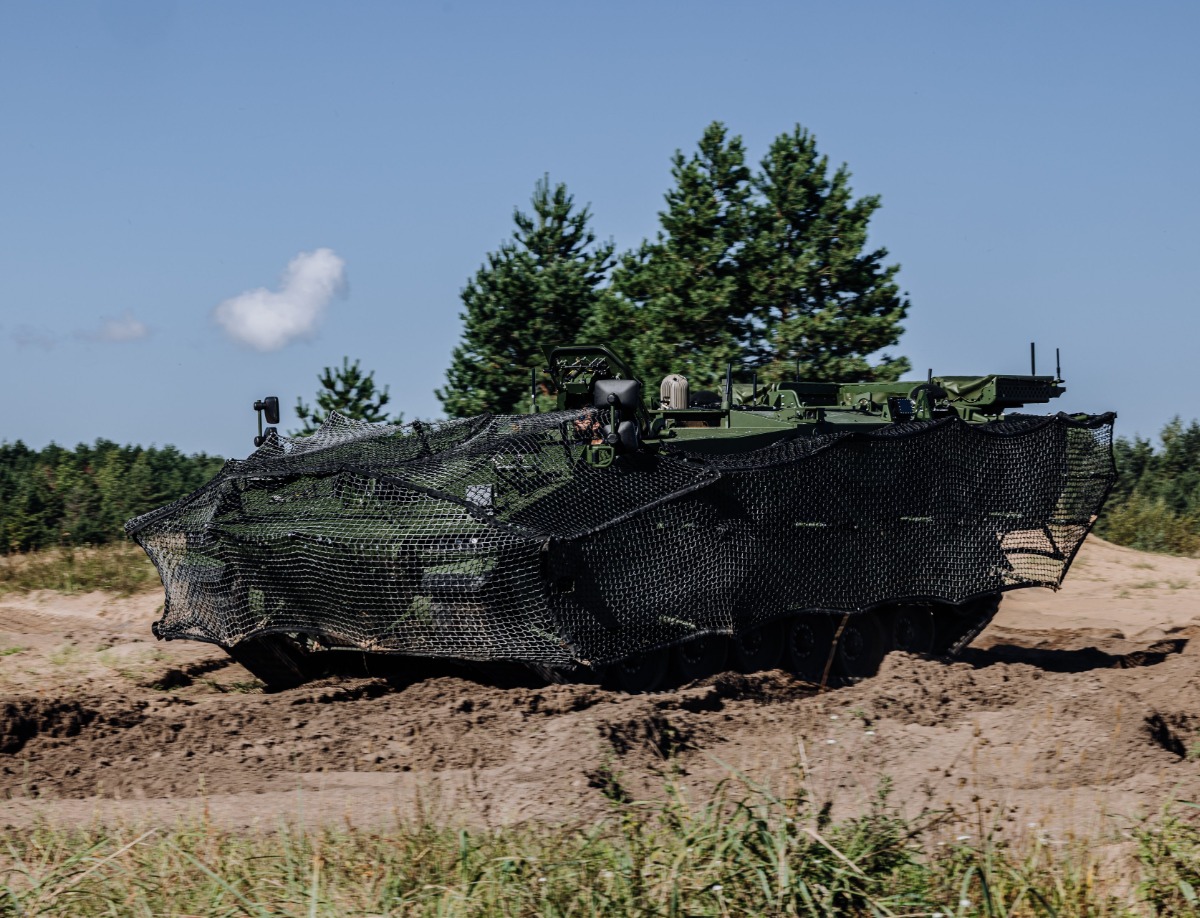
According to Defence Blog, Latvia's Ministry of Defense tested active and passive counter-drone systems on the HUNTER infantry fighting vehicle in Ādaži. Systems from the Spanish manufacturer GDELS-Santa Bárbara Sistemas were involved, and ground-based Latvian drones were also included in the test scenario. The crucial point is not only that testing took place, but when. The first HUNTER vehicles are to be delivered to the National Armed Forces as early as October. If an army is still examining what protective architecture the vehicle needs against cheap small drones at this stage, it is not merely a sign of delay. It indicates that combat experience from Ukraine is changing Western armies faster than their procurement logic.
In the past, the first questions about an infantry fighting vehicle were about the cannon, protection class, and engine. Today, the first operational question is: What happens when a swarm of cheap FPV drones attacks from above? This is where military thinking is shifting. Drone defense is no longer just a capability of the brigade or the army air defense unit. It is becoming a characteristic of the individual platform. Those who do not accept this are ordering vehicles for the last decade.
The HUNTER is a European Industrial Product, but Not Yet a European System
At first glance, the Latvian procurement appears to be a model case of European defense cooperation. The vehicle is based on the ASCOD, a platform used in several NATO countries; the manufacturer is the Spanish GDELS-Santa Bárbara Sistemas; according to the Latvian Ministry of Defense, a total of 84 vehicles are to be introduced between 2025 and 2029. The HUNTER has protection according to NATO standard Level 4, is equipped with a cannon, anti-tank armament, and a machine gun, is operated by three soldiers, and can transport six more. Long-term maintenance has also been contractually secured for 13 years, explicitly involving local industry.
All of this sounds reasonable. But it does not yet prove strategic coherence. Europe can indeed develop, build, localize, and maintain armored vehicles together today. What Europe still cannot do is to show the same consistency in the integration of counter-drone systems, electronic warfare, energy supply, software interfaces, and ammunition logistics. In other words: The platform is European, the vulnerability is too, but the response remains nationally improvised. This is precisely why Latvia must now test on the real vehicle in Ādaži what should have long been part of a common introduction architecture.
One should not be blinded by the symbolism of cooperation. A European vehicle is not yet a European capability system. The real question is not whether the HUNTER comes from Spain or Latvia. It is whether a HUNTER in Latvia, a CV90 in Scandinavia, and a Boxer in Germany can fight against the same drone threat according to compatible rules in the future. Currently, there is little to suggest that this will be the case.
NATO Tests Faster Than Europe Procures
There is no lack of institutional activity. From March 9 to 13, the first NATO TEVV campaign for UAS and C-UAS technologies was launched in Latvia at the Sēlija military site. According to the alliance, industry companies from NATO countries and Ukraine, military users, and government representatives came together there to test intercept drones, electronic warfare, and other procedures under realistic conditions. The site is part of the Rapid Adoption Action Plan logic and is explicitly designed to bring innovation into operational use more quickly.
But is that enough? No. Testing is not standardizing, and standardizing is still not procuring. This three-step process is Europe's problem. NATO can create innovation spaces. National ministries can hold demonstrations. The EU can finance industrial programs. But as long as there is no enforced common architecture for vehicle protection against drones, there will be no mass, but rather a patchwork of sensors, jamming, effectors, and special solutions. In a serious situation, this is expensive, logistically difficult, and operationally risky.
The Latvian demonstration is therefore both encouraging and sobering. Encouraging because a frontline state is obviously not treating the lessons of Ukraine theoretically, but is practically applying them before the commissioning of a new vehicle. Sobering because this adaptation does not follow from an established European doctrine, but from the necessity of the moment. Europe is now reacting faster than in 2022. However, it is still not reacting systemically.
The Real Lesson Lies Not in Latvia, but in Europe's Order Errors
What became visible in Ādaži is fundamentally an order problem. Europe procures platforms, establishes test fields, increases budgets, and talks about resilience. Only afterward does it ask how the platforms are supposed to survive in a drone war. This has long been a mistake in air defense; it is now becoming untenable for mechanized land forces. An infantry fighting vehicle without an integrated counter-drone solution is not outdated today, but incomplete.
Latvia recognizes this earlier than many larger states, precisely because it does not engage in a theoretical security debate on the eastern flank. Yet the uncomfortable point is: The more correct Latvia's test is, the more visible Europe's institutional failure becomes. Those who deliver new vehicles and then test their protection against the most dominant threat of the war have not invested too little money. They have thought in the wrong order. And that is still the real problem of European defense in 2026.
Latvia tested drone defense systems on the HUNTER-ASCOD platform in Ādaži on August 27, 2023. The testing involved 84 armored vehicles, with the first deliveries expected in October 2023. This initiative highlights the need for integrated drone defense capabilities in modern military operations, reflecting lessons learned from the Ukraine conflict. The HUNTER-ASCOD is equipped with NATO-standard protection and various weapon systems.
- Latvia is testing drone defense systems on the HUNTER-ASCOD platform.
- 84 HUNTER vehicles are to be delivered to the Latvian National Armed Forces between 2025 and 2029.
- The testing occurred in Ādaži on August 27, 2023.
- The HUNTER-ASCOD is equipped with NATO-standard protection and various weapon systems.
- The integration of drone defense is seen as essential for modern armored vehicles.