
Lebanon's Cell After Swiss Talks: 60 Days Testing Israel and Iran's Deterrence
 Ahmed Al-Rashid
Lebanon Cell After Switzerland Talks: 60 Days to Test Israel and Iran's Deterrence
On June 22, 2026, talks at Lake Lucerne in Switzerland between the United States and Iran, mediated by Qatar and Pakistan, resulted in what resembles a 60-day roadmap, but it included a military clause more serious than the usual diplomatic language: the establishment of a cell to reduce engagement in Lebanon, linking the calm in southern Lebanon to the security of the Strait of Hormuz and to nuclear negotiations and sanctions.
Militarily, this is not a procedural detail. When the Lebanese-Israeli border becomes a file within a U.S.-Iranian understanding, it means that the front is no longer managed solely between the Israeli army and Hezbollah, nor even between Beirut and Tel Aviv, but has become part of a broader deterrence balance extending from Naqoura to Hormuz. Any military personnel who has served in the region knows that the most dangerous moment is not the moment of gunfire, but the moment each side believes the other needs calm more than they do.
What the New Cell Says
According to Al Jazeera, the mediators agreed on a high-level political committee, direct communication channels, and working groups on nuclear issues, sanctions, and a mechanism for monitoring and resolving disputes. However, the most sensitive clause is the Lebanon cell, which is said to aim at ensuring compliance with a halt to military operations. In cold military language, this means attempting to create a red phone between arenas that do not officially recognize each other: Washington, Tehran, Beirut, Tel Aviv, and Hezbollah in the background.
The problem is that the cell was born from negotiations in which Israel and Lebanon did not participate directly, yet they are expected to adhere to its outcomes. This creates a structural flaw from day one. The cell can prevent tactical miscalculations, but it cannot alone compel a force on the ground to withdraw, nor can it force an armed organization to surrender the only deterrent card it possesses.
602 Square Kilometers Cannot Be Hidden with Diplomatic Language
Al Jazeera pointed out that the security zone established by Israel in southern Lebanon is about 602 square kilometers, or approximately 6 percent of Lebanon's area. This figure is significant because it shifts the discussion from the realm of "limited strikes" to the realm of field control. When Israeli Prime Minister Benjamin Netanyahu states that Israel will remain in the security zone as long as it deems it necessary, he is not talking about a temporary reaction, but about a security doctrine based on forward depth rather than recognized borders.
More dangerously, Israeli Defense Minister Israel Katz stated that Israeli forces will not withdraw from Beaufort Heights in southern Lebanon. This is not just a historical hill or a symbolic site. Any controlled elevation in southern Lebanon provides surveillance capability, fire direction, and early warning, and shortens reaction time to ground and missile movements. Therefore, holding onto it sends a message to both Hezbollah and Iran: Israel does not just want a ceasefire; it wants to engineer a new ground for deterrence.
Israel's Calculations Between Freedom of Action and the Cost of Isolation
So far, Israel has preferred a simple model: a political understanding with Washington that grants it military freedom of action in Lebanon. The new cell threatens this model because it adds Iran, through mediators, to the equation of managing the Lebanese front. This is why some Israeli commentators have described the outcome as a strategic dilemma. The more Israel accepts a broader mechanism, the more its ability to strike targets in Lebanon without political cost diminishes. The more it rejects it, the more it appears to be obstructing a U.S. agreement aimed at calming both Hormuz and Lebanon.
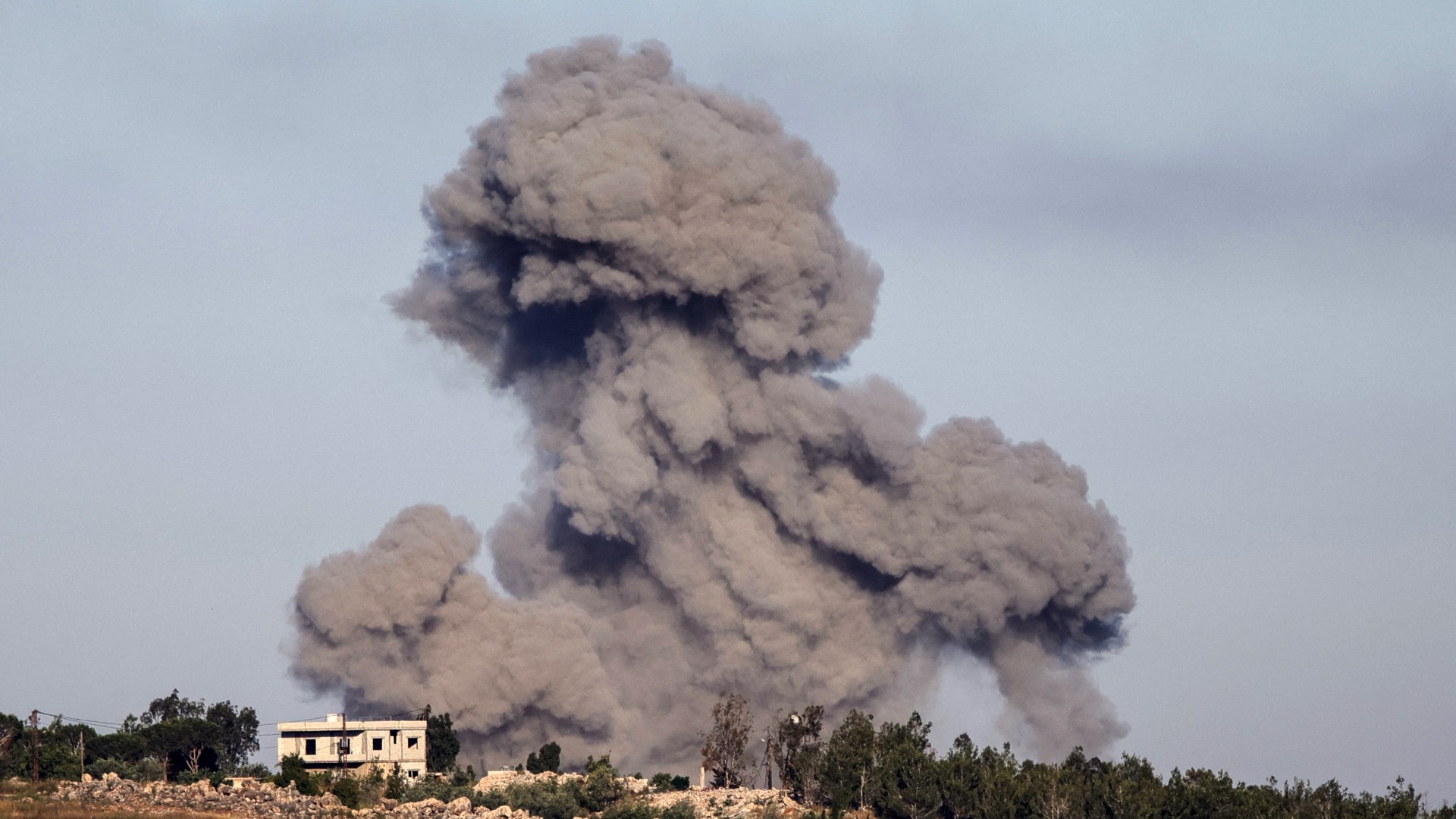
The National reported that Israeli strikes in southern Lebanon on Saturday killed 38 people and injured 12 others, according to the Lebanese Civil Defense. These numbers put pressure on Washington as much as they do on Beirut. U.S. support for Israel remains strong, but it is no longer a blank check when the behavior of the Lebanese front becomes a factor in energy prices, securing navigation, and the success of a difficult U.S.-Iranian understanding internally.
Iran Uses Lebanon as Part of a Deterrence Network, Not as a Separate Arena
Iran does not separate southern Lebanon from the Strait of Hormuz. This is the lesson that many capitals in the region overlook. The agreement also mentioned a special communication line for Hormuz to avoid incidents and misunderstandings and to secure the passage of commercial ships. Al Jazeera reported, citing an analysis by Windward, that only 12 ships crossed the strait on Sunday compared to 35 the previous day. When traffic decreases in this way, every small front becomes part of a larger global calculation.
Practically, Iran does not need to completely close Hormuz to affect the market. It is enough to raise insurance costs, delay crossings, and push companies to calculate the worst-case scenario. Here, Lebanon becomes useful to Tehran not because it wins the war alone, but because it links any pressure on Hezbollah to potential costs in the Gulf. This is not military genius as much as it is the use of the region's geography as it is: choke points, proxies, ports, and anxious energy markets.
Where Do Arab Armies Stand in This Equation?
The uncomfortable question for Arab capitals is this: If the Lebanon front and the Strait of Hormuz are managed through a U.S.-Iranian understanding, where does the ability of Arab states to influence stand? The Gulf has Patriot and THAAD systems, F-15 and F-16 aircraft, and Rafales, but possessing the system is one thing, and having the decision to escalate or de-escalate is another. This is what I always call the capability triangle gap: modern equipment, varying training, and decision-making institutions that do not always have complete operational independence.
Lebanon reminds us that defense is not just about purchasing platforms. Israel operates with an army that links intelligence to firepower to political maneuvering. Iran operates with a network of proxies, missiles, and straits. Meanwhile, many Arab countries reactively move, waiting for Washington, Paris, or London to translate the threat into operational language. In my view, this is the real flaw: the region pays the price of the battle, but it does not always design its own rules.
The Test in 60 Days
The sixty-day roadmap will be measured by three indicators, not by press releases. First: Will deep Israeli strikes in southern Lebanon stop, or will they continue under the banner of "security necessity"? Second: Will Hezbollah accept a calm that does not include a clear withdrawal from positions like Beaufort Heights? Third: Will traffic in Hormuz return to normal levels, or will it remain a suspended pressure tool over negotiations?
The new cell may prevent a wide war, and this is an achievement that should not be underestimated. However, it does not address the deeper contradiction: Israel wants freedom of action within the borders of others, Iran wants practical recognition of its regional role, and Lebanon wants sovereignty that it does not possess the tools for. As the old military saying goes, the map does not lie, but it does not fight on anyone's behalf. In the next eight weeks, the truth will emerge: Are we facing a new deterrence mechanism, or just a temporary truce between unresolved crises?
Israeli airstrikes in southern Lebanon on June 22, 2026, resulted in 38 deaths and 12 injuries. A new cell was created to manage military engagement in Lebanon, linking the region's security to broader U.S.-Iran negotiations. Israeli officials emphasized the importance of maintaining control over strategic areas, such as Beaufort Heights, to enhance deterrence against Hezbollah and Iran.
- Israeli airstrikes killed 38 people and injured 12 in southern Lebanon.
- A new cell was established to reduce military engagement in Lebanon.
- The security area established by Israel in southern Lebanon is approximately 602 square kilometers.
- Israeli Defense Minister stated that Israeli forces will not withdraw from Beaufort Heights.
- The report discusses the implications of U.S.-Iran negotiations on military operations in Lebanon.