
Leclerc's Test in Abu Dhabi 2026 Turns 120mm Shell into Urgent Defense Against FPV
 Ahmed Al-Rashid
Leclerc Test in Abu Dhabi 2026 Turns 120mm Shell into Urgent Defense Against FPV
On May 21, 2026, the French experiment in Abu Dhabi was not just a quirky story about a tank firing at a small aircraft. An Army Recognition report, based on a French confirmation on May 20, stated that a Leclerc tank from the 5th Armored Regiment in the UAE shot down a small aerial target using a 120mm OEFC F1 shell. From a military perspective, the most important figure is not just the caliber of the gun, but the idea of converting existing ammunition in the stockpile into close defense against FPV without installing a new turret or an independent interception system.
What Happened in Abu Dhabi Field
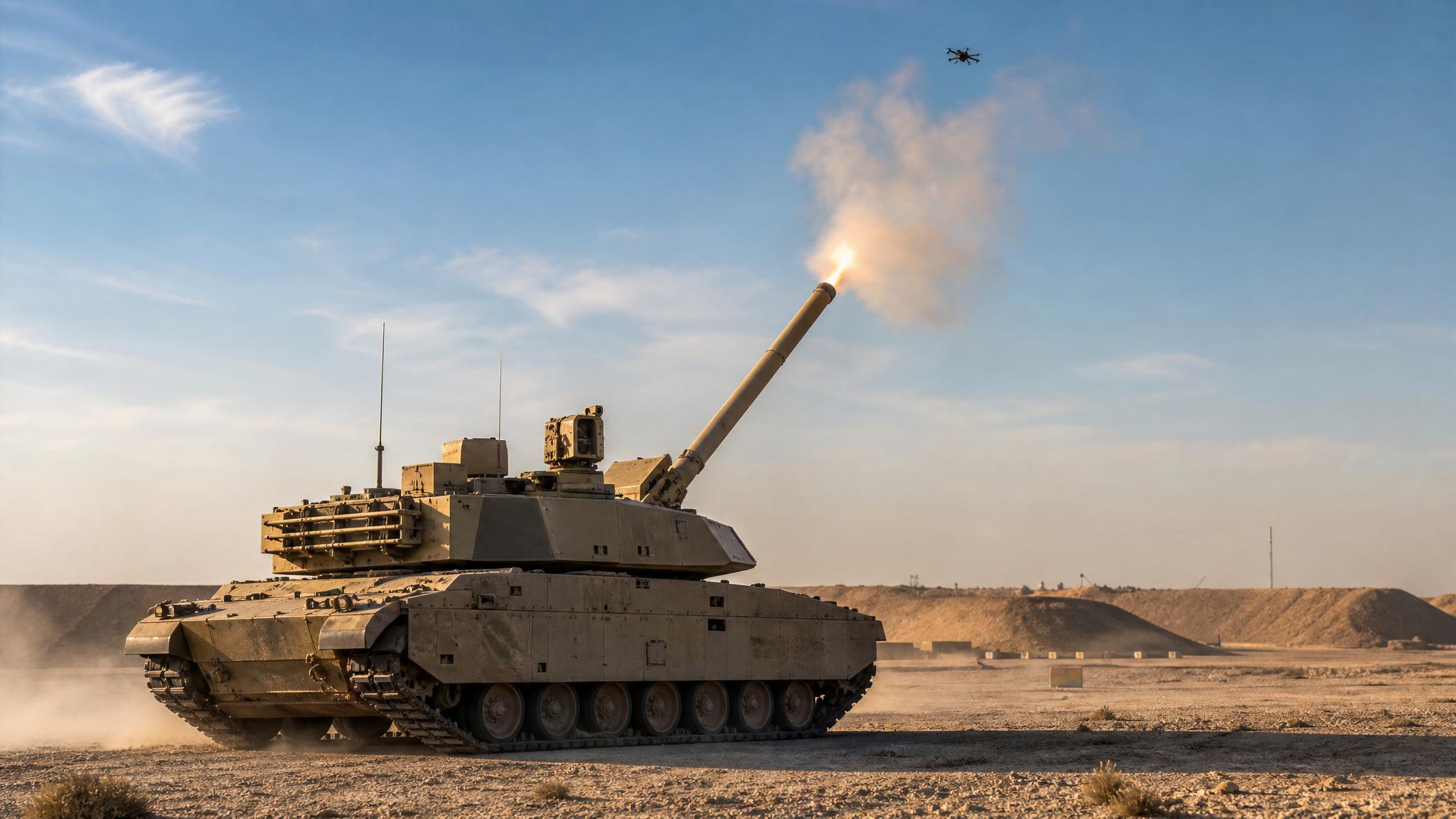
A conceptual image generated specifically for the article, not a field shot from the French experiment.
The French source indicated that the experiment was conducted in Abu Dhabi on a tank from the 5th Armored Regiment, which is a French unit stationed in Zayed Military City since 2016. This detail is important because the UAE is not just a transient training ground for France. There is a permanent French armored force, and there is a desert environment similar to the theaters of the Gulf, Yemen, and Iraq, and there are Arab armies that own or have directly dealt with Leclerc tanks.
The shell used is the OEFC F1, a French 120mm ammunition produced by the GIAT/Nexter family and then KNDS. Its original function is not to shoot down drones, but to engage closely against personnel or exposed targets in urban environments and convoys. However, it disperses, according to circulating data, about 1,100 tungsten balls at a speed of approximately 1,410 meters per second, meaning it operates like a giant shotgun firing a metal cloud in front of the target's path.
Why This Matters More to the Gulf than to France Alone
Any military personnel who has served in the region knows that tanks in the Gulf do not always fight as they do in Central European manuals. The spaces are open, the heat is harsh, supply lines are long, and the small aerial threat does not necessarily come from a country with a conventional air force. The experience of the Houthis in Yemen, the attacks by Iranian-backed militias on bases, airports, and energy facilities, and then the lessons from Ukraine have made the cheap small aircraft a daily threat to armored vehicles rather than an exceptional incident.
The UAE purchased 388 modified Leclerc tanks for desert operations, France has about 406 tanks in the program's history, and Jordan later acquired around 80 surplus Emirati tanks. This means that any practical solution within the Leclerc family is not purely French. If part of the existing 120mm ammunition can be converted into close defense capability, then Oman, Abu Dhabi, and Paris will view the experiment from a different perspective than the marketing pitches at exhibitions.
However, one should not exaggerate. This is not the birth of a new Gepard, nor does it mean that the main battle tank has become an air defense system. The Leclerc gun has limited elevation compared to air defense guns, the ammunition capacity on the tank is limited, and the reaction time against low-flying FPVs may be shorter than the cycle of detection, decision, and firing. The closest French expression is an opportunistic self-defense capability, not an organized air defense layer.
The Triple Capability Does Not Start from Metal
Here I return to the triangle I often talk about: equipment, training, and institution. Owning a Leclerc, M1 Abrams, or K2 does not alone answer the FPV question. The tank needs a crew that knows when to use an expensive shell against a cheap target, a squad leader who knows how to coordinate between jamming, machine guns, and visual surveillance, and a logistics institution capable of providing the right ammunition in the right place.
Practically, the OEFC F1 shell makes the probability of hitting higher than firing a 7.62 or 12.7mm machine gun at a fast small target, as it does not require a precise hit with a single shot. But it also raises the question of cost. If the FPV aircraft costs hundreds or thousands of dollars, and the specialized 120mm shell is much more expensive, not every encounter is suitable for this solution. Its logical use would be when the target approaches a high-value tank, or when jamming and machine guns fail, or when protecting a command and artillery point within a short range.
A Message to Gulf Armies
The political significance of the experiment in Abu Dhabi is no less than the technical significance. France is telling its allies in the Gulf that its relatively old tank can adapt to drone warfare without waiting for a new European system in five years. This is comforting talk for the Gulf customer, but it is not enough. Armies that bought the expensive armored vehicles and then left close defense to chance will pay the price twice, once at purchase and once at the first FPV video that spreads on phones.
In Yemen, we saw that the superior armored vehicle becomes weak when it moves without reconnaissance cover, without field engineering, and without a counter-drone network. In Ukraine, the turret roof and the rear of the engine became daily targets. The Gulf cannot treat these lessons as if they pertain to distant lands. The oil and gas lines, ports, and air bases in the region mean that armored vehicles will always operate under the watch of small drones, loitering munitions, or irregular reconnaissance teams.
The conclusion is not that the Leclerc has found a magic solution, but that the modern tank is forced to carry part of its air defense with it. Those who do not have close protection layers will find themselves asking a fifty-ton tank to wait for the mercy of an aircraft weighing hundreds of grams.
Limits of the French Lesson
There are clear limits. The experiment took place in a training field, not in the chaos of real combat with jamming, dust, fear, and incomplete information. The aerial target in the experiments can be chosen and its path determined, whereas FPVs in war come from an ugly angle, close to the ground, or from behind cover, and sometimes simultaneously with artillery bombardment or jamming of communications. Therefore, it would be a mistake for Gulf leadership to read the experiment as a substitute for dedicated C-UAS systems.
The correct reading is that the Leclerc in Abu Dhabi provided an example of a rapid adaptation mindset. The ammunition is available, the platform is available, and the threat is present. What is usually lacking in our armies is not the metal but the institutional decision to turn the experiment into regular training, then into rules of engagement, then into ammunition stockpiles, and then into explicit evaluations after each maneuver. As the old military saying goes, the bullet that does not find a doctrine does not find a target.
Thus, the experiment seems small in the picture but large in its meaning. The Gulf has spent billions on tanks, aircraft, and long-range air defense, but now faces a cheaper and more embarrassing question: Can these armies protect their valuable platforms from a cheap aircraft before it becomes a promotional shot for a weaker adversary? The Abu Dhabi test does not answer the entire question, but it places it on the table in a way that cannot be ignored.
The Leclerc tank of the 5th Armored Regiment successfully engaged a small aerial target in Abu Dhabi on May 21, 2026, using a 120mm OEFC F1 shell. This test demonstrates the tank's new capability to defend against UAV threats without requiring new systems. The adaptation of existing ammunition for air defense reflects a significant tactical shift in response to evolving threats in the Gulf region.
- Leclerc tank successfully engaged a small aerial target in Abu Dhabi using a 120mm shell.
- The OEFC F1 shell is originally designed for ground targets but was adapted for air defense.
- The test indicates a shift in military tactics to counter small UAV threats in the Gulf region.
- The UAE operates 388 modified Leclerc tanks, with France having 406 in total.
- The experiment highlights the need for armored units to adapt to modern aerial threats.