
Lee Jae-myung: Will Actively Promote the Recovery of Wartime Operational Control from the U.S. During His Term, "There Can Be No Room for Error"
South Korean President Lee Jae-myung has been making significant moves recently. Following his announcement on August 15 to investigate and recover improperly amassed assets of pro-Japanese anti-national actors and hold them accountable for their historical actions, the South Korean leader stated on August 18 that he would earnestly advance the transfer of wartime operational command from the U.S. during his term, emphasizing that “there must not be any mistakes.”
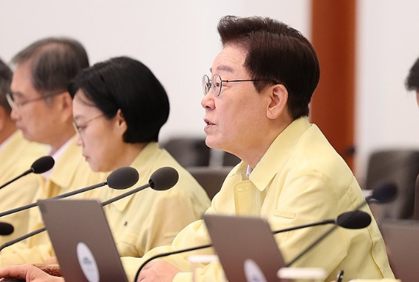
According to reports from Yonhap News Agency and South Korea's Chosun Ilbo, on August 18, one day after the start of the South Korea-U.S. joint military exercise "Ulchi Freedom Shield," Lee Jae-myung chaired a State Council meeting at the Blue House. He stressed the need to ensure the transfer of wartime operational command is completed on schedule during his term, in accordance with the government's original plan, stating that “there must not be any mistakes.” Lee Jae-myung claimed that South Korea has sufficient conditions to achieve self-defense, noting that South Korea's military strength ranks “fifth in the world,” its defense industry is “among the top four globally,” and its weapon systems and combat capabilities are at the forefront worldwide.
Media outlets such as Yonhap News Agency and Deutsche Welle reported that in the early 1950s, the South Korean military transferred command authority to the so-called "United Nations Command" led by the United States, and in 1978 it was handed over to the South Korea-U.S. Combined Forces Command, which is commanded by a U.S. military general. In 1994, South Korea regained peacetime military command authority but did not recover wartime operational command authority.
The attitudes of various parties regarding the transfer of wartime operational command reflect the divisions between South Korea's progressive and conservative factions, as well as the complex adjustments in South Korea-U.S. relations amid changes in the regional security landscape.
Richie, a professor of political science and international relations at Hankuk University of Foreign Studies, stated that progressive South Korean governments have historically actively promoted the transfer of wartime operational command. The governments during the presidencies of Kim Dae-jung and Roh Moo-hyun also publicly supported this plan, viewing it as a symbol of “national sovereignty” and “normalization.” However, for the conservative camp in South Korea, the South Korea-U.S. alliance and the national security assurance system based on it remain their core political agenda. They view “self-defense” and the “hasty” recovery of operational command as real threats to national security.
The U.S. position on transferring wartime operational command to South Korea has also been changing. After the Cold War, the U.S. military hoped to reduce overseas deployments; however, later, Washington sought to strengthen its military presence in the Asia-Pacific region and continue to hold wartime operational command over the South Korean military, which is clearly more advantageous.
Since the Trump administration took office last year, it has been pushing allies to take on more defense responsibilities. According to South Korea's Chosun Ilbo, U.S. Secretary of Defense Lloyd Austin stated on May 30 that South Korea's willingness to regain wartime operational command is “encouraging... We hope to continue to encourage this trend.” However, he also emphasized the “balance” with U.S. military operational plans. South Korea has set the earliest possible date for the transfer of wartime operational command as “no earlier than 2027,” while the U.S. military stationed in South Korea has set the earliest date for meeting transfer conditions as “no earlier than the first quarter of 2029.” The U.S. Forces Korea Commander, General Paul LaCamera, previously expressed that “political convenience should not override conditions” regarding the South Korean government's plans, suggesting that the transfer might be delayed until after the inauguration of the next U.S. president.
Global Times reporter Zheng Xuan
South Korean President Lee Jae-myung announced on August 18, 2023, his commitment to transferring wartime operational control from the U.S. to South Korea during his presidency. He emphasized the importance of completing this transfer without any errors, citing South Korea's military capabilities as sufficient for self-defense. The transfer is planned to occur 'as early as 2027', reflecting ongoing tensions and differing views on military command between progressive and conservative factions in South Korea.
- President Lee Jae-myung announced plans to recover wartime operational control from the U.S.
- The transfer is aimed to be completed during his term in office.
- South Korea's military capabilities are ranked fifth globally.
- The U.S. has historically held wartime command since the 1950s.
- The timeline for the transfer is set for 'as early as 2027'.