
Liaoning Aircraft Carrier Enters Philippine Sea on October 15, PLA's Western Pacific Carrier Training Affects Taiwan Strait Vigilance
 Li Minghui
Liaoning Aircraft Carrier Enters Philippine Sea on October 15, PLA's Western Pacific Carrier Training Raises Alert in Taiwan Strait
The most noteworthy detail on October 15 is not a specific number of military aircraft on a single day, but rather the route of the Liaoning carrier group and the simultaneous high-sensitivity alert around the Taiwan Strait. Information from Japan's Joint Staff Office, compiled by USNI, shows that on the 14th, the Liaoning carrier group passed through the first island chain between Okinawa and Miyako Island, entering the Philippine Sea; the next day, it was spotted heading towards the Luzon Strait. Taiwan's defense department stated on the same day that it is closely monitoring the PLA's annual large-scale exercises, which may be entering a "peak period." These two lines may not necessarily represent a unified, publicly announced exercise against Taiwan, but they do constitute a mutual pressure test in terms of operational geography.
Verifiable Track of the Liaoning Carrier Group
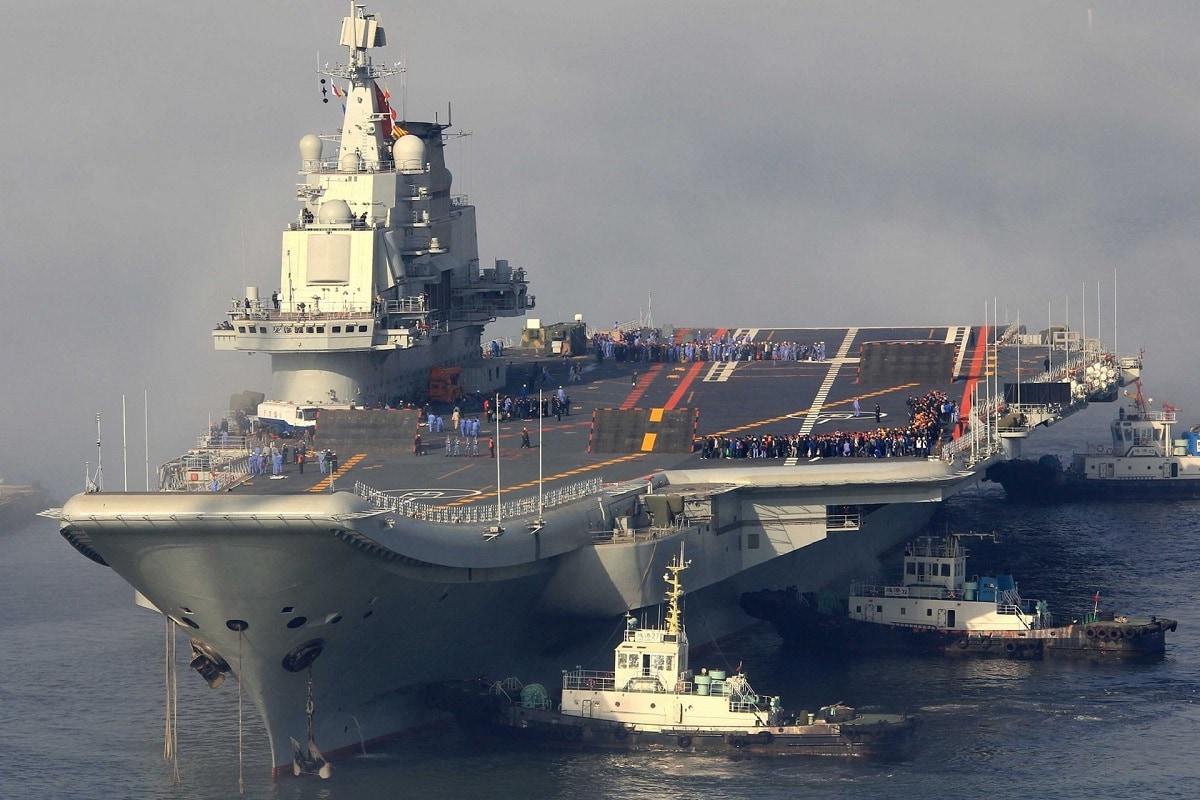
According to publicly available monitoring data from Japan and a report by USNI on October 14, the Liaoning conducted carrier-based aircraft takeoffs and landings approximately 155 nautical miles south of Ishigaki Island on the 14th, recording a total of 10 takeoffs and landings by carrier-based fighter jets and helicopters that day. The group includes the Liaoning, the destroyer Anshan (hull number 103), the frigate Wuxi (hull number 104), and the frigate Huainan (hull number 123); the composition of these vessels is based on reports from Japan and media summaries from the U.S., while the numbers of other escort forces, submarines, and supply ships remain to be confirmed.
The Japanese side monitored the situation using the destroyer Yūgure, P-1, and P-3C patrol aircraft, and scrambled fighter jets due to the activity of carrier-based aircraft. This was a clearly defined training operation with a specific track and a clear Japanese response, rather than merely an inference of "carrier deployment" based on social media. The Chinese Navy stated that it defines this as an annual routine training exercise, claiming it is not aimed at any specific country or target; this statement does not contradict the legality of freedom of navigation, but the location of the exercises still carries military significance.
Why the Time Window is Sensitive
The Liaoning's entry into the Philippine Sea comes about five days before the start of the U.S.-Japan "Sword 27" joint exercise. Public arrangements indicate that the U.S. and Japan plan to organize joint anti-ship training in maritime and aerial areas south of Kyushu, Shikoku, and northeast of Okinawa, and plan to deploy ground-based anti-ship systems related to island defense. In simple terms, the route taken by the Liaoning carrier group is not an abstract "Western Pacific route," but rather enters a direction heavily covered by U.S.-Japan island chain forces, aerial reconnaissance, and anti-ship firepower. For the PLA, this is closer to testing the group’s ability to maintain the rhythm of carrier-based aviation, counter-reconnaissance, and maneuvering after crossing the Miyako Strait; the 10 takeoffs and landings can only prove that flight activities occurred that day and cannot be extrapolated to indicate high-intensity sustained operations; the overall scale of the exercises remains to be confirmed.
Surveillance Around the Taiwan Strait and Overlapping Gray Areas
On October 15, Taiwan reported that within the previous 24 hours, it detected 15 instances of PLA military aircraft and 17 instances of military ships operating around the Taiwan Strait; these numbers should be understood according to Taiwan's public statements, and there is currently no independent real-time method to verify them one by one. Focus Taiwan reported that Taiwan's defense department believes that the PLA's large-scale exercise season is approaching and is strengthening monitoring. Compared to simply counting instances, more attention should be paid to the relatively high number of ships, which represents a sustained maritime presence: its role can be intelligence gathering, pressure on shipping lanes, and readiness deployment, or it may just be an overlap of routine deployments in multiple directions, which cannot be directly equated to a blockade rehearsal.
The cognitive warfare and propaganda ramp-up mentioned by Taiwanese media also need to be judged separately from the activities of actual military forces. Its visible effect is to raise societal expectations of "upcoming exercises," thereby amplifying the psychological impact of each report of naval and air activity; however, without evidence such as exercise no-fly zones, firepower subjects, or formal announcements from the Eastern Theater Command, it is inappropriate to describe it as a large-scale joint exercise against Taiwan that has already been initiated.
From the Dongsha Water Cannon Dispute to Arms Sales Issues
On October 2, the incident near Dongsha where Taiwan's Coast Guard used water cannons to drive away Chinese fishing boats has led to an overlap of maritime law enforcement friction and military posture. Reuters reported on the 14th that China stated Taiwan "must bear the consequences" of the incident. Such statements do not necessarily indicate an immediate military escalation, but they will expand the political interpretation space for subsequent activities of coast guard, navy, and militia vessels. Meanwhile, the approval, delivery pace, and delays of U.S. arms sales to Taiwan remain core variables in the relationship between Beijing, Taipei, and Washington; the policy continuity following the meeting between Xi Jinping and Donald Trump cannot be derived from a single carrier operation.
The author believes that the real focus should not be on whether the "Liaoning appears," but rather on whether it can maintain continuous flight operations after crossing the first island chain, whether it forms verifiable linkages with air and naval forces in other directions, and whether there will be significant changes in the composition of vessels reported by Taiwan. If these indicators lack subsequent evidence, October 15 should be defined as a high-sensitivity distant sea training and regional alert overlap, rather than a comprehensive exercise against Taiwan that has already occurred.
References
- Japan's Joint Staff Office public monitoring information, compiled by USNI News on October 14, 2026
- NHK, October 15, 2026, "China aircraft carrier to conduct training in west Pacific"
- Focus Taiwan, October 15, 2026, "Taiwan watching for large-scale PLA drills as peak season nears"
- Reuters, October 14, 2026, "Taiwan must bear the consequences of water cannon incident China says"
- Public statement from the People's Liberation Army Navy regarding routine training in the Western Pacific on October 14 (as reported by USNI)
The Liaoning aircraft carrier group conducted training exercises in the Philippine Sea on October 15, 2026, involving four ships and 10 aircraft. This operation coincided with increased military activity reported by Taiwan, as the PLA prepares for potential large-scale drills. The training is seen as a response to upcoming US-Japan joint military exercises in the region.
- Liaoning aircraft carrier group entered the Philippine Sea on October 15, 2026.
- The group includes four ships and conducted 10 aircraft takeoffs and landings.
- Taiwan reported increased PLA military activity in the Taiwan Strait.
- The training coincides with the upcoming US-Japan joint military exercises.