
The 2026 Japan-U.S. Joint Integrated Firepower Demonstrated by NMESIS and the Type 12 Improved Model
 Tanaka Takashi
NMESIS and the Improved Type 12 System Demonstrate Joint U.S.-Japan Integrated Firepower in 2026
There are only about 110 kilometers from Yonaguni Island in Okinawa Prefecture to Taiwan. During the U.S.-Japan joint integrated exercise "Keen Sword 26," which will be conducted from October 19 to 29, the U.S. Marine Corps' anti-ship missile NMESIS and the air defense system MADIS will be deployed on the island for the first time. The Japan Ground Self-Defense Force (JGSDF) is also expected to deploy the Improved Type 12 Surface-to-Ship Guided Missile, which has a range of approximately 1,000 kilometers, and is currently referred to as the "Type 25 Surface-to-Ship Guided Missile" by the JGSDF. This exercise may mark a turning point from a traditional naval superiority competition centered on vessels to a phase where dispersed islands operate as a mobile missile network.
Three Shooters Gather on Yonaguni Island
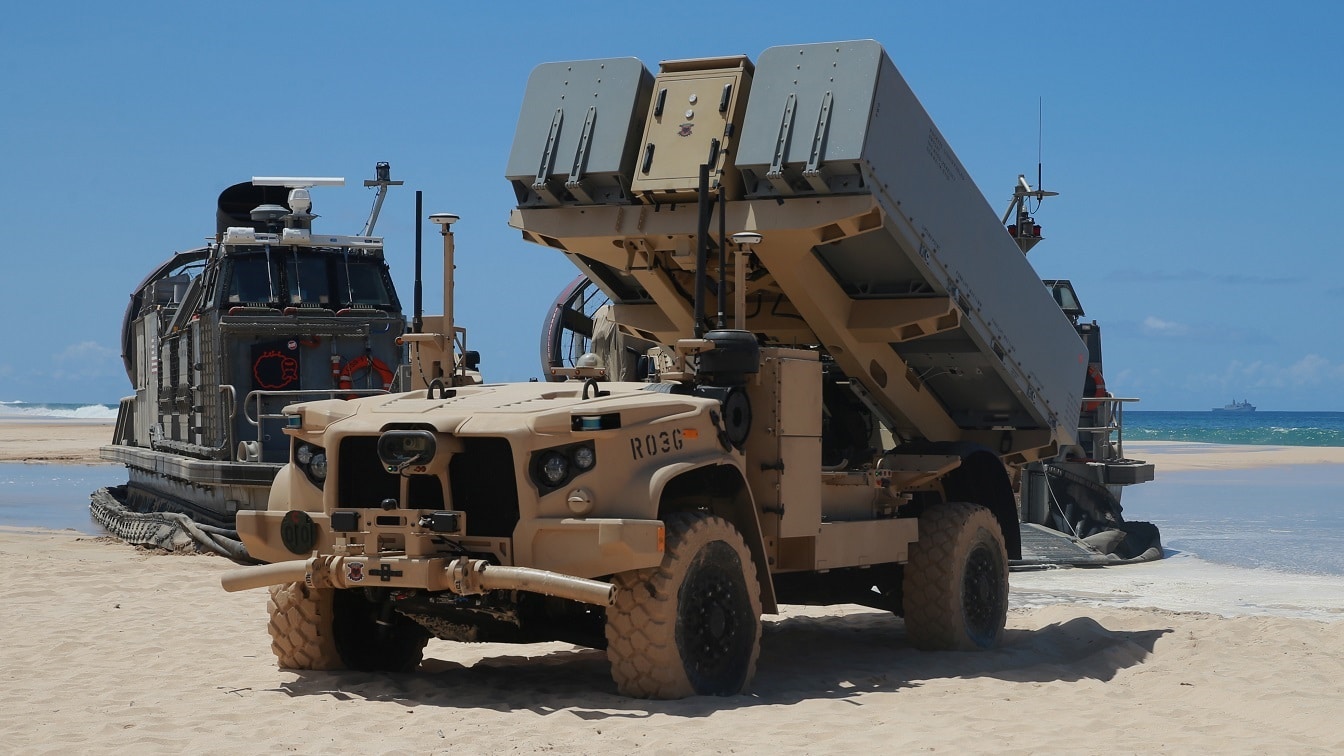
According to Defense News, NMESIS has a range of approximately 115 miles, or about 185 kilometers, and MADIS protects the Marine Corps' coastal forces from aerial threats. The U.S. Army's HIMARS is also expected to be deployed on Ishigaki Island, and there is a possibility that the medium-range missile "Typhon" will move to Okinawa. In addition to the Type 25 SSM, Japan will also involve the Type 88 Surface-to-Ship Missile and the Type 03 Medium-Range Surface-to-Air Guided Missile (Improved) in the training.
- U.S. Marine Corps: Maritime traffic denial with NMESIS, local air defense with MADIS
- U.S. Army: Long-range firepower with HIMARS, and possibly Typhon
- Japan Ground Self-Defense Force: Anti-ship and air defense integration in the southwestern islands centered on the Type 25 SSM
It is also noteworthy that large vessels of the Japan Maritime Self-Defense Force (JMSDF) and U.S. aircraft carriers will not be at the forefront. As carrier strike groups are being repurposed for the Middle East, this time the focus will be on a structure where sensors and missiles deployed on the islands deny access to the maritime area, rather than a scenario where "vessels dominate the waters."
Separating Capability from Intent
The 2026 edition of the "Defense White Paper" by the Ministry of Defense positions China's military buildup and cooperation between China and Russia, as well as between Russia and North Korea, as part of the most severe and complex security environment since the end of World War II. The scale of about 45,000 personnel from nine countries participating in Keen Sword 26 is an attempt to translate this recognition into practical training.
However, the deployment of missiles does not equate to the establishment of an effective denial capability. The roads, ports, and airports on Yonaguni Island are shared with civilian infrastructure, and the transportation of large equipment itself is constrained. Even if launchers are dispersed, if satellite communications, refueling, reloading, and command and control after damage cannot be maintained, the figure of 1,000 kilometers will remain just on paper.
Furthermore, the concerns expressed by Yonaguni Town regarding the scale of the exercise highlight issues of political intent. While Japan and the U.S. are trying to demonstrate a willingness to deter rather than prepare for an attack against China, for residents, the movement of military vehicles and the use of ports are not abstract deterrence. The defense of the southwestern islands will be determined not only by the performance of missiles but also by how much the local community can accept operations during peacetime.
The Challenge for the Alliance is Sustainability, Not Firepower
The true value of this exercise lies not in placing NMESIS and the Type 25 SSM on the same screen. It is about verifying who confirms target information, which country's command makes the launch decision, and which units continue the mission after communications are lost. The island defense of Japan and the U.S. has weaknesses not in the lack of firepower, but in the logistics to sustain dispersed forces over a long period and the slowness of political decision-making.
From the perspective of a former JMSDF officer, an exercise without an aircraft carrier is not a weakness but rather a realistic stress test. However, what is truly at stake is not the range of missiles. It is whether the alliance can sustain its combat power at the front lines, like on Yonaguni Island, without losing the understanding of the local residents.
Main Sources
The U.S. Marine Corps deployed NMESIS and MADIS on Yonaguni Island as part of the joint military exercise 'Keen Sword 26' from October 19 to 29, 2026. The Japan Self-Defense Forces are enhancing their Type 12 anti-ship missile capabilities. The exercise involves approximately 45,000 personnel from 9 countries, indicating a significant military collaboration aimed at countering regional threats.
- The U.S. Marine Corps will deploy NMESIS and MADIS on Yonaguni Island for the first time.
- The Japan Self-Defense Forces will enhance their Type 12 anti-ship missile capabilities during the exercise.
- The exercise involves approximately 45,000 personnel from 9 countries, reflecting a significant military collaboration.
- The exercise marks a shift from traditional naval dominance to a distributed missile network across islands.
- Concerns have been raised about the local infrastructure's ability to support large military operations.