
Liaoning Fleet's Voyage of Over 40 Days: What’s Different This Time?
The Navy's Liaoning aircraft carrier group successfully completed its long-range realistic combat training on the 22nd and safely returned to its home port in Qingdao. During the more than 40 days of training, the group operated in the South China Sea, the Western Pacific, and other maritime airspaces, deeply conducting practical application verification, which significantly enhanced the carrier group's ability to fulfill its mission tasks. What are the outstanding features of such high-intensity, high-density realistic training? What tests did the Liaoning carrier group undergo?
Highlight One
Transitioning through multiple maritime airspaces with extended training duration
This long-range training lasted over 40 days. Military expert Zhang Junsha stated that the Liaoning aircraft carrier completed its longest long-range training to date, "more than 40 days should be the longest duration in the history of the Liaoning aircraft carrier's long-range training, and the capability of the long-range offensive and defensive system has been further enhanced."
The Liaoning carrier group continuously transitioned through multiple maritime airspaces, including the South China Sea and the Western Pacific, with high intensity and a wide span. Military expert Li Yaqiang noted that conducting realistic training in different maritime areas is extremely important for troop training.
Li Yaqiang: The amphibious assault operations in the South China Sea require more direct engagement, and the mission may be more urgent. The exercises between the Liaoning carrier group and the amphibious assault ships for land attack operations have particularly realistic significance. Even when reaching the Western Pacific region, in the open sea, the aircraft carrier and the amphibious assault ships can still conduct coordinated combat training, with training subjects significantly different from those in the South China Sea. The more complex and diverse troop actions are crucial for improving the overall combat level and forming a comprehensive combat capability.
Highlight Two
High degree of realism in training
The Liaoning aircraft carrier group continuously transitioned through multiple training maritime airspaces, tightly constructing an early warning detection system, meticulously planning and organizing joint shore-sea confrontation, tactical flight of carrier-based aircraft, and group search and rescue training, continuously honing and enhancing the group’s realistic training level.
Li Yaqiang stated that the most prominent feature of this training for the Liaoning carrier group is its high degree of realism.
Li Yaqiang: Comprehensive sea control is itself the most basic task of an aircraft carrier, so establishing such a reconnaissance and alert area and forming a comprehensive maritime and aerial monitoring network is an extremely important prerequisite for future operations; the operational coordination between shore and sea involves, firstly, the coordination of shore-based command systems, including reconnaissance systems, alert systems, communication systems, and battlefield situational awareness systems; secondly, organizing sea and air coordination, especially in joint exercises with amphibious assault ships in land operations, which are particularly useful for realistic training.
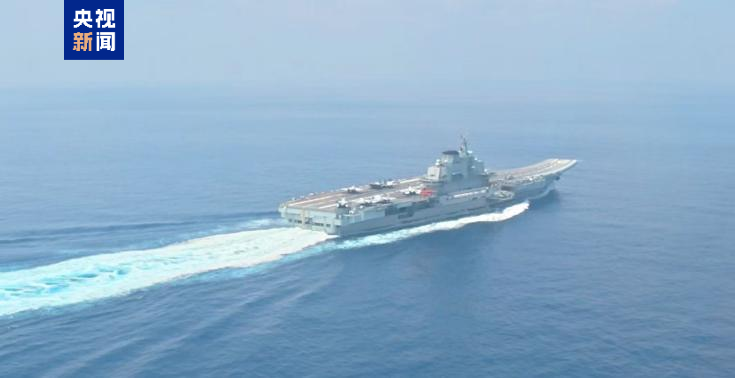
△ Training scenes of the Liaoning carrier group
Highlight Three
Joint training with the amphibious assault ship group
In a certain maritime area of the Western Pacific, the Liaoning carrier group conducted joint exercises with the amphibious assault ship group, engaging in system integration training, refining the operational effectiveness of the carrier group in conjunction with the amphibious assault ship group for long-range combat actions.
Li Yaqiang: The aircraft carrier can carry fixed-wing carrier-based fighter jets to ensure sea control and strikes against surface targets. The tasks originally assigned to carrier-based helicopters can be transferred to the amphibious assault ships, allowing for close coordination even in offshore areas, where the amphibious assault ships can undertake urgent strike missions against enemy submarines, enabling the aircraft carrier to focus on achieving air superiority and striking coastal targets, thus forming a stronger strike capability.
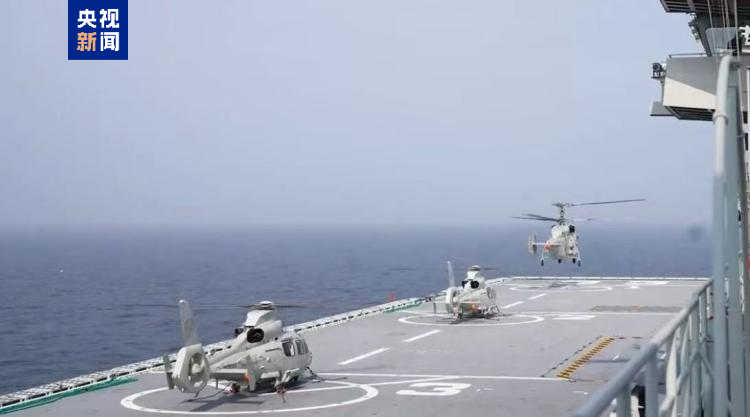
△ Joint exercises between the Liaoning carrier group and the amphibious assault ship group
Highlight Four
Yuan-Yu-20 tanker aircraft providing aerial refueling for carrier-based aircraft
Zhang Junsha stated that the appearance of the Yuan-Yu-20 during this long-range training significantly enhanced the operational radius and loitering time of carrier-based fighter jets. Using the Yuan-Yu-20 to refuel carrier-based fighter jets, compared to the buddy refueling method between two carrier-based aircraft, allows for a greater fuel capacity and a larger refueling radius.
Zhang Junsha: The refueling radius of the Yuan-Yu-20 is about 1,000 kilometers, which can refuel carrier-based fighter jets, expanding the operational radius of the J-15 fighter jets. This increases the depth of maritime defense operations for carrier-based aircraft and the carrier group, extending the range of long-range offensive and defensive operations.
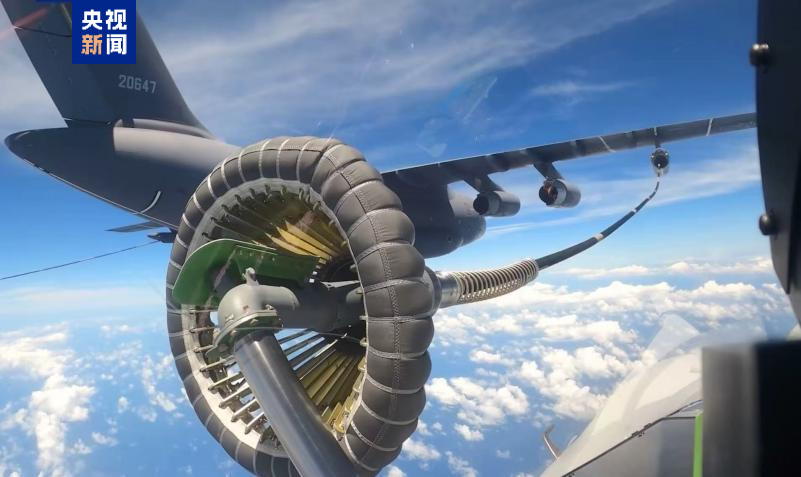
△ Scenes of the Yuan-Yu-20 refueling carrier-based fighter jets during training
Highlight Five
Professional and prudent handling of dangerous actions by Japanese forces
This training was a routine exercise organized by the Chinese Navy according to its annual plan, aimed at continuously improving mission capability, in accordance with relevant international laws and practices, and not targeting specific countries or objectives. During the training, Japanese vessels and aircraft repeatedly conducted close tracking, monitoring, and provocative actions.
Zhang Junsha stated, "Such close reconnaissance and provocative actions not only severely affect the normal training of the PLA but also pose serious risks to navigation and flight safety."
The Liaoning carrier group maintained a high state of alert throughout, continuously organizing combat takeoffs of carrier-based aircraft, flexibly changing combat formations, and professionally and prudently handling the dangerous actions of the Japanese forces.
Teng Jianqun: A defining action of the aircraft carrier is to continuously change the formation of the group during navigation or aerial combat. The primary task of the carrier group is to rely on the carrier-based aircraft to strike relevant targets, while our carrier group is also equipped with destroyers and frigates, which largely provide air defense, anti-submarine, and anti-surface vessel combat tasks for the carrier, so changing combat formations is also an important part of deploying the carrier group for training in the open sea.
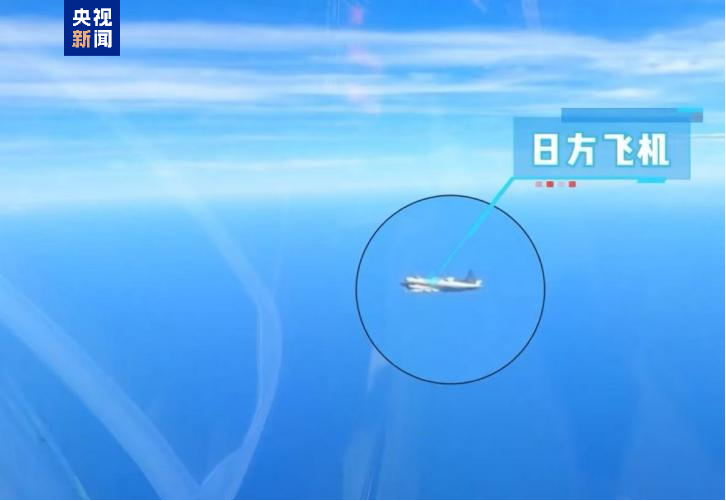
△ Scenes of Japanese forces tracking, monitoring, and provocative actions
The Navy's Liaoning carrier group safely returned to its home port on the 22nd, successfully completing this long-range realistic combat training. In this regard, Teng Jianqun stated: "The carrier group can go out and go far, while also safely and smoothly returning to its home port, which demonstrates that the carrier group and carrier technology can fully accomplish the various tasks assigned by the country."
Supervisor丨Wu Zhehua Reporter丨Ning Bo Yang Kai
The Liaoning aircraft carrier group completed over 40 days of realistic combat training, returning safely to Qingdao on the 22nd. The training involved operations in the South China Sea and Western Pacific, enhancing the group's capabilities through joint exercises with amphibious assault ships. The use of the Yunyou-20 tanker significantly increased the operational range of the carrier-based J-15 fighter jets, while the group remained vigilant against provocations from Japanese naval forces.
- The Liaoning aircraft carrier group completed over 40 days of training in various maritime regions.
- The training included joint exercises with amphibious assault ships in the Western Pacific.
- The Yunyou-20 tanker was used to extend the operational range of carrier-based aircraft.
- The exercises were conducted in response to provocations from Japanese naval forces.
- The carrier group maintained a high state of readiness throughout the training.