
Liaoning's 5 Ship Philippine Sea Drill Exposes America's Carrier Gap
 Marcus Chen
Liaoning's 5 Ship Philippine Sea Drill Exposes America's Carrier Gap
Five Chinese hulls east of Luzon are more important than one American carrier leaving Yokosuka. Japan's Joint Staff confirmed on May 26 that the Liaoning carrier group was operating about 880 kilometers southwest of Okinotorishima, with flight operations from the carrier the next day. The group was not large by U.S. Navy standards. It was Liaoning, the Type 055 cruiser Wuxi, the Type 052D destroyer Kaifeng, the new Type 054B frigate Luohe, and the Type 901 fast combat support ship Hulunhu. But that is enough to make the point.
The point is not that Liaoning can beat USS George Washington in a carrier duel. It probably cannot. The point is that China is putting a complete, supported carrier package into the Philippine Sea while America's forward-deployed carrier is still working through the mechanics of getting back on patrol. In the first island chain, timing is combat power.
The New Frigate Matters More Than the Carrier
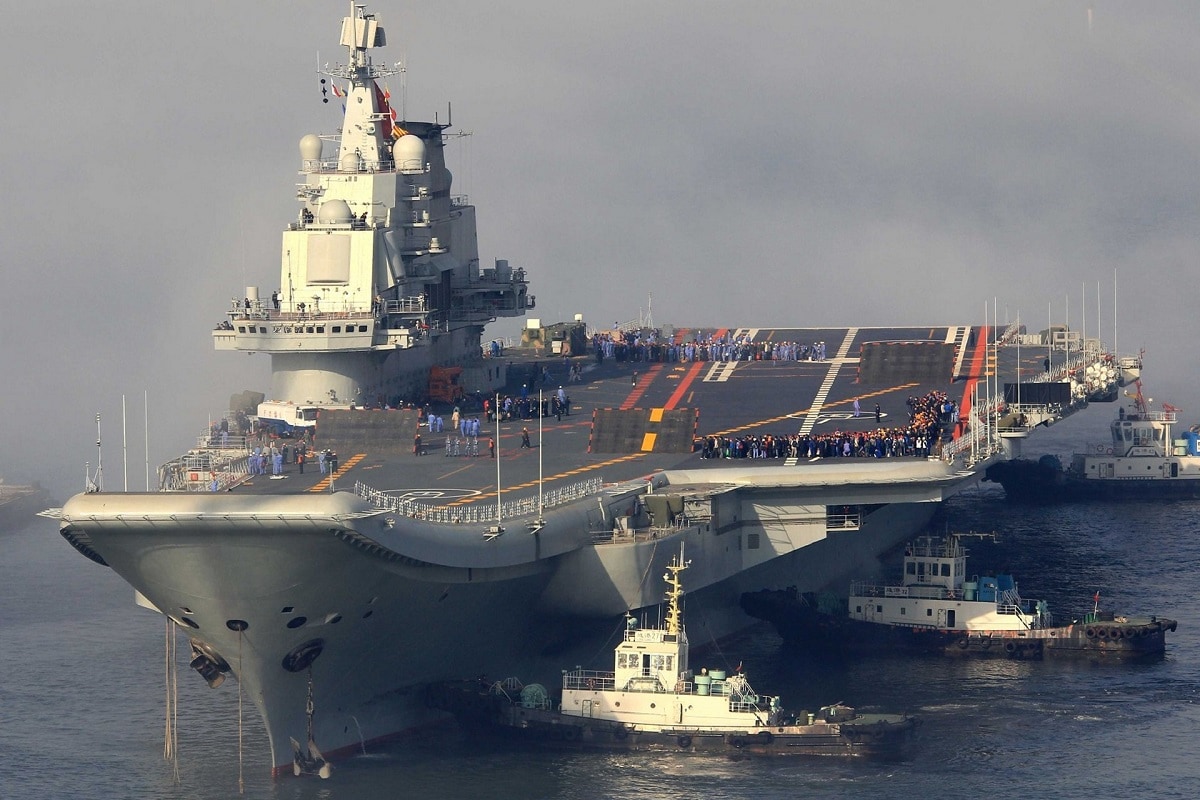
Liaoning is a known quantity. She is a Kuznetsov-derived ski-jump carrier, conventionally powered, and limited by the physics of launching aircraft without catapults. Her J-15 fighters carry less fuel and ordnance than they would from a catapult carrier. She is not Fujian, and she is not a Chinese equivalent of a Nimitz-class ship.
That is why the escort mix matters. Luohe is the first Type 054B frigate confirmed in a Liaoning Western Pacific carrier group, according to reporting by The Diplomat and Japan's release. The Type 054B is a bigger, more modern successor to the Type 054A, built to improve anti-submarine warfare, area surveillance, and blue-water escort capacity. In a Taiwan or Luzon Strait contingency, China's hardest problem is not launching a few fighters from Liaoning. It is keeping a task group alive long enough to complicate U.S. and Japanese reinforcement routes from Guam and Japan.
Wuxi and Kaifeng provide the heavier air-defense and anti-surface punch. Hulunhu is the other quiet signal. A fast combat support ship in the group means the PLAN is not just conducting a photo-op transit. It is practicing endurance. Anyone who has served on a destroyer knows the tactical map starts lying as soon as fuel, food, spare parts, and maintenance cycles are ignored. China has spent two decades building hulls. Now it is practicing the habit that turns hulls into presence.
George Washington Is Present But Not Yet the Answer
USS George Washington left Yokosuka on May 23 at 1:45 p.m., according to Yokosuka City, which also listed the Nimitz-class carrier's crew at 5,052. USNI News reported that Carrier Air Wing 5 was conducting carrier qualification training off Kyushu through May 30 before George Washington begins its spring patrol. That is normal naval business. Pilots need traps. Deck crews need repetitions. A carrier air wing does not become combat credible by being listed on a PowerPoint slide.
But the operational fact remains awkward: the Chinese carrier group is already in the Philippine Sea while the U.S. forward-deployed carrier is transitioning from port and qualification work into patrol. That is not a scandal. It is a reminder that one forward-deployed carrier is not the same thing as continuous carrier coverage. Maintenance, certification, escort availability, air wing readiness, and weather all eat into the calendar.
The U.S. Navy still has the better carrier system. George Washington carries a larger and more capable air wing than Liaoning. Her nuclear propulsion gives her endurance that China's first carrier cannot match. U.S. deck operations, airborne early warning, electronic attack, undersea coordination, and strike integration remain deeper than what the PLAN can demonstrate from Liaoning.
That advantage is real. It is also not always present at the exact place and hour Washington wants it.
The Geography Is the Warning
The location is what makes this deployment worth more than routine carrier watching. A carrier group east of Luzon sits near the hinge between the Taiwan contingency and the South China Sea problem. The Luzon Strait is nearly 200 miles wide, but operationally it is a gate. Through it run submarines, surface action groups, aircraft, tankers, intelligence collectors, and the reinforcement routes that connect Japan, Guam, the Philippines, and Taiwan.
If China can regularly move carrier groups through that gate and sustain them east of the Philippines, it forces U.S. planners to account for another problem set. A Liaoning group does not need to win sea control across the whole Philippine Sea. It only needs to impose uncertainty on the timelines for U.S. movement, surveillance, and strike packages. In a crisis, losing twelve hours to uncertainty can matter as much as losing a ship.
This is also where the Philippines becomes more than a treaty talking point. The carrier's reported position east of Luzon overlaps the logic behind recent U.S. and allied exercises in northern Luzon, Batanes, and the Philippine Sea. Those islands are not symbolic terrain. They are sensor sites, missile sites, refueling nodes, and denial positions. If they are underdeveloped, then the United States is asking a carrier and a handful of submarines to do too much of the early work.
What This Deployment Does Not Prove
It does not prove China can run U.S.-style carrier strike operations. It does not prove Liaoning can survive a concentrated U.S.-Japanese submarine and air campaign. It does not prove Beijing has solved the problem of fighting far from land-based air cover.
It proves something narrower and more useful: the PLAN is now comfortable sending a mixed escort carrier group into the Philippine Sea with a new frigate and an oiler, while Japan watches and the U.S. carrier cycle turns. That is a readiness signal, not a war-winning formula.
Washington should read it that way. The answer is not to panic about Liaoning. The answer is to stop pretending that a single forward-deployed carrier, however capable, can be the default answer to every Western Pacific crisis. More land-based anti-ship missiles in the Philippines, more undersea magazine depth, more allied maritime patrol aircraft, and more repair capacity west of the dateline matter as much as the carrier headline.
China's first carrier is still limited. Its operating pattern is not. That is the gap.
Sources
- Japan Joint Staff press release on Chinese Navy activity, May 26, 2026
- USNI News reporting on Liaoning and USS George Washington, May 26, 2026
- The Diplomat reporting on the Type 054B frigate joining the Liaoning group, May 27, 2026
- Yokosuka City notice on USS George Washington departure, May 23, 2026
The Chinese Navy's Liaoning carrier group conducted a naval drill in the Philippine Sea, operating 880 kilometers southwest of Okinotorishima on May 26, 2026. This group included five vessels, highlighting China's capability to project naval power while the USS George Washington was transitioning from port. The positioning of the Chinese carrier group complicates U.S. and Japanese military logistics in the region.
- Liaoning carrier group operated 880 km southwest of Okinotorishima on May 26, 2026.
- USS George Washington left Yokosuka on May 23, 2026, for carrier qualification training.
- The Type 054B frigate Luohe is confirmed in the Liaoning group.
- The Chinese carrier group is positioned to complicate U.S. and Japanese reinforcement routes.
- The deployment signals China's readiness to operate carrier groups in the Philippine Sea.