
Lockheed says its Valkyrie laser downs cruise missile
A Lockheed Martin high-energy laser has destroyed a surrogate cruise missile target for the first time, a company executive said, months after the U.S. Army said it no longer planned to put the same weapon into service.
Jack Cheung, program director for Lockheed Martin’s Laser and Sensor Systems, announced the test on social media, calling it the team’s “FIRST EVER engagement against a surrogate cruise missile target – with full kill chain integration.”
“It was the first kill WITHOUT track augmentation, WITH short engagement time at meaningful distance,” Cheung wrote. Track augmentation usually refers to beacons or reflectors fitted to a test target to make it easier for a weapon to lock on. Cheung didn’t say when or where the test took place, or how far away the target was.
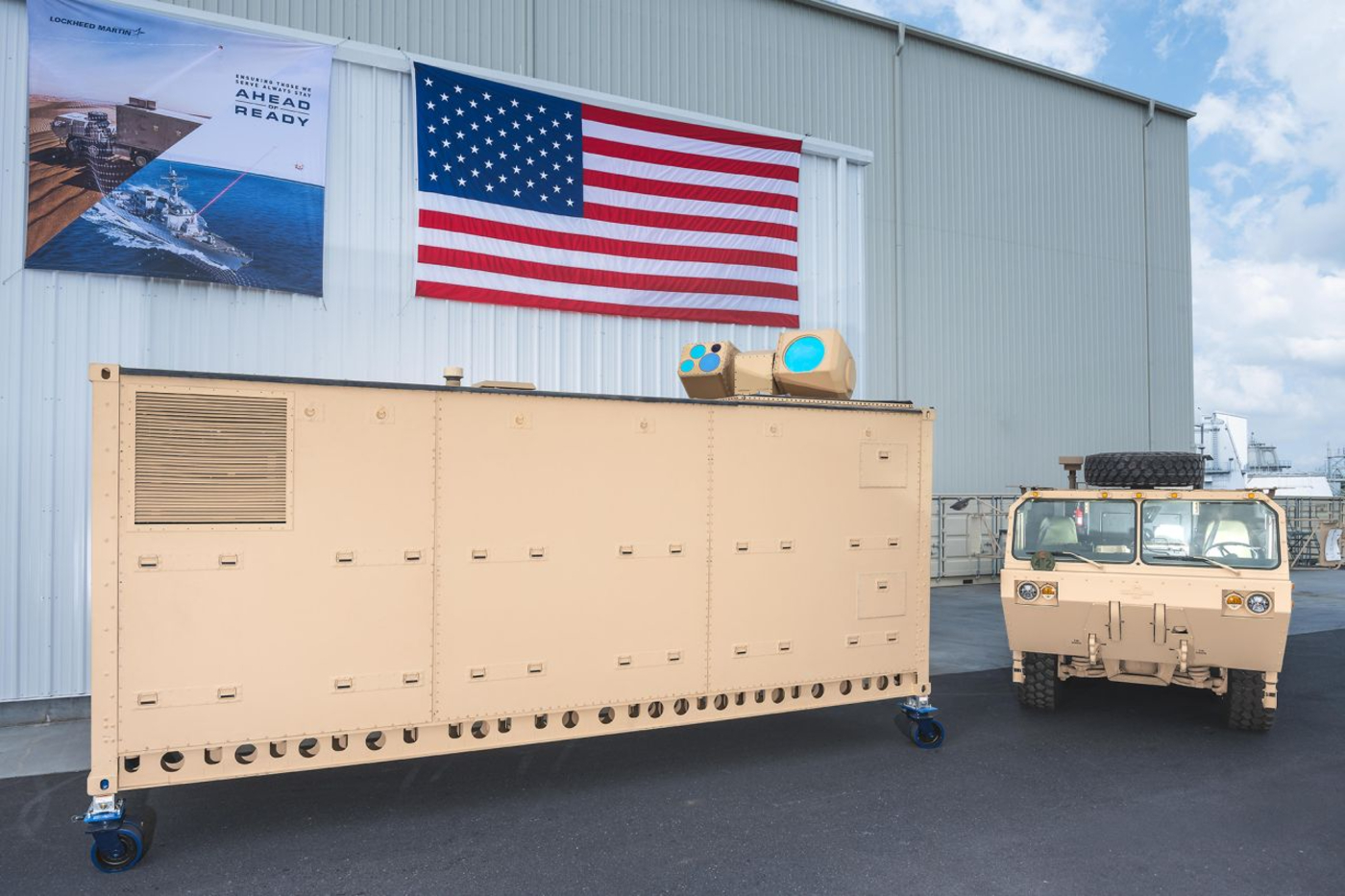
A photo with the post shows a tan, shipping container-sized enclosure topped with a beam director, parked next to a military truck in front of a hangar. A Lockheed Martin spokesperson confirmed to Laser Wars that the system is the company’s 300-kilowatt Indirect Fire Protection Capability-High Energy Laser, or IFPC-HEL, also known as “Valkyrie.”
At 300 kilowatts, Valkyrie is among the most powerful laser weapons the U.S. military has tested. It was built for the U.S. Army to protect bases and troops from cruise missiles, drones, rockets and mortar rounds.
The Army has since stepped back. In a Congressional Research Service report published March 9, Army officials said the service no longer planned to transition IFPC-HEL into active service, according to Laser Wars.
The technology lives on under a new program. The Department of War’s fiscal 2027 budget request said the Pentagon would use lessons from IFPC-HEL in the new Joint Laser Weapon System, or JLWS, a joint U.S. Army and U.S. Navy effort, Laser Wars reported.
In June, IFPC-HEL was one of several laser weapons shown to Secretary of War Pete Hegseth at a directed energy demonstration at White Sands Missile Range in New Mexico.
A month later, the Department of War awarded Lockheed Martin and nLight a combined $86 million, with a ceiling of $847 million, under JLWS to develop laser weapons capable of defeating cruise missiles.
“Huge congratulations to the entire team that is working to get directed energy into the hands of operators who need it!” Cheung wrote.
Content preview only. Full article available at source. View Full Article
Lockheed Martin's high-energy laser system successfully destroyed a surrogate cruise missile target at White Sands Missile Range in June 2023. This marks the first engagement of its kind without track augmentation. The 300-kilowatt Indirect Fire Protection Capability-High Energy Laser (IFPC-HEL), known as 'Valkyrie', was developed for the U.S. Army but is now being adapted for the new Joint Laser Weapon System (JLWS).
- Lockheed Martin's high-energy laser destroyed a surrogate cruise missile target for the first time.
- The test was announced by Jack Cheung, program director at Lockheed Martin.
- The system used is the 300-kilowatt IFPC-HEL, also known as 'Valkyrie'.
- The U.S. Army has stepped back from transitioning IFPC-HEL into active service.
- The technology will inform the new Joint Laser Weapon System (JLWS) program.