
Lockheed’s cruise missile contract crossed $10 billion
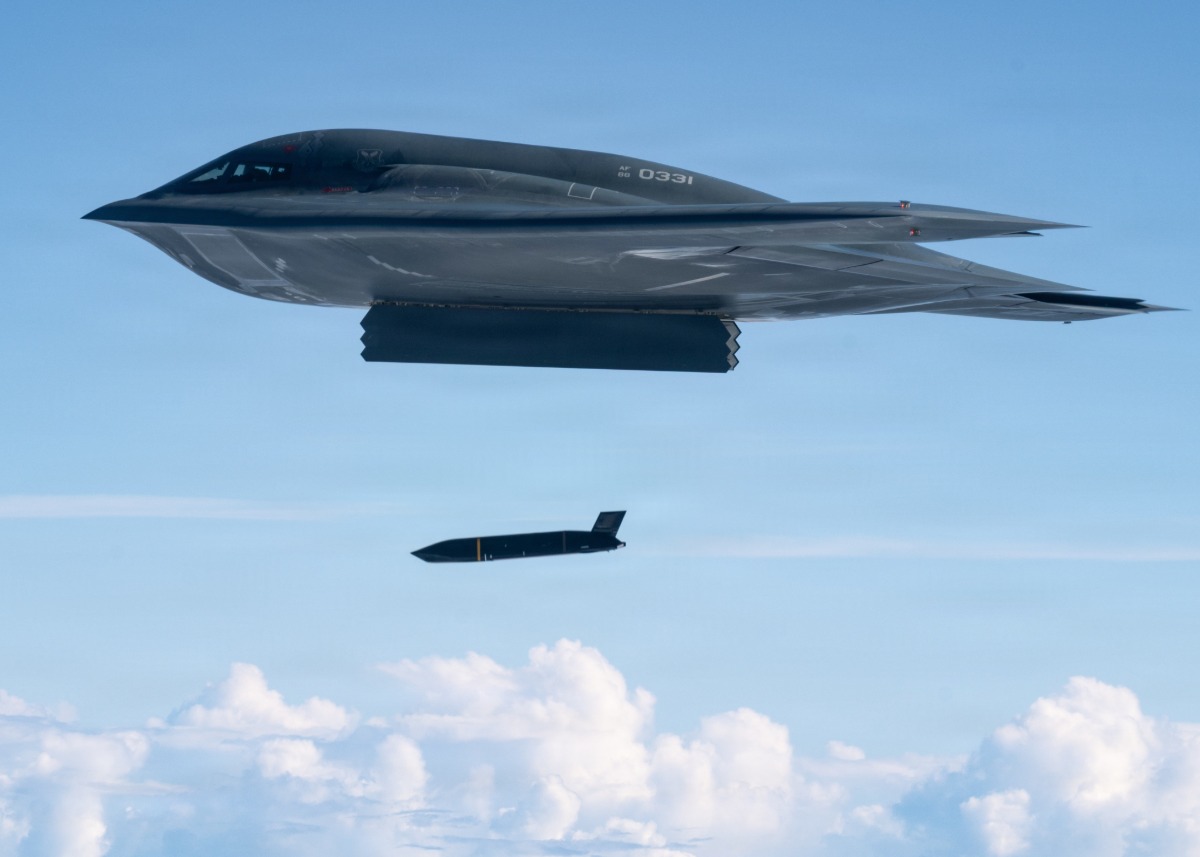 B-2 deploys an AGM-158C LRASM as part of Valiant Shield 2026 over the Philippine Sea, June 27, 2026. Photo by Thomas Barley
The U.S. Air Force has added $826 million to its bulk missile contract with Lockheed Martin, pushing the total value of the deal past $10 billion for the first time.
The Air Force Life Cycle Management Center at Eglin Air Force Base, Florida, issued the contract modification for continued production of the Joint Air-to-Surface Standoff Missile, known as JASSM, and the Long Range Anti-Ship Missile, known as LRASM. The award brings the contract’s total cumulative value to $10.48 billion, up from $9.65 billion. Work will be done at Lockheed Martin’s Orlando, Florida, facility, with completion expected by July 31, 2030.
The same contract crossed $9.485 billion in August 2025, when the Air Force added roughly $4.3 billion covering JASSM lots 22 through 26 and LRASM lots 9 through 12, with deliveries running to Poland, the Netherlands, Japan and Finland under Foreign Military Sales agreements. This latest $826 million addition keeps that same production line running rather than opening a new one. The funding is split across fiscal 2024, 2025 and 2026 missile procurement accounts, Navy weapons procurement funds, research and development money, operations and maintenance funds, and Foreign Military Sales money, reflecting how deeply intertwined U.S. and allied orders have become on this program.
JASSM is a stealthy, long-range cruise missile built to strike heavily defended, fixed or moving targets on land from outside the range of most enemy air defenses. The baseline version has a range of about 370 km (230 miles), while the extended-range JASSM-ER variant, now the more common configuration in Air Force inventories, reaches roughly 1,000 km (620 miles). JASSM has been in Air Force service since 2009 and is cleared to fly on the F-15, F-16, F/A-18, B-1B and B-52, giving multiple aircraft types a common long-range strike weapon rather than each platform needing its own missile. LRASM is a derivative of the JASSM-ER airframe adapted to hunt and destroy ships at sea, carrying a roughly 450 kg (1,000-pound) warhead. It flies on U.S. Navy F/A-18E/F Super Hornets and U.S. Air Force B-1B bombers today, with F-35 and F-16 integration work also underway to expand which aircraft can carry it.
Allied demand for both missiles has kept growing beyond the four countries already named on this contract. The U.S. State Department cleared a potential $842 million sale of JASSM-ER missiles to Denmark for its F-35s in June 2026, and approved a separate sale of JASSM-ER to Italy in December 2025. Australia and Finland have flown JASSM on their F/A-18 fleets for years, while Poland remains the only customer outside the U.S. to field the longer-range JASSM-ER, integrated on its F-16C/D fleet since deliveries began following a 2016 order. Israel has also been in discussions with Washington over a potential JASSM purchase.
The contract falls under the Pentagon’s Large Lot Procurement approach, which buys missiles in large multi-year batches rather than through smaller annual orders. The Air Force and Lockheed say the structure lowers the cost per missile, stabilizes Lockheed’s supply chain, and lets production ramp up faster than year-by-year contracting would allow. Lockheed opened a dedicated JASSM and LRASM factory in Troy, Alabama, in 2021 and added a 225,000-square-foot automated production facility in 2022 to support the higher volumes, incorporating robotic paint lines and automated forecasting tools.
Lockheed opened a dedicated JASSM and LRASM factory in Troy, Alabama, in 2021 and added a 225,000-square-foot automated production facility in 2022 to support the higher volumes, incorporating robotic paint lines and automated forecasting tools. The company has said ramping up production of both missiles is central to keeping pace with demand from the U.S. military and its growing list of allied customers.
Content preview only. Full article available at source. View Full Article
The U.S. Air Force added $826 million to its missile contract with Lockheed Martin, raising the total to $10.48 billion for the production of JASSM and LRASM missiles. This modification was issued by the Air Force Life Cycle Management Center at Eglin Air Force Base on June 27, 2026, with completion expected by July 31, 2030. The contract supports ongoing production and includes deliveries to allied nations under Foreign Military Sales agreements.
- The U.S. Air Force's missile contract with Lockheed Martin surpassed $10 billion.
- An additional $826 million was added to the contract for continued production of JASSM and LRASM missiles.
- The contract modification was issued by the Air Force Life Cycle Management Center at Eglin Air Force Base, Florida.
- The production is expected to be completed by July 31, 2030.
- The contract includes deliveries to multiple allied countries under Foreign Military Sales agreements.