
Mali 2026 — HRW documents 73 civilians killed between JNIM, FLA, and Africa Corps
 Marie Dubois
Mali 2026 — HRW documents 73 civilians killed between JNIM, FLA, and Africa Corps
In Zambougou, sixty kilometers from Bamako, passengers were taken off their buses before witnessing the vehicles burn on the road. The scene, documented by Human Rights Watch in a report published at the end of June and reported by RFI on July 1, is not a humanitarian detail added to the Malian war. It is now the center of the theater of operations.
Since the coordinated offensive on April 25, Mali is no longer just facing classic jihadist pressure. The Support Group for Islam and Muslims (JNIM), affiliated with Al-Qaeda, is fighting alongside the Azawad Liberation Front (FLA), a Tuareg separatist coalition, against the Malian army and its Russian partners from Africa Corps, heirs of Wagner. This alliance does not erase the ideological differences between jihadists and separatists. It suspends them long enough to create a military problem that Bamako does not yet know how to solve.
The documented toll changes the nature of the debate
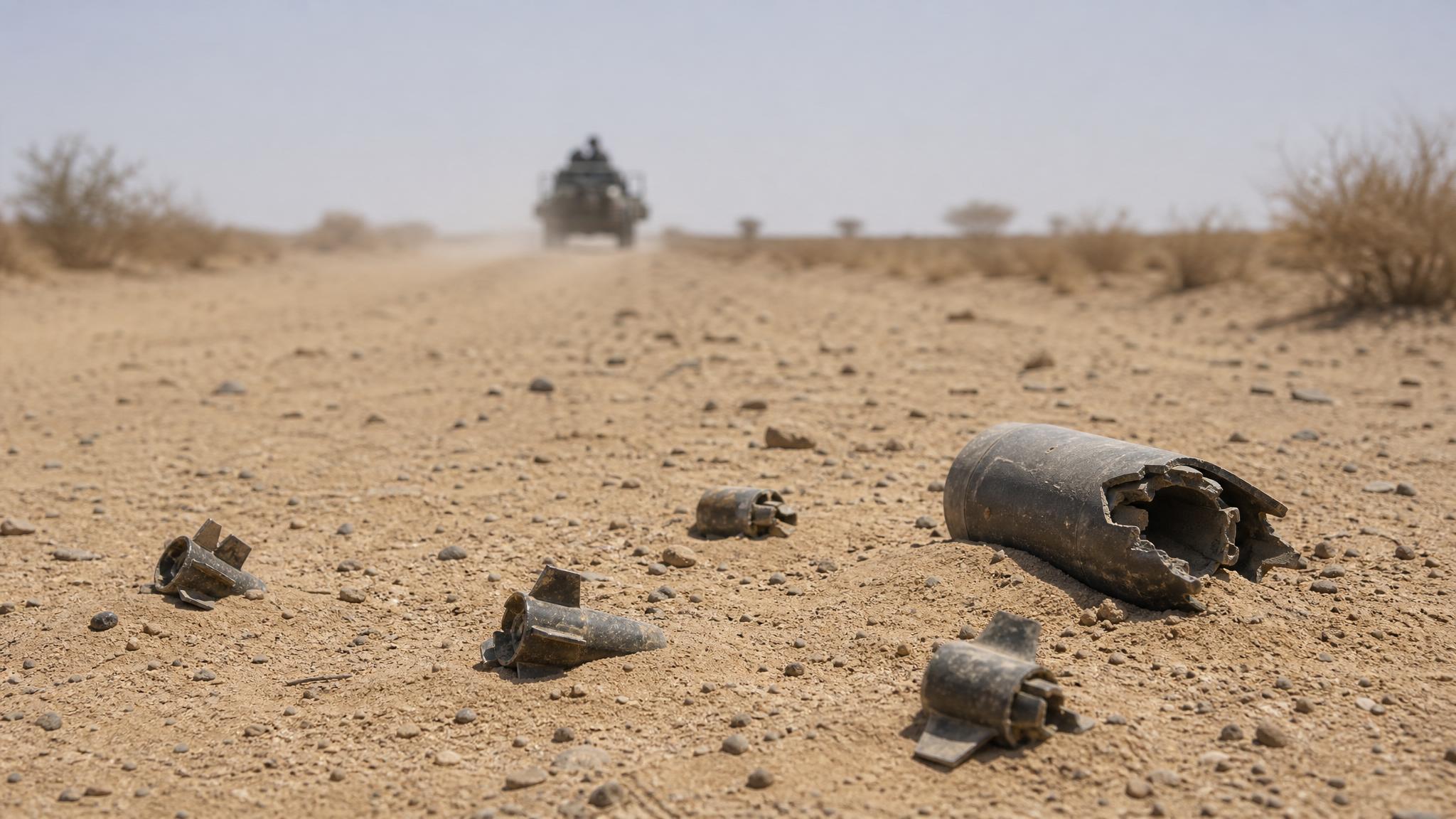
Illustrative image hosted by HiWars showing remnants of munitions in a Sahelian environment, used to contextualize the reported civilian risks in Mali.
HRW states that it interviewed 34 people between April 26 and June 9, including 30 direct witnesses, verified four videos, six photographs, and analyzed satellite images. The report attributes at least 13 civilian deaths and 25 injuries to the fighting in Gao and Kidal. It also documents operations by the Malian army and allied militias against Fulani communities in the center of the country, resulting in 38 civilian deaths, including 23 children, as well as two apparent drone strikes in Guimbé and Tené that caused an additional 22 deaths.
The figure of 73 civilians killed is therefore not a propaganda statistic. It compiles distinct episodes, with varying degrees of certainty. This is precisely why it deserves attention. In the Sahel, perfect tolls almost never exist. Villages empty, families bury quickly, phones disappear, military authorities lock down access. When an organization manages to establish locations, dates, and modes of action, it provides an operational map of violence.
The lockdown of Bamako plays out on the roads
The most concerning point is not just Kidal, even though the city retains enormous symbolic power. It is the road. Between May 6 and 21, HRW claims that JNIM burned more than 40 civilian vehicles heading towards Bamako. Since September 2025, the group has also targeted fuel tankers and convoys, causing shortages, power outages, school disruptions, and paralysis of daily life.
A capital does not always fall through a frontal assault. It can be strangled by miles. In the Sahel, a road is never just a simple axis on a map. It is a chain of wells, markets, checkpoints, repair shops, drivers, and villages that know who passed by the day before. If JNIM instills fear between Bamako, Ségou, Sikasso, or the Guinean border, it transforms resupply into a permanent military operation.
On the ground, this forces the army to choose. Escort convoys near the capital, regain the initiative in the North, hold the cities in the center, protect communities accused of aiding the enemy, or respond to image attacks produced by jihadist videos. No Sahelian army has enough reliable battalions to do everything at once.
The JNIM-FLA alliance exploits the weakness of the Russian model
The rapprochement between JNIM and FLA is tactically logical. The FLA brings in-depth knowledge of the North, local networks, and a memory of the war against Bamako. JNIM provides Sahelian depth, clandestine discipline, and the ability to strike economic flows. Together, they impose a two-dimensional war on the Malian army: hold the desert and secure the roads near the capital.
Africa Corps was supposed to compensate for this weakness with firepower, technical intelligence, and support for Malian units. But the HRW report shows the political cost of this approach. Drone strikes, sweep operations, and reprisals against Fulani communities can produce an immediate effect. They also destroy the human intelligence upon which any serious counter-insurgency depends.
I have seen this mechanism elsewhere in the Sahel. When a village stops talking to the army, it is not always out of sympathy for the jihadists. It is often out of fear, humiliation, or because a previous patrol confused a last name, a motorcycle, or a herd with evidence of complicity. JNIM knows how to turn these wounds into recruitment.
The war against civilians becomes a strategic multiplier
RFI cites Ilaria Allegrozzi, Sahel researcher at HRW, who emphasizes that most of the documented deaths do not come solely from clashes between fighters but also from counter-insurgency operations and strikes. This observation is significant. It means that Bamako risks producing more enemies than it neutralizes, especially in the Fulani areas of the center and the northern corridors where state authority remains intermittent.
JNIM is no less brutal. The public execution of a Quranic teacher in Tonka, threats against civilians moving despite the siege, and the burning of buses without direct military targets demonstrate a deliberate coercion strategy. But the movement does not need to be popular to advance. It only needs the state to appear more dangerous, more distant, or more unpredictable than itself.
The junta of Assimi Goïta has built its legitimacy on regained sovereignty after the departure of French and UN forces. However, sovereignty in an internal war is measured less by Bamako's speeches than by the ability to protect a driver between Koumantou and the capital, a child in Guimbé, or a trader in the Kidal market.
The next risk lies in the center of Mali
The North attracts attention, but the center remains the fragile point. Ségou, Mopti, the Fulani areas, and the roads to Bamako form the space where the war can shift from a military crisis to an economic survival crisis. If civilian convoys slow down, if drivers refuse certain stretches, if communities stop reporting armed movements, the capital will feel the pressure even before a new raid approaches its outskirts.
Intelligence remains incomplete. Malian authorities do not always respond to investigation requests, armed groups lie out of self-interest, and witnesses speak under threat. But the trend is clear: violence against civilians is no longer a secondary damage. It has become a tool of territorial control.
The next alert to watch for is therefore not just a new spectacular attack in Bamako. It may be silence: a less frequented road, a market with fewer supplies, a deserted Fulani village after the passage of a column, or a fuel convoy that does not arrive. In this war, the absence of movement can signal more than an explosion.
Between April 25 and June 9, 2026, 73 civilians were killed in Mali due to conflicts involving JNIM, FLA, and Africa Corps. Notable incidents occurred in Zambougou, Gao, and Kidal, where military operations targeted civilian populations. The JNIM has intensified attacks on supply routes, exacerbating the humanitarian crisis and threatening the stability of Bamako and surrounding areas.
- 73 civilians killed in various incidents
- JNIM and FLA are collaborating against the Malian army
- Military operations have targeted Peul communities
- Drones were used in attacks causing civilian casualties
- The situation in central Mali is deteriorating with economic implications.