
Mali 2026 — the army and Africa Corps cross the threshold of the RBK-500
 Marie Dubois
Mali 2026 — the army and Africa Corps cross the threshold of the RBK-500
In Oubder, near In-Gouzma, and then in Tadjmart, near Aguelhoc, two airstrikes carried out last week in northern Mali left more than just craters. According to RFI, images examined by specialists allow for the identification of a Russian cluster bomb RBK-500 and ShOAB-0.5 submunitions. The Malian army claimed both strikes as counter-terrorism operations, without specifying the munitions used. It is this technical silence that matters.
On the ground, a bomb is never just a bomb. A cluster munition disperses small explosives over a wide area; some do not explode immediately and remain active for shepherds, children, makeshift mechanics, and armed groups that return to search the positions. RFI cites Cat-UXO, which states that an RBK-500 can release up to 565 submunitions. In the Malian desert, this transforms a pinpoint strike into a territorial control problem.
Two strikes that shift the red line
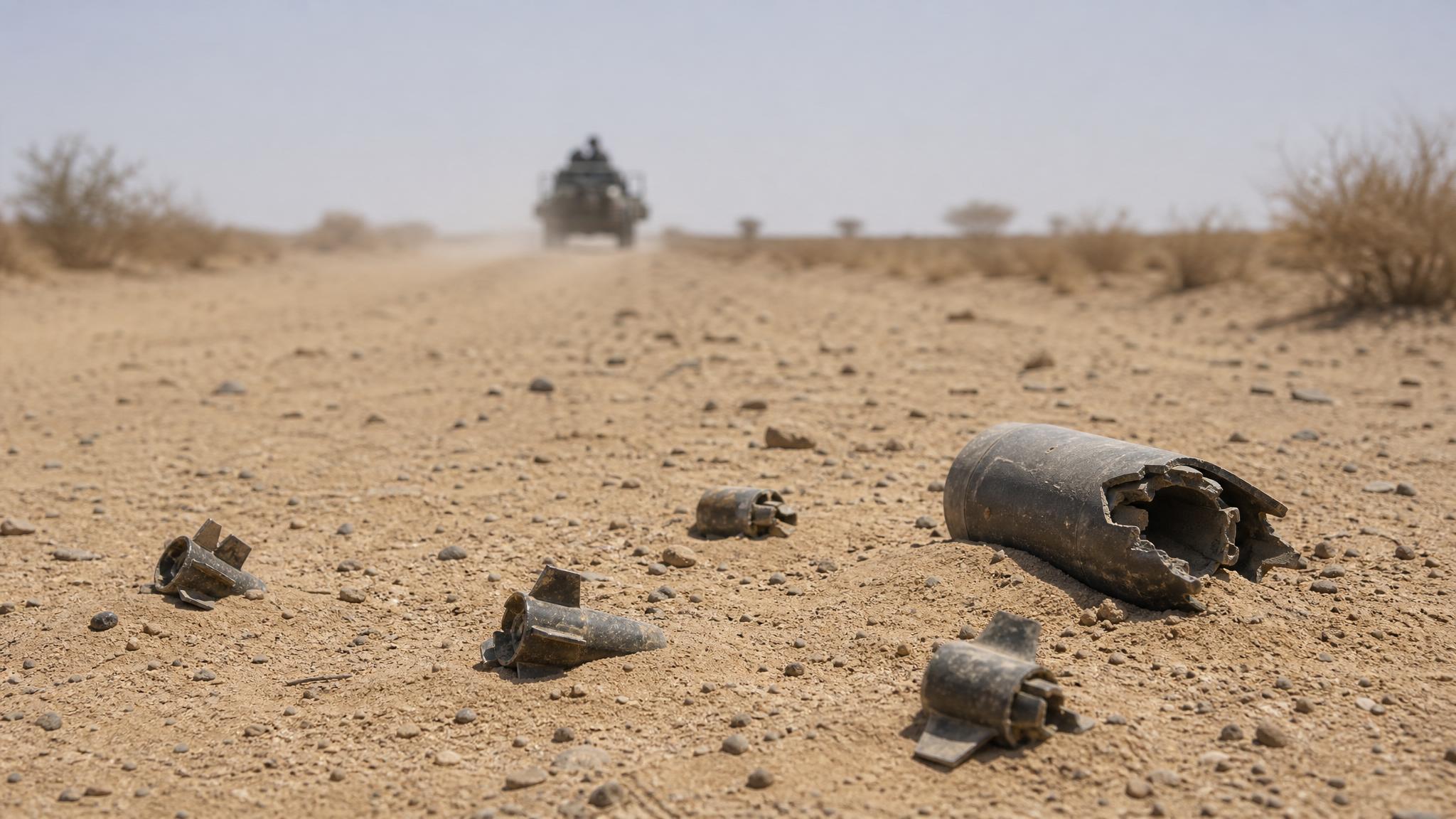
AI-generated illustration — unexploded munitions in a Sahelian environment, not a photograph of the strikes in Oubder or Tadjmart.
The two sites mentioned are not insignificant. Oubder, in the Tombouctou region, is located in the arc where armed movements test the depth of the Malian state after the coordinated attacks of April 25. Tadjmart, near Aguelhoc, refers to the road to Kidal, which is the symbolic and military heart of the North. These localities are passages, fallback zones, grazing areas, and corridors where the presence of the army depends as much on logistics as on firepower.
The use of the RBK-500 suggests an operational constraint. When a force uses saturation munitions, it seeks less to engage a single target than to deny an area, disrupt a concentration, or quickly strike a mobile adversary. This can have an immediate military logic against a column or a bivouac. But the same logic produces a lasting cost in a space where the army does not hold every village after the strike.
The Northern War becomes a war of denial
Since the attacks in April, the Malian balance of power is no longer that of a simple counter-insurgency campaign. The Support Group for Islam and Muslims (JNIM, affiliated with al-Qaeda) and the Azawad Liberation Front (FLA) have cooperated against Bamako despite their deep differences. Al Jazeera reported that JNIM claimed responsibility for attacks on several military sites, while the FLA asserted control over Kidal with Malian prisoners. The Guardian described the death of Defense Minister Sadio Camara and the withdrawal of elements of Africa Corps from Kidal as a strategic shock for Bamako and Moscow.
In this context, cluster munitions become the symptom of an army trying to regain the initiative from the air. Aviation, drones, and Russian partners allow strikes where ground columns advance too slowly. But holding the ground after a strike around Aguelhoc or on the routes to Tombouctou requires something else: local intelligence, units capable of staying for several days, demining teams, and a minimal relationship with the communities that must report unexploded ordnance.
This is where the Sahelian experience is brutal. A bombed and uncleared area becomes an abandoned zone. Armed groups know how to exploit this. They can harness the anger of families, film metal remnants, promise local justice, or simply wait for patrols to avoid contaminated paths. An unexploded submunition can therefore serve twice: first as a weapon, then as a political argument.
The Russian problem for Bamako
The Russian dimension is central, but it must be described accurately. RFI writes that the identified weapons are of Russian manufacture and that Malian forces operate with Africa Corps, a paramilitary force controlled by Moscow and heir to the Wagner footprint in Mali. This does not prove, at this stage, which crew dropped the munitions or which chain of command validated its use. This is information to be kept conditional.
But the political effect is already there. Mali has ratified the Convention on Cluster Munitions, which came into force in 2010. If the use is confirmed by independent investigations, Bamako will not be able to treat the matter as a technical detail. The junta had sold the break with Paris and the arrival of Moscow as a restoration of sovereignty. However, a sovereignty that depends on banned weapons and foreign advisors becomes fragile, especially when military results remain contested.
Africa Corps, for its part, needs to show that it brings more than a praetorian guard. After Kidal and the setbacks in April, its credibility hinges on the ability to produce visible effects. Saturation strikes respond to this pressure: they give an impression of power. But they also risk reducing Bamako's political space with the Tuareg, Arab, and Fulani communities in the North, already wary of operations conducted from the capital.
Bamako under logistical pressure
The most worrying situation is not only in the north. RFI also reports that, on Tuesday, at least fifteen vehicles, including buses, trucks, and cars, were set on fire near Faraba, between Siby and Narena, on the road connecting Bamako to Guinea. JNIM fighters reportedly made passengers disembark before burning the vehicles, with no deaths reported. This attack is part of the blockade that JNIM has imposed around Bamako since late April.
Here lies the operational paradox: while the army and its allies strike far to the north with heavy bombs, JNIM works the roads close to the capital. A capital does not fall solely through a frontal battle. It is strangled by fuel, trucks, markets, rumors, and the fear of taking to the road. If Bamako must dedicate its air resources to the North while securing the routes to Guinea, Côte d'Ivoire, and Ségou, the campaign becomes a war of kilometers.
In the French army, one quickly learns that a convoy in the Sahel is never just a simple movement. It is a complete operation: reconnaissance, repair, medical evacuation, fuel, radio communication, air cover if possible. The Malian forces face this equation with less logistical depth, a more mobile adversary, and Russian dependence. The RBK-500 does not solve these problems.
The risk of dead lands
The next step to watch is not just a diplomatic condemnation. It is much more concrete: who will mark Oubder and Tadjmart, who will warn the herders, who will neutralize the unexploded submunitions, and who will have access to the sites if the area remains contested? If no one does, these strikes will produce dead lands, spaces where the state does not really return but where civilians pay for a long time.
For Bamako, the threshold crossed is therefore double. Militarily, the army shows that it now accepts saturation means in a fragmented internal war. Politically, it exposes its counter-terrorism campaign to an accusation that will survive victory statements. Armed groups do not need to win all battles to exploit this fault. They just need to return to the paths when the army leaves, and let the metal remnants speak for them.
The Malian Army conducted airstrikes last week in Oubder and Tadjmart, utilizing RBK-500 cluster munitions. These strikes are part of anti-terror operations aimed at denying territory to armed groups. The use of such munitions raises concerns about long-term civilian safety due to unexploded ordnance. The involvement of Africa Corps, a paramilitary force linked to Russia, highlights the complex military dynamics in the region.
- Malian Army conducted airstrikes in northern Mali using RBK-500 cluster munitions.
- The strikes occurred in Oubder and Tadjmart, near Aguelhoc.
- RBK-500 can release up to 565 submunitions, posing long-term risks to civilians.
- The use of cluster munitions indicates operational constraints faced by the Malian forces.
- The situation reflects a shift in the military dynamics in northern Mali.