
Metele struck by the United States and Nigeria — 20 ISWAP fighters killed in 2026
 Marie Dubois
Metele struck by the United States and Nigeria — 20 ISWAP fighters killed in 2026
In Metele, in northern Borno, the war against the Islamic State in West Africa has taken a more precise, discreet, and American form. On May 17, the U.S. Africa Command (AFRICOM) confirmed it had conducted, in coordination with the Nigerian government, new kinetic strikes against Islamic State militants in northeastern Nigeria. The following day, the Nigerian Defence Headquarters reported that more than 20 ISIS/ISWAP fighters had been killed after observing a concentration and movement of armed groups around Metele.
This is not an isolated operation. It comes just days after the announcement of the death of Abu-Bilal al-Minuki, presented by Washington and Abuja as a senior leader of the Islamic State and a major figure in ISWAP. On the ground, the sequence matters as much as the toll. First, a decapitation strike, then a follow-up strike against the regrouping fighters. It is a hunting sequence, not just a show of force.
A limited but very political strike
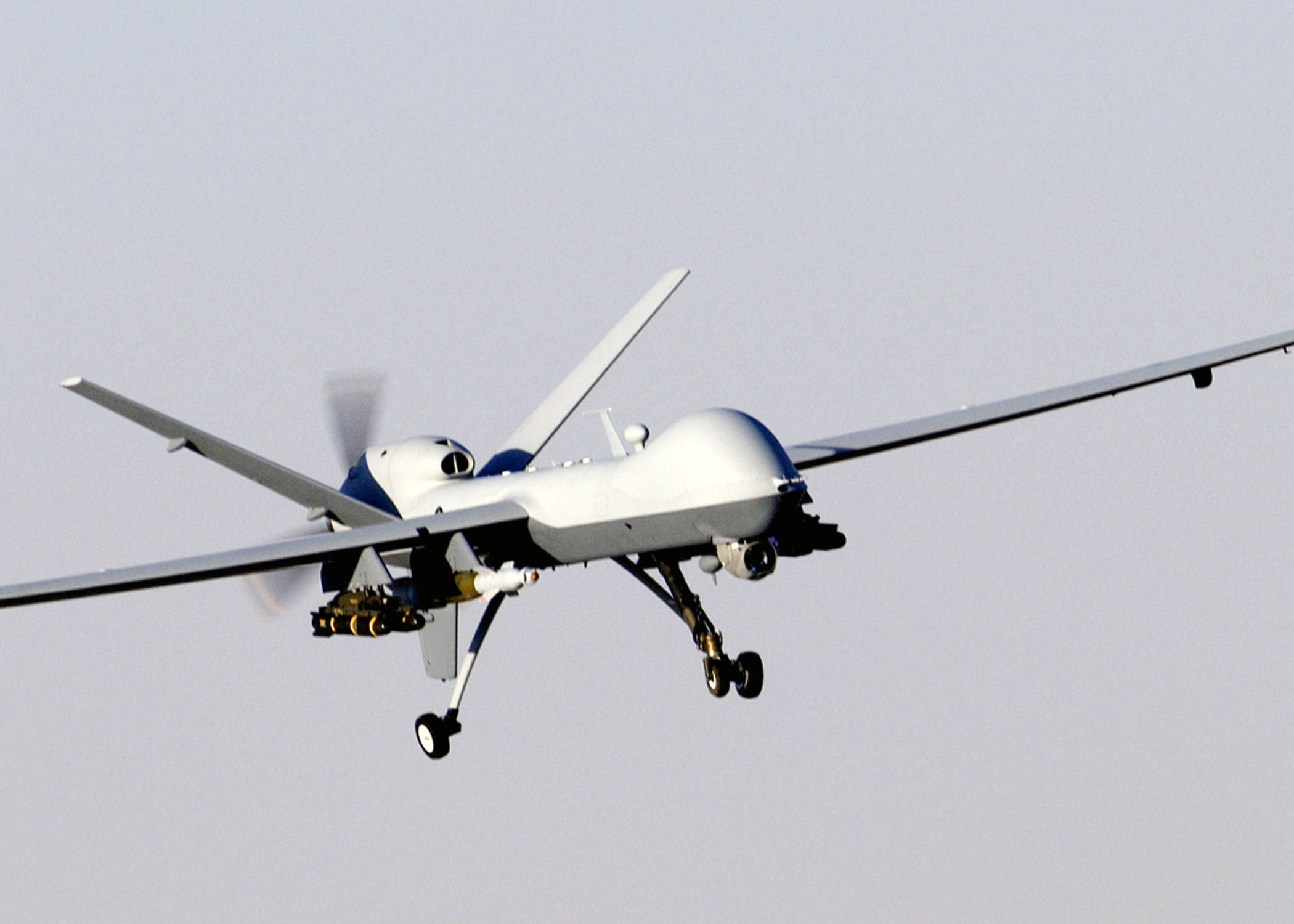
The image illustrates an American capability for surveillance and precision strikes. It does not show the operation in Metele.
AFRICOM chose a brief formulation. The targets were reportedly confirmed as Islamic State militants by intelligence, full assessments are ongoing, and no American or Nigerian military personnel were reported injured. This caution is important. In this theater, an enemy casualty figure without independent assessment remains a tactical indicator, not proof of strategic disruption.
The Nigerian statement is more aggressive. General Samaila Uba, director of defense information, claims that the strikes are part of a campaign aimed at dismantling terrorist networks, preventing sanctuaries, and maintaining pressure on armed groups in the Northeast. This rhetoric is classic in Abuja. But the new operational fact lies elsewhere: Nigeria publicly acknowledges close coordination with AFRICOM at a time when national sovereignty remains a sensitive issue throughout West Africa.
The key phrase from AFRICOM is not the death toll. It is the commitment to employ specialized American capabilities for the benefit of partners. In military language, this means intelligence, surveillance, targeting, data fusion, and probably remote strike capability.
Metele remains a key point in Lake Chad
Metele is not an anonymous point on the map. The locality is located in northern Borno, deep in the Lake Chad basin, where roads, sandy tracks, and lakeside areas allow armed groups to disappear among islets, abandoned villages, and vegetation zones. From experience, it is terrain that punishes heavy columns and rewards mobile networks. One can lose contact for a few hours and find the adversary twenty kilometers away, already mixed in with civilian flows.
ISWAP has built part of its resilience on this geography. The group does not need to hold a city for long to impact regional security. It only needs to maintain local intelligence relays, caches, escape routes to the shores of the lake, and a capacity to strike isolated posts. The death of a leader, even an important one, does not automatically destroy this system. However, it can create a short window during which communications, finances, and internal discipline become disorganized.
It is probably this window that the strikes in Metele seek to exploit. After the death of al-Minuki, fighters must regroup, confirm survivors, move weapons, choose who commands, and decide whether to retaliate. These movements create signatures. A group that remains dispersed is difficult to target. A group that concentrates to restore its chain of command becomes vulnerable.
The American return is not Barkhane
The comparison with the Francophone Sahel is tempting, but it can be misleading. Washington is not returning to Nigeria with a territorial presence operation comparable to Barkhane in Mali or Niger. The emerging model is lighter: a few dozen military personnel, intelligence sharing, technical training, targeting support, and strikes when the opportunity is deemed sufficient. Al Jazeera reminds us that American soldiers have recently been deployed to Nigeria for training, intelligence, and technical support, under Nigerian command authority according to Abuja.
This architecture has an obvious political advantage. It avoids large visible bases, foreign convoys on the roads, and the image of a Western army permanently stationed in the country. It also gives the Tinubu government a narrative margin: the operation is Nigerian, and American capabilities are a force multiplier.
But it creates a less visible dependency. If the intelligence that allows for target fixation primarily comes from American means, then operational sovereignty is measured less by the flag on the statement than by control of the detect-identify-strike-assess chain. This is where many Sahelian armies have found themselves trapped: able to claim a victory, less able to reproduce it without the foreign architecture around them.
ISWAP can absorb human losses
More than 20 fighters killed, if the figure is confirmed, is a real success. It reduces a cell, disrupts a meeting, and may deprive ISWAP of mid-level leaders. But it is not the type of loss that destroys an insurgency rooted in the Lake Chad basin. The group has already survived strikes, internal rivalries, ground operations, and repeated announcements of the neutralization of commanders.
The real question is the pace. A precision strike every few months produces a media effect. A sustained series, based on reliable local intelligence, can make regroupings dangerous, complicate logistics, and force commanders to communicate less. This slows down an organization. It does not replace it with the state.
The opposite risk also exists. If strikes become the primary tool, Nigerian forces may neglect the slower work: controlling axes, human intelligence, protecting markets, minimal repair of local administration. In Borno, the population knows very well how to distinguish between a successful explosion and lasting security.
The next phase will be played on the ground
Full assessments from AFRICOM are still ongoing. It is not yet known which leaders were killed, whether civilians were affected, or if the strikes destroyed significant equipment. This area of uncertainty must remain in the analysis. The fog is not a bureaucratic detail; it is a constant of the theater.
For Abuja, the immediate challenge is to prevent ISWAP from turning the loss of al-Minuki into a retaliation campaign. For Washington, it is about showing that a limited American presence can produce rapid effects without reopening the debate on large African bases. For civilians in Borno, the question is simpler: will the road, the market, and the school be safer next week?
The answer will depend less on the victory statement than on what follows around Metele, Monguno, and the shores of the lake. If Nigerian units occupy the crossing points, exploit captured intelligence, and maintain pressure without punishing communities, the strike on May 17 will have had operational value. If the space is left empty after the explosions, ISWAP will return via secondary routes. In northern Borno, a strike opens a door. It does not hold the ground.
Sources: U.S. Africa Command, statement of May 18, 2026; Nigerian Defence Headquarters cited by TheCable, Premium Times, and Channels Television; Al Jazeera, May 18, 2026.
On May 17, 2026, U.S. Africa Command and Nigerian forces conducted airstrikes in Metele, Borno, killing over 20 ISWAP fighters. This operation, part of a broader campaign against terrorist networks, was confirmed by both AFRICOM and the Nigerian Defence Headquarters. The strikes utilized U.S. intelligence and precision targeting capabilities.
- U.S. and Nigerian forces conducted airstrikes on May 17, 2026.
- Over 20 ISWAP fighters were reported killed.
- The operation was coordinated with the Nigerian government.
- The strikes are part of a campaign to dismantle terrorist networks in the region.
- The operation highlights U.S. military capabilities in precision strikes.