
Middle East Conflict: U.S. "Tomahawk" Missile Usage Hits Record High with 850 Launched, About Half of U.S. Military's Middle East Stockpile
【Global Times Special Correspondent Chen Yang】The military actions launched by the United States and Israel against Iran have been ongoing for over a month, and the high-intensity combat operations are rapidly depleting U.S. military ammunition reserves. The U.S. newspaper Stars and Stripes reported on March 30 that "the U.S. military has launched a record number of 'Tomahawk' cruise missiles so far." Bloomberg warned on March 31 that the U.S. military has consumed at least 2,400 interceptors in its operations to intercept Iranian missiles and drones. Under pressure from ammunition stockpile constraints, the U.S. even requested Poland to deploy a set of "Patriot" missile defense systems in the Middle East, but Poland refused.
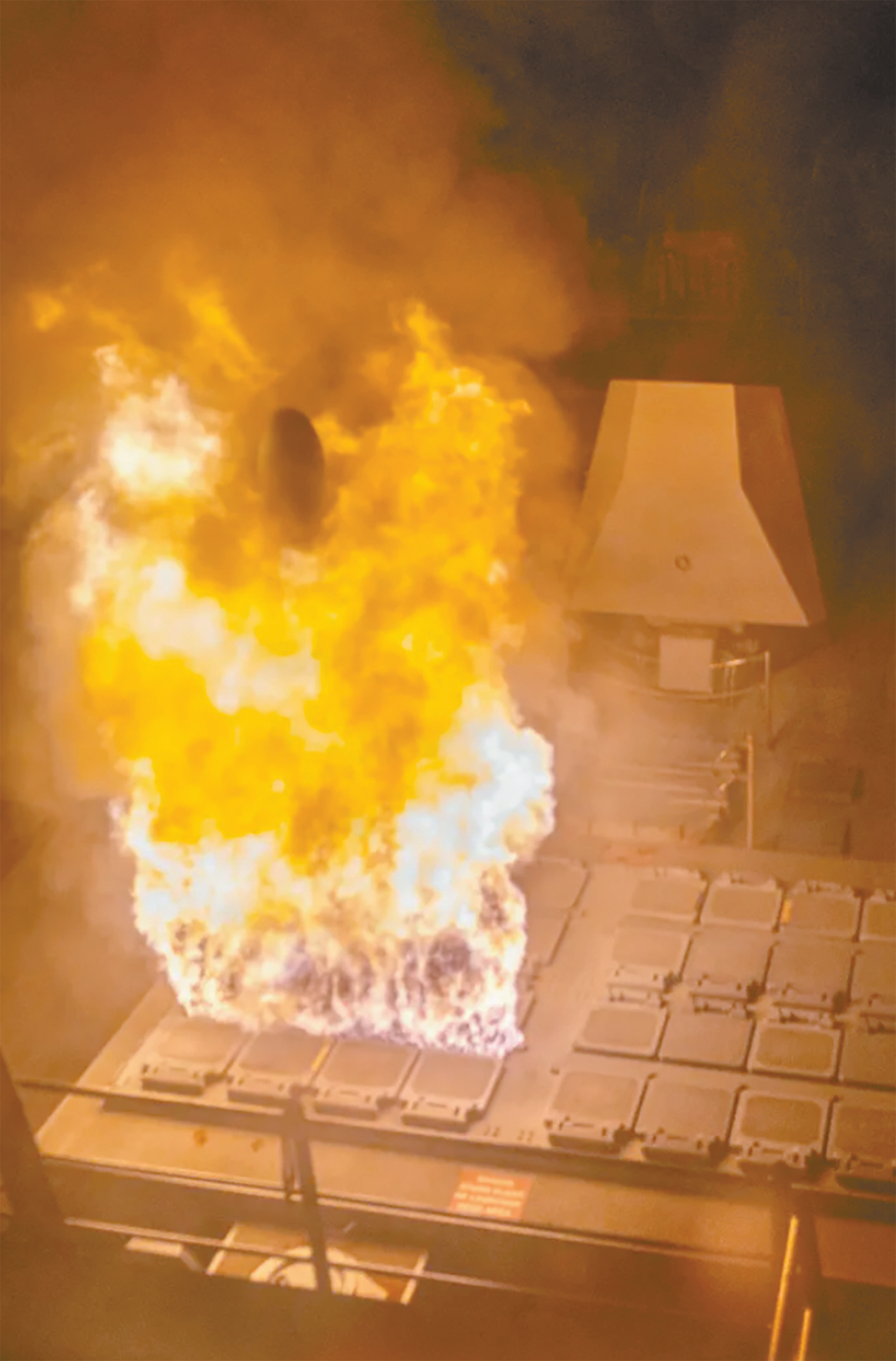
Record Consumption of 'Tomahawk' Missiles
According to Stars and Stripes, the latest analysis from the Center for Strategic and International Studies (CSIS) shows that the Pentagon has launched "more Tomahawk missiles than in any other military operation in history" during the "Epic Fury" operation against Iran. The report states that replenishing these ammunition stocks will take time and "will pose short-term risks to the United States."
The Washington Post recently cited unnamed U.S. officials stating that since the U.S. and Israel launched military actions against Iran, the U.S. Navy has fired over 850 "Tomahawk" missiles, and some within the Pentagon have expressed concerns about the quantity of missiles consumed. According to Pentagon documents, the total procurement of "Tomahawk" missiles by the U.S. since production began is 9,240. Since 2019, the U.S. has maintained its "Tomahawk" missile stockpile through regular recertification and modernization upgrades of older models, with about 250 missiles undergoing modernization each year.
Mark Cancian, a senior advisor at CSIS, analyzed that after deducting the number of missiles used by the U.S. military in previous conflicts and routine training, the U.S. Navy may have had only 3,100 "Tomahawk" missiles before launching military actions against Iran. If the report of the U.S. military firing 850 "Tomahawks" is true, it means that the U.S. military has used about 1/4 of its total stockpile. According to Russian news agency Sputnik, based on this calculation, the remaining "Tomahawk" missile stockpile can only sustain battlefield consumption for 3.7 months.
Stars and Stripes reported that the number of "Tomahawk" cruise missiles used by the U.S. military in the "Epic Fury" operation has exceeded that of the 2003 "Operation Iraqi Freedom," during which the U.S. military launched a total of 802 "Tomahawk" missiles. Following that was the 1998 "Operation Desert Fox" in Iraq (325 missiles) and the 1991 "Operation Desert Storm" against Iraq (288 missiles). What concerns U.S. think tanks even more is that the 850 "Tomahawk" missiles are equivalent to about half of the U.S. military's stockpile in the Middle East. The U.S. military's active "Tomahawk" missiles can only be launched from naval surface ships and submarines, "they cannot be resupplied at sea, and once these missiles are expended, U.S. naval vessels need to return to ports with specialized facilities to reload."
According to data obtained by CSIS, the U.S. military actually procures about 90 "Tomahawk" missiles each year. Pentagon budget documents show that the U.S. Navy has only requested funding for 57 of these missiles for the fiscal year 2026. Recent Pentagon notifications indicate that future annual production of "Tomahawk" missiles will be increased to over 1,000, but this will take time.
Other Weapons Also Consumed in Large Quantities
In addition to the large number of "Tomahawk" cruise missiles, Bloomberg reported that the U.S. military has also consumed a significant amount of precision-guided munitions in its airstrikes against Iran, including over 1,000 units of the "Joint Air-to-Surface Standoff Missile" (JASSM), which costs $1.5 million each. This stealth missile is primarily carried by U.S. military aircraft, with a basic range of about 370 kilometers and an extended range of about 900-1,000 kilometers. Bloomberg cited U.S. official documents stating that its manufacturer, Lockheed Martin, can produce a maximum of only 860 JASSM missiles in 2026, far from replenishing wartime losses.
Because of this, photos circulating on social media show that U.S. Air Force B-52 strategic bombers, which typically carry JASSM missiles for standoff strike missions, have started directly entering Iranian airspace to drop "Joint Direct Attack Munitions" (JDAM) guided bombs since late March. The latter has a relatively abundant stockpile and has become the primary munition widely used by U.S. military aircraft in the latter half of the conflict. However, due to the shorter range of JDAM guided bombs, it also increases the risk of U.S. airstrikes.
Although White House Press Secretary Levitt previously stated that the U.S. military "has more than enough arms, ammunition, and weapon reserves to achieve the operational goals set by President Trump," U.S. Secretary of Defense Hegseth also claimed, "We are not short on ammunition." However, reports from U.S. think tanks warn that the massive consumption of "Tomahawk" and other missiles in the "Epic Fury" operation poses risks for the U.S. in other theaters—especially the Western Pacific.
According to Kelly Grieco, a senior researcher at the Stimson Center, "We have recognized the inadequacy of long-range strike capabilities, so we have been working to accumulate a stockpile of high-end precision strike weapons, but in reality, ongoing conflicts have led to their continuous depletion." Although the Pentagon has announced it will invest more funds for this purpose, U.S. defense analysts state that increasing missile production is not something that can yield immediate returns just by investing money; it requires a corresponding defense industrial base, ample supply of critical materials, and a sufficient number of skilled workers.
Foreign Media Reports Contradict Pentagon Statements
Bloomberg reported that, in addition to the severe depletion of offensive munitions, the inventory of interceptors in the U.S. air defense missile defense systems is also in urgent need. Since the outbreak of the U.S.-Israel-Iran conflict, the U.S. and its allies in the Middle East have launched at least 2,400 interceptors, mainly "Patriot-3" and "Patriot-2" missiles. Before the conflict erupted, the total stockpile of Gulf countries was less than 2,800 missiles. According to statistics from The Washington Post, the U.S. military alone has launched over 1,000 interceptors, including those from the "Patriot" series and the "THAAD" missile defense system.
To replenish losses, the U.S. military has had to redeploy missile defense systems from Europe and the Asia-Pacific region, which has raised concerns among U.S. allies. The Polish newspaper Rzeczpospolita reported on March 31 that the U.S. requested Poland to transfer a set of "Patriot" missile defense systems for deployment in the Middle East to replenish its increasingly urgent ammunition stockpile. The Polish Defense Minister responded that Poland's missile defense system is used to protect its airspace and NATO's eastern flank and "will not be moved elsewhere."
What worries U.S. media even more is that, despite Pentagon officials claiming that since the conflict began, Iranian missile and drone launches have decreased by about 90%, five individuals familiar with U.S. intelligence told Reuters that the Pentagon can only confirm that it has destroyed about 1/3 of Iran's missile stockpile, with another 1/3 of Iranian missiles remaining uncertain, possibly damaged due to U.S.-Israeli bombings or hidden in underground tunnels and bunkers. Sources also revealed that assessments of Iran's drone capabilities are similarly uncertain. These statements starkly contrast with those of Trump and the Pentagon, suggesting that the effectiveness of U.S. airstrikes may not be as good as the Pentagon boasts, and if the conflict continues, it will place greater pressure on U.S. ammunition stockpiles.
The U.S. Navy has launched over 850 Tomahawk missiles in military operations against Iran, significantly depleting its missile stock in the Middle East. This operation has been ongoing for over a month, with the U.S. military also consuming at least 2400 intercept missiles. Concerns have arisen regarding the sustainability of U.S. missile inventories, as the remaining stock can only support operations for about 3.7 months at the current rate.
- U.S. has launched over 850 Tomahawk missiles against Iran, depleting about half of its Middle East stock.
- U.S. military has consumed at least 2400 intercept missiles during operations against Iranian missiles and drones.
- The Pentagon's analysis indicates that the current missile usage exceeds historical military operations.
- The U.S. Navy's remaining Tomahawk inventory can sustain operations for approximately 3.7 months at the current rate of consumption.
- Poland refused U.S. request to deploy a Patriot missile system to the Middle East.