
Mikhail Britnev delivers armored vehicles to Mali — Russia strengthens Africa Corps after 3,435 deaths
 Marie Dubois
Mikhail Britnev delivers armored vehicles to Mali — Russia strengthens Africa Corps after 3,435 deaths
On July 25, in Bamako, Malian state television showed a long column of armored vehicles and military trucks entering the capital. This was not just a simple display of equipment. According to a BBC Verify investigation published on August 2, these vehicles appear to have been transported to the port of Lomé by the Russian cargo ship Mikhail Britnev, a vessel already sanctioned by the United States, before crossing through Togo and then Burkina Faso to reach Mali.
On the ground, this logistical detail matters more than many political statements. An army that is losing the initiative in the north does not recover with slogans. It recovers with trucks, troop carriers, spare parts, fuel, and a route safe enough to move the convoy. Russia has thus sent a very concrete message to Bamako: it is not withdrawing from the Malian theater, even after the recent setbacks of Africa Corps.
A maritime route from Baltiysk to Lomé and then a Sahelian road
According to BBC Verify, the Mikhail Britnev left Baltiysk, on the Baltic Sea, on June 18. Maritime tracking data indicates that it passed through the North Sea and then the English Channel, where it was reportedly accompanied by a Russian Ropucha-class vessel. The ship then turned off its transponder before reappearing as it approached Lomé on July 9. Satellite images analyzed by experts would show trucks, BTR-type armored personnel carriers, and light infantry vehicles on board.
The most sensitive part is not just maritime. The land route announced by Bamako passes through Togo and Burkina Faso, two areas that illustrate how the Malian war is no longer just read on a national map. Lomé signed a military cooperation agreement with Moscow at the end of 2025. Ouagadougou, led by a junta also close to Russia, serves as a strategic depth between the Gulf of Guinea and the central Sahel. For anyone who has followed a column in this area, the real test begins after the port: long roads, checkpoints, vulnerability to ambushes, and the need for local intelligence.
Why this delivery comes at the worst time for Bamako
The timing explains the urgency. The Associated Press and TimesLIVE describe Mali as being engaged in its most serious security crisis in several years. The Jama'at Nusrat al-Islam wal-Muslimin (JNIM), affiliated with al-Qaeda, and the Azawad Liberation Front (FLA), a Tuareg separatist movement formed in 2024, are now coordinating certain operations against Malian forces and Africa Corps. This is not an ideological merger. It is tactical coordination against a common enemy.
According to data cited by AP from ACLED, deaths related to attacks by armed groups in Mali increased by 35% in the first seven months of 2026, rising from 2,546 in the same period in 2024 to 3,435. This increase provides a cold measure of Bamako's operational failure since the break with Paris. The departure of Barkhane in 2022 was supposed to open a phase of military sovereignty. Four years later, Malian sovereignty depends on a flow of Russian material that passes through a Togolese port and traverses another coup-led state.
The delivery can help rebuild mobile capabilities. BTR armored vehicles and military trucks provide endurance to a force that must simultaneously hold the north, the center, and the routes leading to Bamako. But they do not solve the main problem: dispersion. The JNIM knows how to force an army to hold too many points at once. The FLA adds knowledge of the northern terrain that the columns coming from Bamako do not always possess.
Africa Corps gains weight but loses discretion
The replacement of Wagner by Africa Corps, a structure now anchored to the Russian Ministry of Defense, has changed the political nature of the engagement. Moscow no longer has just a mercenary proxy in Mali. It bears a more direct share of military responsibility, and thus of reputational cost. This is where the Human Rights Watch report, relayed by Al Jazeera on July 31, becomes important.
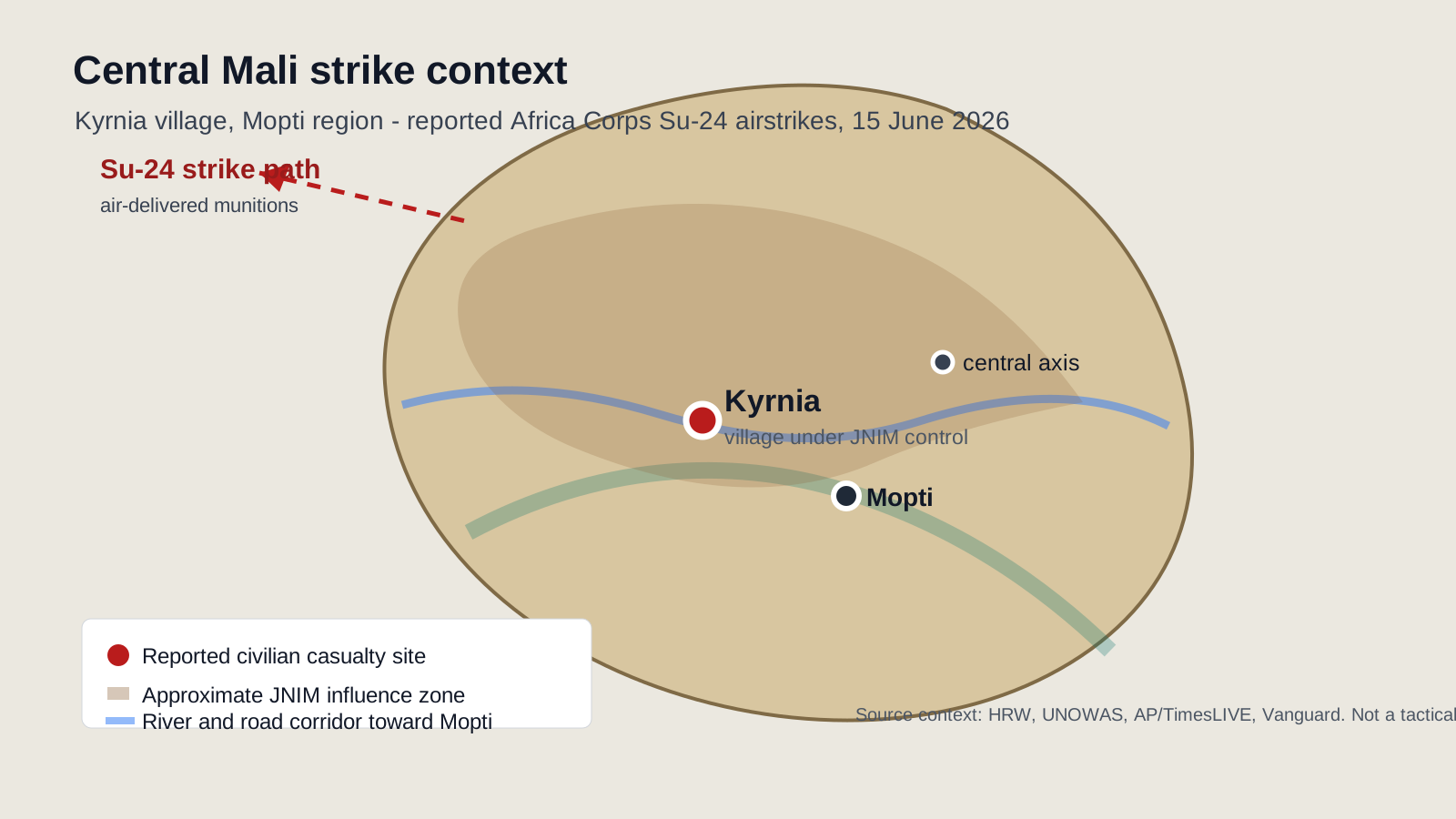
HRW accuses Russian paramilitaries from Africa Corps of killing eight civilians, including three children, during an airstrike on June 15 in Kyrnia, in the Mopti region. The organization claims that an aircraft identified by two Malian military sources as a Su-24 dropped at least two munitions. HRW specifies that about 100 JNIM fighters were in the village, controlled by the group for six years, but that the targeted points were not jihadist positions. Africa Corps, for its part, claimed to have struck a gathering of terrorists and eliminated several commanders. The two versions cannot be reconciled without an independent investigation.
This is where field experience imposes caution. In a village under JNIM control, the line between coercion, forced commerce, and real collaboration is often blurred. But a strike that hits the residence of a village chief or a small livestock market does not automatically become legitimate because the village lives under jihadist authority. In counterinsurgency, this type of error is never just moral. It produces lost intelligence, families that remain silent, and roads that close.
The convoy is not enough to retake the north
Militarily, the vehicles delivered by the Mikhail Britnev can allow Bamako and Africa Corps to prepare limited offensives towards recently lost areas. Charlie Werb, an analyst at Aldebaran Threat Consultants cited by BBC Verify, believes that Moscow continues to provide forces, weapons, and equipment since the conflict entered a new phase on April 25. This is consistent: Russia cannot allow its main Sahelian partner to appear abandoned at a time when the JNIM and the FLA show that they can act together.
But a mechanized offensive in northern Mali requires more than a fleet of vehicles. It is necessary to secure the routes, maintain tires and transmissions, supply the armored vehicles, evacuate the wounded, find reliable guides, and prevent the adversary from choosing each engagement. Between Mopti, Niono, Anefis, and the northern roads, distances quickly consume the apparent power of a column. The jihadists and separatists do not need to destroy all the vehicles. They only need to slow down, isolate, and force Bamako to disperse its reserves.
A Russian war without a quick victory
The delivery of the Mikhail Britnev thus shows one clear thing: Moscow is doubling down in Mali. It is willing to mobilize a sanctioned maritime route, a West African port, and a land corridor controlled by friendly regimes to keep Africa Corps in the fight. For Bamako, this is an immediate political assurance. For Malian civilians, it is more ambiguous: more resources may mean better protection of the routes, but also an intensification of strikes and retaliatory operations in villages suspected of supporting the JNIM.
The next indicator will not be the exact number of armored vehicles that entered Bamako. It will be necessary to see if the Malian and Russian forces can sustainably reopen threatened routes and hold the recaptured areas for more than a few weeks. If the convoy remains a show reserve around the capital, the JNIM and the FLA will have already won the essential: forcing Russia to sustain a war of attrition far from its ports, on routes that its adversaries know better than it does.
On July 25, 2026, a long column of armored vehicles and military trucks arrived in Bamako, Mali, delivered by the Russian cargo ship Mikhail Britnev. This shipment, which included BTR armored personnel carriers, was part of Russia's ongoing support for Africa Corps amid a severe security crisis in Mali, marked by increased attacks from armed groups. The logistical route involved transport through Togo and Burkina Faso, highlighting the complexities of military supply in the region.
- Mikhail Britnev delivered armored vehicles to Mali on July 25, 2026.
- The delivery included BTR armored personnel carriers and military trucks.
- The equipment was transported from Baltiysk to Lomé, then through Togo and Burkina Faso to Bamako.
- Mali is experiencing its most severe security crisis in years, with increased attacks from armed groups.
- Africa Corps has taken on a more direct military role in Mali, replacing Wagner.