
EU releases 3.47 billion euros for Gripen and drones — Europe's air defense remains a timing issue
 Dr. Klaus Weber
EU releases 3.47 billion euros for Gripen and drones — Europe's air defense remains a timing problem
3.47 billion euros flowed to Kyiv on July 30. The European Commission refers to it as the defense facility of the 90-billion-euro Ukraine Support Loan; funding is intended for drones, missiles, air defense, and combat aircraft, including the Swedish Gripen package. The amount sounds large enough to be considered a breakthrough in Brussels. However, it is small enough to reveal the fundamental problem: Europe can release money faster than it can train pilots, develop interceptors, sensors, and integrated command chains.
This is not a rhetorical triviality. In the same week, several sources reported that Kyiv aims to have a prototype of the European missile defense project Freyja by mid-2027. A prototype in 2027 is quick for a defense administration. For a city that must defend against ballistic missiles today, it is late. It is precisely in this gap between budget logic and wartime that Europe's strategic dilemma lies.
What the 3.47 billion euros actually buy
The Commission describes the payment as part of the defense window within the 90-billion-euro loan for Ukraine. This is important because it is not a classic bilateral arms delivery. It is a financial architecture: Brussels lends, Kyiv procures, national industry and supply chains implement. For drones and ammunition, this model can work because Ukrainian and European manufacturers have relatively short production cycles. The situation is different for aircraft and air defense.
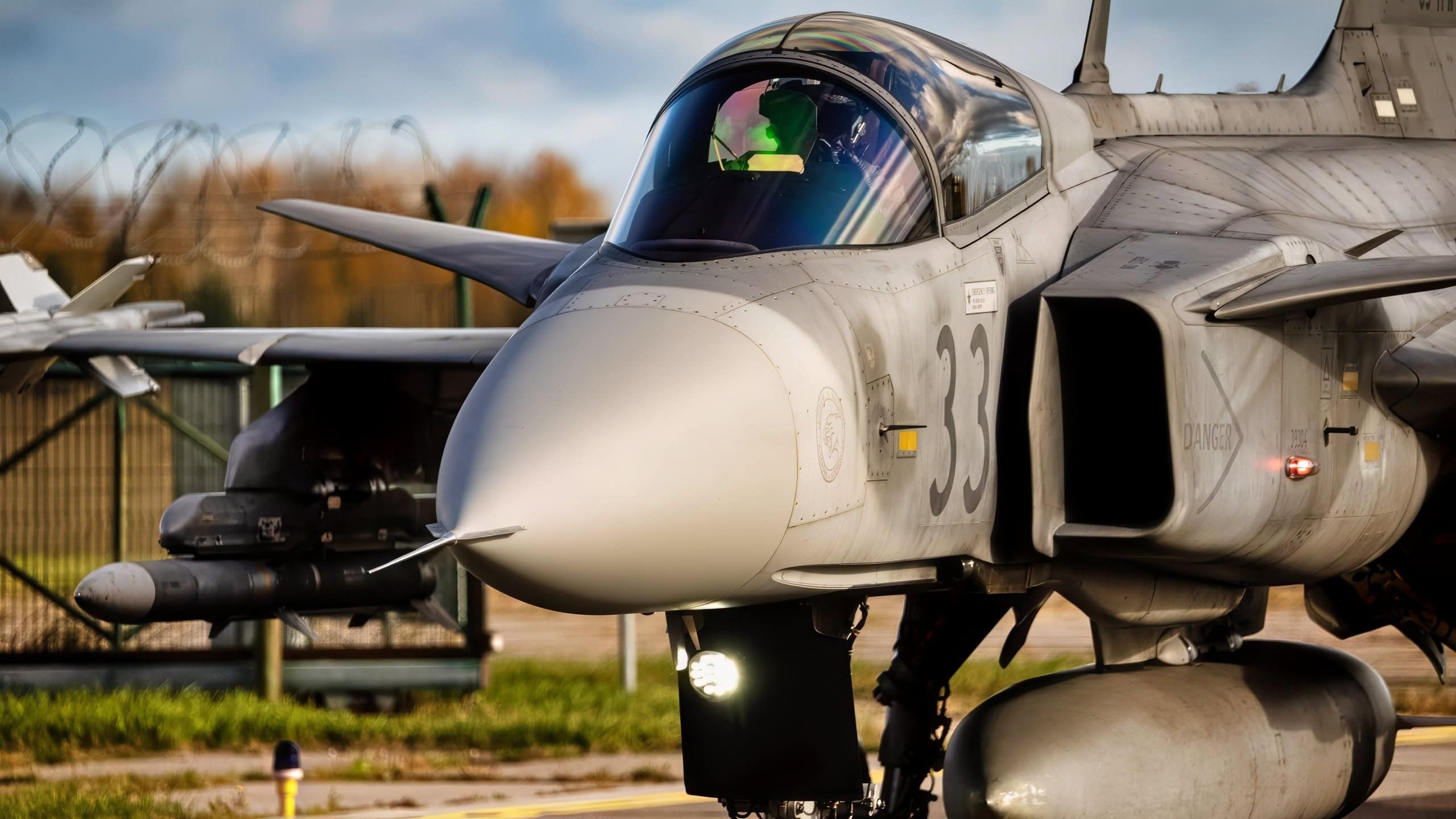
A Gripen is not an artillery shell. The JAS 39 was designed for decentralized operations, short runways, and relatively low ground crew requirements; that is precisely why it is politically attractive for Ukraine. But even a comparatively maintenance-friendly fighter jet requires training, spare parts, data links, mission planning, weapons integration, and secured airfields. If EU money finances Gripen capabilities today, it does not immediately buy air superiority. It buys an option for Ukrainian air defense in two or three operational cycles.
The same applies to air defense. Patriot, SAMP/T, IRIS-T SLM, NASAMS, and future European systems cover different altitudes, ranges, and threats. Against Shahed drones, an expensive Patriot interceptor is economically nonsensical; against Iskander or Kinzhal profiles, cheap short-range defense is militarily inadequate. Therefore, the 3.47 billion euros must not only buy material but also a layering of systems. This very layering is Europe's weak point.
Freyja shows the institutional bottleneck
The Freyja project is politically understandable. Kyiv wants a European response to the dependence on American Patriot systems. According to Reuters, a prototype is to be developed by mid-2027; already in mid-July, there was talk of a coalition against the Russian ballistic threat. This sounds like European strategic autonomy in its most useful form: not as a slogan, but as a concrete defense system against a specific Russian operational pattern.
But a missile defense system is the opposite of a pure procurement item. It combines early warning, fire control, radar, launchers, software, interceptors, logistics, and rules of engagement. Whoever writes the software determines what the system sees. Whoever builds the interceptor determines against which speed and trajectory it can realistically operate. Whoever approves the rules of engagement determines whether it reacts in seconds or in session logic. Europe has industrial competence in all three areas. It has rarely bundled them in a common program in a timely manner.
Here, the difference between capability and capacity becomes visible. Europe can technologically develop almost everything needed for Ukrainian air defense. However, it cannot automatically deliver it in the necessary quantities, at the necessary time, and with compatible operational chains. This is not a lack of engineers. It is a lack of institutional acceleration.
Germany remains a key state and bottleneck at the same time
The Ukrainian side is simultaneously talking about a long-term defense partnership with Germany. This makes sense: Germany is central to IRIS-T, artillery, ammunition, armored vehicles, and industrial financing. At the same time, Germany shows why money alone does not replace strategy. The special fund has enabled procurements, but it has not transformed the Bundeswehr overnight into an industrial pace-setter. Berlin can help Kyiv, but Berlin cannot provide Brussels alone with the missing program leadership.
The smaller European contributions illustrate the same pattern. Latvia wants to deliver 42 Patria vehicles to Ukraine; Baltic states continue to train Ukrainian soldiers; individual governments finance drone lines or ammunition. Each of these steps is useful. However, together they do not automatically result in a European air defense architecture. They create a mosaic, the military value of which depends on whether someone assembles the pieces with operational authority.
More European money is necessary. It just does not equate to more European defense capability.
The political risk of the credit model
The 90-billion-euro framework has one advantage: it makes support more predictable. Ukraine can rely on multi-year financial flows instead of waiting monthly for national budget debates. This is crucial for defense planning. Factories do not build layers out of declarations of solidarity; they build layers when orders are reliable.
The downside lies in the diffusion of responsibility. When Brussels pays, Kyiv orders, Sweden delivers Gripen components, Germany supplements air defense, and national parliaments review export or budget issues, it becomes difficult to say who is politically responsible for delays. The EU is good at translating money into programs. It is worse at transforming programs under wartime pressure into unified military effect.
This becomes particularly dangerous if the United States conditions its aid to Ukraine more strongly or limits it technologically. Europe wants to be less dependent on Washington but remains closely tied to American infrastructure in strategic air defense, satellite reconnaissance, ammunition standards, and high-value components. Freyja can reduce this dependence in the long term. It cannot replace it by 2026.
The real question for 2026
The Brussels payment is therefore neither symbolic politics nor a breakthrough. It is a serious step in an incomplete system. For Kyiv, what matters now is whether the 3.47 billion euros lead to more interceptor capacity, more drone production, more air defense missiles, and a reliable Gripen path before winter. For Europe, what matters is whether it learns to distinguish between financing and capability.
The irony is bitter: Europe must now spend money, even though money does not solve the core problem. Without money, there are no factories, no pilots, and no interceptors. But with money alone, there is still no integrated air defense. The 3.47 billion euros buy time for Ukraine. Whether they also buy time for Europe's strategic maturation depends on whether Brussels finally turns the credit instrument into an industrial command structure.
Source basis: European Commission IP/26/1710 from July 30, 2026; Reuters on Freyja and the European missile defense initiative from July 27, 2026; Chatham House on the Ukrainian air defense gap from July 28, 2026; Ukrainian Ministry of Defense on the German-Ukrainian defense partnership from July 28, 2026; LSM on the Latvian Patria delivery from July 31, 2026.
The European Union allocated 3.47 billion euros for defense procurement to Ukraine on July 30, 2026, aimed at enhancing military capabilities through drones, missiles, air defense systems, and Gripen fighter jets. This funding is part of a broader strategy to reduce reliance on American defense systems and improve European military autonomy. However, challenges remain in timely production and integration of these systems into a cohesive defense architecture.
- 3.47 billion euros allocated by the EU for defense support to Ukraine.
- Funding includes procurement of drones, missiles, air defense systems, and Gripen jets.
- A prototype of the Freyja missile defense system is expected by mid-2027.
- Germany is a key player in the defense partnership with Ukraine.
- The funding model raises concerns about accountability and strategic effectiveness.