
Multiple Parties in a Stalemate, Defense Autonomy Faces Severe Setbacks, Europe's Next-Generation Fighter Jet's Path is Unclear
[Global Times Special Correspondent Chen Yang, Global Times Reporter Ma Jun] The sixth-generation fighter jet project, the "Future Combat Air System" (FCAS), jointly promoted by Germany, France, and Spain, has recently been halted after repeated delays. According to a report by U.S. Defense News on the 9th, German Chancellor Merz and French President Macron have agreed to cancel the project, ending this iconic defense initiative in Europe. The Financial Times reported on the 9th that against the backdrop of global air forces moving towards sixth-generation fighters, the future development prospects of Europe's fighter jets have been overshadowed.
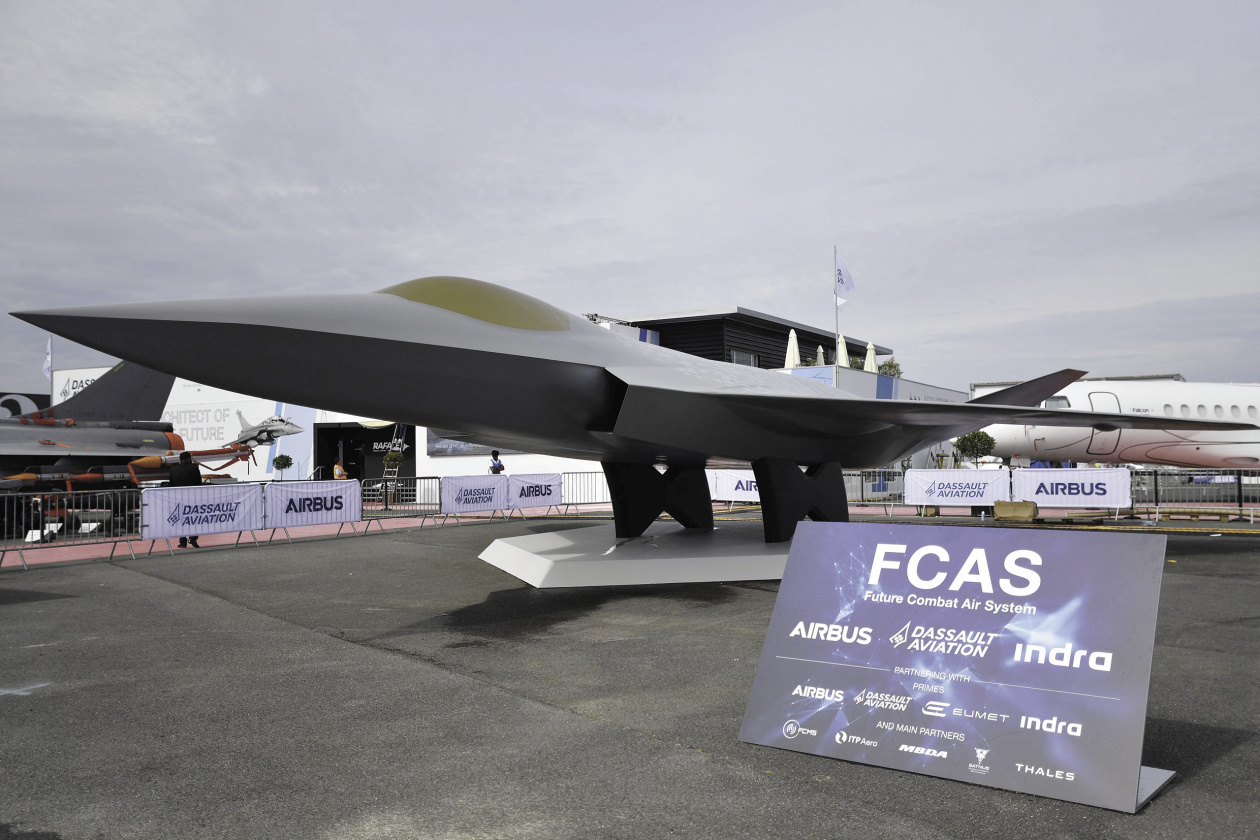
From Ambitious to Difficult
Reuters reported that Merz and Macron discussed the troubled FCAS fighter jet during a break at the EU-Western Balkans summit held in Montenegro. After consultations, the leaders of France and Germany concluded that the European aerospace group Airbus, representing Germany and Spain, and France's Dassault Aviation could not reach an agreement on the "joint development of the fighter jet," and "there is no hope of breaking the months-long deadlock." Merz suggested that Macron stop the development work on the fighter jet. "This highlights the difficulties Europe faces in rebuilding its military capabilities after decades of underinvestment."
The FCAS project was officially launched in 2017. Macron and then-German Chancellor Merkel announced that this ambitious project includes a crewed "Next Generation Fighter" (NGF) and an unmanned "Remote Carrier" as part of the "Next Generation Weapon System" (NGWS), which is planned to be operational around 2040. The entire project is led by the NGF fighter jet, which is expected to replace France's Rafale and Germany's Eurofighter Typhoon.
In 2019, Spain announced its participation in the FCAS project at the Paris Air Show, marking the official upgrade of the project from a bilateral cooperation between France and Germany to a trilateral joint development. From the concept model of the NGF fighter jet released at that time, its overall layout chose a "conservative" approach, adopting a large outward-leaning V-tail design instead of a tail-less design that would provide better stealth capabilities, while also eliminating the canard layout commonly used by typical European fighters like the Rafale and Typhoon. This change is the result of a comprehensive assessment of stealth performance, flight performance, and development risks, and is widely seen as a compromise between "avant-garde" and "conservative."
Chinese experts interviewed by the Global Times stated that since European countries have not developed fifth-generation fighters, and at that time there was no unified understanding of sixth-generation fighters globally, the concept model of the NGF fighter does not meet the standards for all-aspect stealth that are now widely recognized. However, the FCAS project does indeed carry many characteristics of next-generation fighters, including a helmet display system that uses a lot of augmented reality technology to achieve capabilities such as "see-through" fuselage and information fusion, and command and control of drone swarms through a highly secure encrypted "combat cloud," coordinating with other nodes on the battlefield.
However, the FCAS project soon became overshadowed by disputes over work share agreements. According to the initial agreement, Dassault was the prime contractor for the project, while Airbus was the prime contractor for the unmanned systems and air combat cloud, but the German side was concerned that the share obtained by the German industry was too small, as Dassault is entirely French, while Airbus includes shares from France, Germany, and Spain, which could lead to uneven distribution.
Subsequently, due to unclear positioning, insufficient technological reserves, and control issues, the progress of the FCAS project became difficult, with the first flight of the NGF fighter jet being pushed back from 2025 to 2029 or even later, and now the entire project has come to a standstill.
German-French Power Struggle Becomes Project Risk
As the difficulty of developing modern fighter jets increases, several countries with limited capabilities have adopted a joint development model, but this has also led to risks in competing for project leadership, with the FCAS project being a typical negative case.
The U.S. website "Defense" reported that there are significant differences between Germany and France regarding the requirements for the next-generation fighter jet. In February of this year, Merz publicly questioned the feasibility of the project, believing that key issues had never been adequately addressed during the planning phase. He stated that France demands that the next-generation fighter must be capable of carrying nuclear weapons and be able to take off and land from aircraft carriers. "Paris is trying to shape the new fighter jet around France's military needs, which may not necessarily align with Germany's needs."
In fact, as early as the late 1990s during the development of the European Eurofighter, France had profound disagreements with other European partners due to its unique strategic needs and issues of project leadership, ultimately choosing to withdraw and independently develop the Rafale fighter jet. As a permanent member of the UN Security Council with nuclear weapons and nuclear-powered aircraft carriers, France clearly stated in the 1980s that the new generation of fighter jets must have carrier-based takeoff and landing capabilities and the ability to carry tactical nuclear weapons. Meanwhile, other European countries led by the UK, Germany, and Italy had no need for aircraft carriers at that time and did not undertake independent nuclear strike missions, preferring to develop a heavy fighter focused on air defense interception.
At the same time, France, relying on the success of the Mirage series of fighter jets, insisted on maintaining leadership in the project, hoping that the overall design of the new aircraft would be determined by France, while other countries hoped to establish a more equitable cooperative structure for joint decision-making. This structural contradiction ultimately led to France's withdrawal around 1985, while the UK, Germany, Italy, and Spain continued to complete the development of the Eurofighter.
Now this scenario is repeating itself: France continues to demand that the NGF fighter must have nuclear strike capabilities and the ability to take off and land from aircraft carriers, but these features will impose additional costs on the fighter jet. For example, to carry tactical nuclear weapons and other special payloads, the size, position, and aerodynamic shape of the internal weapon bay must be redesigned; to ensure the safe release of nuclear weapons, the airframe must undergo "nuclear hardening" and special electromagnetic shielding, which will increase weight and technical costs. To withstand the enormous impact forces of carrier takeoffs and landings, the fuselage and landing gear must be significantly reinforced, and modifications such as folding wings, reinforced landing gear, and tailhooks for carrier-based aircraft also mean high engineering design and retrofit costs.
For Germany and Spain, these features of the NGF fighter are completely unnecessary and instead become a burden that increases costs and reduces versatility. The German side once proposed a compromise plan to develop two independent versions, but it was rejected by France. From the French perspective, the land-based version proposed by Germany has almost no common components with France's carrier-based/nuclear strike version, and the French side would not be able to share the high R&D and manufacturing costs through large-scale procurement. The total budget for the FCAS project has already reached 100 billion euros, and simultaneously developing two entirely different fighter jets would cause the already tight project budget to balloon, far exceeding the capacity of any European country. At the same time, Germany's dual aircraft plan means that Dassault will lose control over the German land-based version, and its technological achievements and market may flow to the competing Airbus. Therefore, Dassault's CEO bluntly stated that "we do not support the idea of two designs" and warned that Airbus's unwillingness to compromise would lead to the project's "death."
Is There a Turnaround Ahead?
Defense News reported that currently, France and Germany are moving towards a face-saving solution, which is to continue advancing other parts of the project (such as the highly secure link "combat cloud," drone series, air-launched weapons, and possibly other aerial platforms) under the name of the "Future Combat Air System," aside from the core crewed fighter. The German newspaper Frankfurter Allgemeine Zeitung reported that the German government believes that the "true essence of FCAS" should continue to operate as "Europe's system of systems," which in a sense integrates aircraft, drones, and other equipment into a "nervous system."
The Financial Times reported on the 9th that after the termination of the Franco-German-Spanish FCAS project, a group led by Airbus and composed of eight aerospace and defense companies is planning to form a Germany-led alliance aimed at independently developing a European sixth-generation fighter jet. However, whether Germany has enough funds and technology to support the sixth-generation fighter project on its own remains uncertain.
The "Defense" website's "Battle Zone" channel proposed more possibilities for the future. For example, Germany may participate in another European sixth-generation fighter project, the "Global Combat Air Program" (GCAP), promoted by the UK, Italy, and Japan. However, the GCAP project is already in the later stages, and it is uncertain whether it will accept new major partners. Additionally, Airbus has also proposed to collaborate with Sweden's Saab to develop the next-generation fighter jet, as both sides have more closely aligned performance requirements for the new fighter. At the same time, the urgency for Germany and Sweden to transition to a sixth-generation fighter is not as pressing—Sweden has just introduced the new generation "Gripen E" fighter, while Germany is looking forward to receiving the U.S.-made F-35 stealth fighter and more Eurofighter Typhoons, providing both sides with ample time to advance the sixth-generation fighter project.
Reports indicate that, in contrast, France's loss of NGF partners may be more challenging. Although Dassault claims to have the technical strength to independently develop a sixth-generation fighter, parting ways with Germany and Spain means that France must independently improve its technological ecosystem, lacking opportunities for sharing and trial-and-error. While Dassault's "Neuron" unmanned demonstrator provides a certain foundation for its drone technology, significant R&D investment is still needed in critical areas such as engine technology, stealth materials, and artificial intelligence flight control.
Unlike the needs of other European countries, France insists on developing the NGF fighter with carrier-based and nuclear strike capabilities, and its most fundamental and non-negotiable strategic needs are thus facing potential risks. If the progress of independent development is severely delayed, it will affect the modernization of France's sea-based and air-based nuclear deterrent forces.
Germany and France have halted the Future Combat Air System (FCAS) project due to unresolved disputes over development and funding. The project, which aimed to create a sixth-generation fighter jet by 2040, faced challenges from differing military requirements and budget concerns. The total budget for the project has reached 100 billion euros, with France's insistence on nuclear capabilities complicating collaboration.
- The FCAS project has been officially halted by Germany and France due to unresolved disputes.
- The project aimed to develop a sixth-generation fighter jet by 2040.
- Germany and France have differing requirements for the fighter jet, complicating collaboration.
- The total budget for the FCAS project has reached 100 billion euros.
- France's insistence on nuclear capabilities for the fighter jet has led to further disagreements.