
NATO Chooses Up to 10 Swedish GlobalEyes Over Boeing
 Alexandra Reeves
NATO Chooses Up to 10 Swedish GlobalEyes Over Boeing
NATO just made a procurement decision that looks technical and feels political. At the summit in Ankara, Secretary General Mark Rutte announced that the Alliance will begin formal negotiations with Saab for up to ten GlobalEye airborne early warning and control aircraft. That would put a Swedish-built platform in line to replace NATO's ageing Boeing E-3A Sentry fleet, the same American-designed aircraft that has been the Alliance's airborne radar backbone since the Cold War.
The word "negotiations" matters. Saab said on 7 July that it has not yet signed a contract or received an order, and that the next step is talks with the NATO Support and Procurement Agency. But the direction is now clear enough: NATO has chosen GlobalEye as its future AEW&C solution, after a previous plan to buy Boeing's E-7A Wedgetail fell apart.
That is not just a change of aircraft. It is a small but sharp signal that Europe's defence industrial base is no longer content to be the junior partner in every high-end NATO capability.
The E-3 Fleet Is Running Out of Time
NATO's current AWACS force is built around 14 Boeing E-3A aircraft based at Geilenkirchen in Germany. According to NATO's own description of the force, those aircraft conduct air policing support, crisis response, maritime support, airspace management and the broader intelligence picture that commanders need before they move forces. Since Russia's full-scale invasion of Ukraine in 2022, the E-3As have flown hundreds of patrols along the eastern flank, including over the Baltic and Black Sea regions, watching Russian aircraft, missiles, drones, ships and ground movements from outside Ukrainian airspace.
The aircraft still works, but the fleet is old. NATO says the E-3A is undergoing a Final Lifetime Extension Programme to keep it operationally viable through 2035. That sounds reassuring until you remember what 2035 means in procurement time. For a multinational programme involving common funding, basing, crews, training, software, certification and political approvals, 2035 is practically tomorrow morning.
One E-3 flying at 30,000 feet can cover more than 120,000 square miles of surveillance area, roughly the size of Poland, according to NATO. Three aircraft in coordinated overlapping flights can provide continuous radar coverage across Central Europe. That is the capability gap NATO cannot afford to discover late.
Why GlobalEye Won
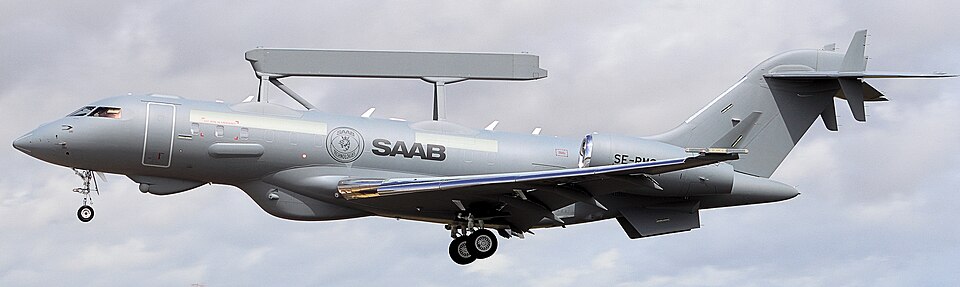
Saab's GlobalEye is built around the Bombardier Global 6500 business jet, not a converted airliner. Its main sensor is the Erieye Extended Range radar mounted in a long dorsal fairing rather than a rotating dome. Saab says the aircraft combines air, maritime and ground surveillance with a multi-domain command-and-control system from one platform.
The technical claim is straightforward: GlobalEye is designed to track aircraft, drones, low-observable threats, ballistic and hypersonic missiles, surface contacts and moving ground targets even in cluttered or jammed environments. Saab's product literature says the aircraft has more than 12 hours of endurance and an instrumented range above 350 nautical miles, or about 650 kilometres. It also says a GlobalEye at 35,000 feet can detect low-level threats flying at 200 feet beyond 458 kilometres. Manufacturer numbers always deserve caution, but they explain why this platform has been gathering political momentum.
Breaking Defense reported from Ankara that Rutte described the procurement as "up to 10 Saab GlobalEyes," while Swedish Prime Minister Ulf Kristersson said the aircraft would be operating from Swedish bases by 2027. If that timeline holds, it would give NATO a northern operating node for a sensor fleet that is directly relevant to the Baltic Sea, the High North and Russia's western military districts.
Here is the thing: GlobalEye did not win in a vacuum. NATO had selected the E-7A Wedgetail in 2023 as its intended E-3 successor. That plan became shaky after Washington moved to cancel its own E-7 programme, then partly reversed course under pressure from Congress and airpower advocates. European allies watched the United States argue with itself about the aircraft NATO had been expected to buy. They drew the obvious conclusion.
The Alliance Politics Are the Point
Everyone in Washington likes to say European allies should spend more on defence. Fine. But when Europeans spend more and then choose a European platform, some of the same voices suddenly discover their love for transatlantic interoperability.
Interoperability matters. So does supply. The uncomfortable lesson from the E-7 saga is that buying American can still leave Europe exposed to American budget politics. If the Pentagon cancels, delays or redesigns a programme, NATO does not get a veto. It gets a problem.
GlobalEye gives NATO a different problem, but probably a better one. Saab will need to prove it can scale production, sustain a multinational fleet and integrate the aircraft into NATO's broader Allied Future Surveillance and Control architecture. A handful of advanced aircraft will not replace the whole sensor web. Satellites, ground radars, maritime patrol aircraft, drones and national intelligence feeds all have to connect cleanly. If GlobalEye becomes a boutique European trophy programme instead of a working command-and-control node, NATO will have bought symbolism at very high altitude.
Still, the politics are hard to miss. Sweden joined NATO only recently. Now its defence industry is being lined up for one of the Alliance's central shared capabilities. France has already ordered two GlobalEyes with options for more, Canada has opened negotiations for its own future AEW&C requirement, and other European states have been circling the same question: why keep waiting for an American programme that Washington itself cannot seem to settle?
What Moscow Will Notice
Russia will not care much about the procurement drama. It will care about coverage. An aircraft that can watch air, sea and land activity across the Baltic approaches, northern Europe and the eastern flank complicates Russian planning. Airborne early warning is not glamorous in the way fighters and missiles are glamorous, but it is the nervous system of modern air defence. Without it, aircraft fly blinder, missile warnings arrive later and commanders spend more time guessing.
Ukraine has shown what happens when drones, missiles, electronic warfare and dispersed strike systems compress the decision cycle. NATO's eastern flank is now being built around that lesson. The Alliance needs aircraft that can see low, far and through interference. It also needs enough of them to maintain coverage when maintenance, crew fatigue and crisis deployments collide.
Up to ten GlobalEyes sounds like a serious fleet, but the final number is still open. So are basing, delivery schedule, common funding, crew structure and integration with existing NATO command systems. Those details will decide whether this is a clean transition or another allied procurement story that looks good at the podium and ugly in the spreadsheet.
The Real Message
The immediate story is that NATO picked Saab's GlobalEye to replace an ageing E-3A fleet. The larger story is that the Alliance has learned something from the Wedgetail mess: dependence on American platforms is not the same as certainty.
This is good news for Europe's defence industry and a warning to Boeing. It is also a test for NATO. If allies want European capability, they have to pay for it, standardise it and operate it together instead of treating it as a political souvenir from a summit.
The next thing to watch is not the press release. It is the contract. If NSPA and Saab turn this into a firm order quickly, NATO will have made a real move toward European-owned high-end surveillance. If the talks drag, the old E-3s will keep flying into the 2030s while everyone pretends that choosing a replacement is the same as fielding one. Moscow would be perfectly happy with that distinction.
NATO has selected Saab's GlobalEye aircraft to replace its aging E-3A Sentry fleet, with formal negotiations beginning in Ankara. The GlobalEye is expected to be operational from Swedish bases by 2027, marking a significant shift in European defense capabilities. This decision comes as NATO seeks to reduce reliance on American platforms amid ongoing geopolitical tensions.
- NATO has chosen Saab's GlobalEye to replace the E-3A Sentry fleet.
- Formal negotiations with Saab are set to begin.
- The GlobalEye aircraft is expected to operate from Swedish bases by 2027.
- The E-3A fleet is undergoing a Final Lifetime Extension Programme until 2035.
- This decision reflects a shift in Europe's defense industrial base towards greater autonomy.