
NATO, Patriot and Poland 2026 — Rutte promises protection, Europe's air defense remains patchy
 Dr. Klaus Weber
NATO, Patriot and Poland 2026 — Rutte promises protection, Europe's air defense remains patchy
Brussels, November 21, 2026. Two Russian missiles and a suspected drone landed on Polish territory again on Friday. The next day, NATO Secretary General Mark Rutte stated that the alliance would defend "every inch" of Polish territory. Politically, this is the right message. Militarily, however, it does not answer the crucial question: With which sensors and interceptors will this protection actually be ensured next winter?
A guarantee is not an intercept shield
Rutte is responding to a problem that has not been resolved since the first Russian airspace violations. NATO can demonstrate political resolve as soon as a member state is affected. However, it cannot classify every flight path in advance nor economically engage every missile. This is precisely where the difference lies between Article 5 as a political commitment and air defense as a technical capability.
The recent incidents should also not be viewed in isolation. According to Defense One, following earlier drone and missile incursions, two more Russian projectiles and a suspected drone fell in Poland on Friday. French and Polish representatives describe Russian sabotage, cyberattacks, and airspace tests as part of a "phase zero" of the conflict. Moscow is thereby testing not only the response time of the Polish Air Force but also the political threshold of the alliance.
Patriot PAC-3 MSE protects key points, not all of Poland
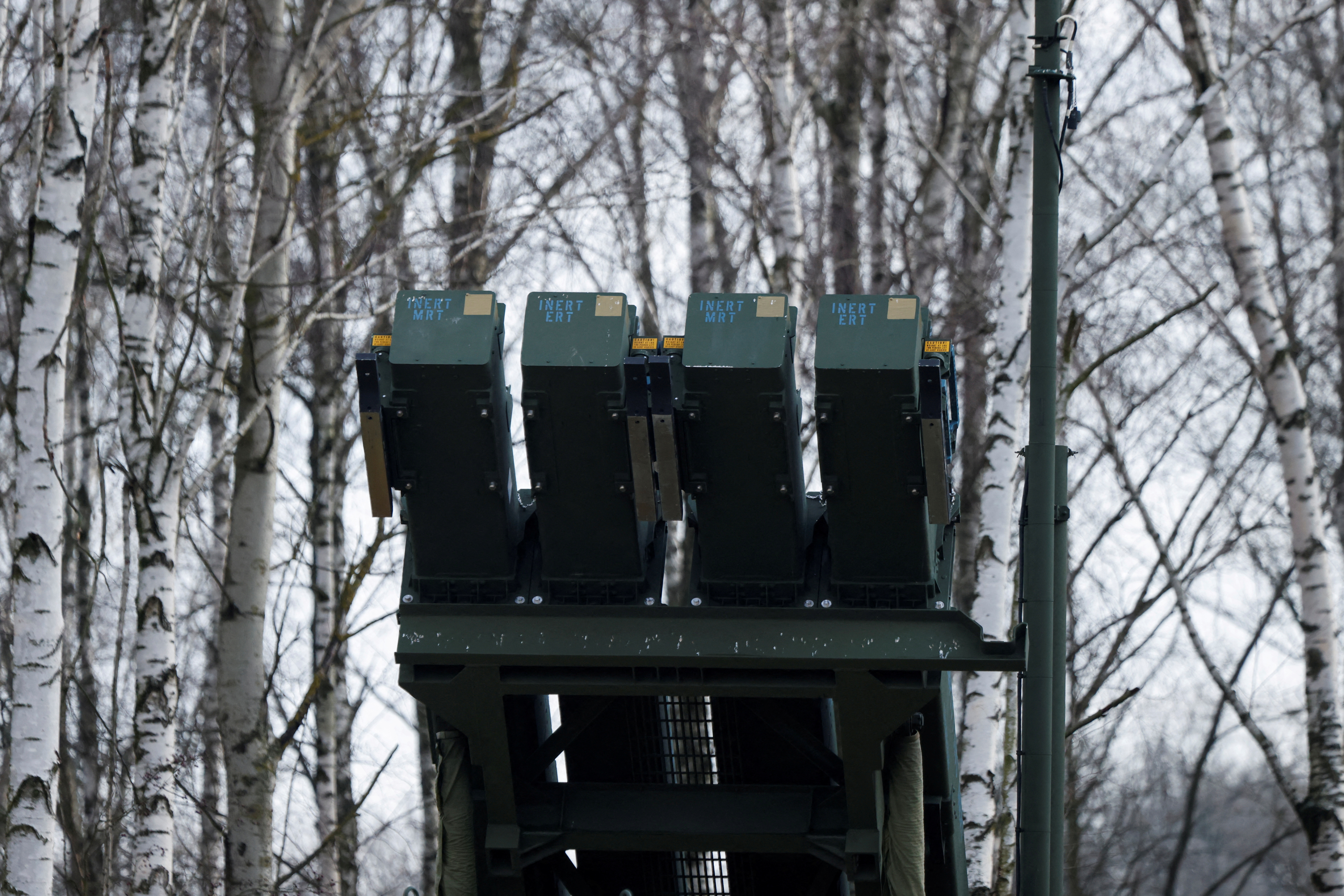
Poland is investing heavily in air defense. The centerpiece is Patriot with PAC-3 MSE interceptors, supplemented by Polish systems like Piorun and NATO air surveillance. PAC-3 MSE operates on the hit-to-kill principle and is specifically designed against tactical ballistic missiles. This is a high-performance capability, but not a magical dome over a country with nearly 313,000 square kilometers of area.
A Patriot unit protects a limited area and must simultaneously integrate radar, launchers, logistics, and command and control. Against individual ballistic targets, the investment is militarily plausible. However, against cheap drones, decoys, and complex salvos, a cost problem arises: an expensive interceptor can be tactically successful yet strategically too costly. Therefore, Europe's air defense needs a layered architecture of long-range radar, electronic warfare, anti-aircraft guns, inexpensive intercept drones, and systems like IRIS-T SLM or SAMP/T.
This is the difference between procurement and capability. A country can buy Patriot without automatically possessing a sustainable air defense. It requires trained crews, spare parts, integrated command networks, and sufficient ammunition. Ukraine has demonstrated in this war how quickly high consumption can deplete even modern stocks. For Poland, the question is therefore not only how many launchers were ordered but how many layers they can maintain in continuous operation.
Ukraine is both shield and test lab
The joint statement of the coalition of the willing from November 19 confirms at least 70 billion euros in military equipment, support, and training for Ukraine for both 2026 and 2027. Additionally, the EU support loan provides a total of 90 billion euros for military and financial assistance by the end of 2027. The statement explicitly names the reinforcement of Ukrainian air and missile defense as a priority.
This is strategically understandable. Every Russian cruise missile detected and engaged in Ukraine provides European forces with data on flight profiles, electronic countermeasures, and the limits of their sensors. Ukrainian experiences with drone swarms, improvised networking, and rapid target assignment are more valuable to Poland than some glossy brochure from a defense contractor. But learning does not replace stockpiles. A dataset cannot replace a PAC-3 MSE missile.
The political irony is considerable: Europe declares the defense of Ukraine as the defense of Europe, yet still clings to nationally separated procurement paths. Germany, France, Italy, and Poland possess different systems, data standards, and operational doctrines. NATO can coordinate, but it cannot wish away the lack of missile production. The dependence on US satellites, reconnaissance, and parts of missile production remains.
Rutte is right but omits the cost
NATO must protect Poland. An evasive answer would invite Moscow to further tests. However, the formula "every inch" must not be confused with comprehensive invulnerability. Deterrence only works if the opponent believes in the capability and the political will. For capability, however, press conferences do not count, but sensor coverage, response times, ammunition stocks, and industrial re-production do.
The events of this week therefore reveal Europe's actual dilemma. Washington sends contradictory political signals while European governments promise more responsibility for Ukraine and the NATO eastern flank. At the same time, the industrial and operational base remains fragmented. More money is necessary, but it does not create an integrated air defense overnight.
Rutte promises Poland protection. The alliance must now show that this protection is more than a red line on a map. Europe's credibility depends on whether it turns every Russian airspace test into not just a condemnation but a permanently available capability. Otherwise, Article 5 remains strong as a declaration and weak as a shield.
Sources
- Reuters, November 21, 2026, statement by NATO Secretary General Mark Rutte on the protection of Polish territory.
- Defense One, November 20, 2026, report on Russian missile and drone incursions and European air defense plans.
- NATO, Ukraine Defence Contact Group, Brussels, November 17, 2026.
- Élysée Palace, Joint Statement of Germany, France, the United Kingdom, and Ukraine, November 19, 2026.
Two Russian missiles and a suspected drone landed in Poland on November 21, 2026. NATO Secretary General Mark Rutte promised to defend Polish territory, emphasizing the need for effective air defense systems. Poland is heavily investing in air defense, including the Patriot PAC-3 MSE, but faces challenges in integrating these systems with NATO capabilities. The coalition of willing nations confirmed a commitment of at least 70 billion euros for military support to Ukraine, prioritizing the enhancement of Ukrainian air and missile defense.
- Two Russian missiles and a suspected drone landed in Poland on November 21, 2026.
- NATO Secretary General Mark Rutte stated the alliance will defend every inch of Polish territory.
- Poland is investing heavily in air defense systems, including Patriot PAC-3 MSE missiles.
- The report highlights the challenges of integrating European air defense capabilities.
- The coalition of willing nations pledged at least 70 billion euros for military support to Ukraine.