
NATO's 5 Percent Target 2026 Fails Due to Iran Dispute Between Trump and Europe's E5
 Dr. Klaus Weber
NATO's 5 Percent Goal 2026 Fails Due to Iran Dispute Between Trump and Europe's E5
90 billion dollars more in defense spending in one year should actually be a success story. Mark Rutte brought this figure to the Oval Office to show Donald Trump that Europe and Canada understood his demand for more burden-sharing. However, on the same day, the leaders of Germany, France, Great Britain, Italy, and Poland met in Berlin to address another problem before the Ankara summit: More money does not replace a common political commitment when Washington expects overflight rights, base access, and allegiance in a crisis.
Rutte Promotes Spending, Trump Demands Obedience
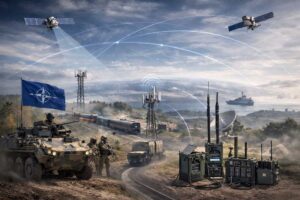
The immediate cause is not Ukraine, but the Iran War. Trump accused several NATO partners of inadequately supporting the United States militarily and logistically. According to reports from Washington, he complained that the allies had let the U.S. down on a small matter; Rutte, on the other hand, tried to point out the use of European bases by several thousand U.S. flights. This defense is institutionally revealing: It shows that NATO solidarity under Trump is no longer primarily understood as a Article 5 promise, but as the short-term usability of national infrastructure for American operations outside of Europe.
This is a different logic than that on which the European debate about the 5 percent goal is based. Europeans talk about budgets, procurement, and industrial capacity. Washington talks about political availability. Both are interconnected, but they are not identical. A state can spend 3.5 percent of its GDP on core defense and still not want to support an American operation in the Middle East. For Trump, that is disloyalty. For many European governments, it is constitutional, parliamentary, or strategic caution.
The E5 as a Substitute Format for an Overwhelmed EU
The Berlin E5 meeting was therefore more than a preparation for the NATO summit on July 7 and 8 in Ankara. Friedrich Merz, Emmanuel Macron, Keir Starmer, Giorgia Meloni, and Donald Tusk attempted to form a European leadership group that can act faster than the EU-27 and is militarily more relevant than many symbolic Brussels formats. The E5 circle includes the largest European military powers and key supporters of Ukraine; it is also an acknowledgment that the Common Security and Defense Policy remains too cumbersome for crises of this speed.
The agenda was concrete: long-range weapons, air defense, artificial intelligence, security guarantees for Ukraine, and a stronger European pillar within NATO. However, this very list shows the weakness of the format. Air defense means Patriot, SAMP/T, IRIS-T, and ammunition production; long-range weapons mean political escalation readiness; AI means not only research but also data access, command architecture, and procurement. The E5 circle can coordinate. It cannot replace a binding budget or operational decision for parliaments in Berlin, Rome, Warsaw, Paris, and London.
The American Enabler Problem Becomes Visible
The real news of the past week was not Hegseth's sharp tone, but the announced six-month review of the American troop presence and the already effective reduction of certain crisis capabilities. This refers not only to troop numbers. It refers to tanker aircraft, reconnaissance, drones, warships, command structures, and logistical nodes. In the German debate, it is still too often pretended that American presence in Europe can be additively replaced with national brigades. This is wrong. Strategic enablers are not accessories, but the operating systems of modern armed forces.
Here lies the core of Europe's defense dilemma. Since 2022, European states have learned to buy weapons. They have not yet learned to organize military effectiveness together. An additional frigate, another tank battalion, or a new drone line are important, but they do not automatically close the gap in air refueling, integrated air defense, satellite reconnaissance, and multinational command. Therefore, American pressure does not only affect budgets. It affects the institutional architecture in which Europe has so far comfortably assumed American capabilities.
Support for Ukraine and Hormuz Mission Follow Different Logics
Merz spoke in Berlin of a strong signal to Russia: Ukraine remains strong. This formula is correct but incomplete. European support for Ukraine has a relatively clear political basis: Russia is waging a war of aggression in Europe, and the costs of a Ukrainian defeat would be directly European. European involvement in security operations in the Strait of Hormuz follows a different logic. It concerns energy and trade routes, yes, but it is not identical to the defense of alliance territory.
Macron and Meloni signaled readiness for a mission in the Hormuz context, provided Washington and Tehran continue to implement their memorandum. This sounds pragmatic but shows the political fault line. Europe cannot simultaneously claim to become strategically more autonomous and treat every American expectation outside of Europe as an alliance obligation. Autonomy does not mean anti-Americanism. It means the ability to distinguish between European core interests, alliance solidarity, and American warfare.
The 5 Percent Goal Measures Input, Not Availability
The new NATO goal of 5 percent by 2035 is intended to serve as a sign of determination in Ankara. The formula seems simple: 3.5 percent for classic defense, 1.5 percent for resilience, infrastructure, and related security expenditures. However, this very simplicity is dangerous. It creates a common number without enforcing common priorities. Spain, Italy, Belgium, or the Czech Republic can formally catch up and still leave other capability gaps open compared to Germany or Poland. Germany can spend more and still fail due to procurement duration, personnel issues, and ammunition stocks.
Rutte understands this tension. That is why he shows Trump charts on spending increases and American jobs in arms production. This is politically clever but analytically thin. If European demand primarily fills American production lines, NATO cohesion may temporarily increase, but there will be no European operational capability. If European states invest more in their own industry, friction with Washington will grow because American expectations and European autonomy do not align.
Ankara Will Not Be a Summit About Money, But About Reliability
The Ankara summit will therefore not be decided by whether Europeans will accept a higher number. This question is largely answered. What is crucial is whether NATO can find a new relationship between American protection guarantees and European political independence. Trump demands loyalty as operational allegiance. The E5 want to define responsibility as European leadership capability. Rutte tries to bridge both with the language of burden-sharing.
More European money may reassure Trump, but it does not answer the question of who decides how European power is used.
This is the uncomfortable point that Berlin can no longer postpone. Europe's defense spending is increasing; its strategic dependence will only decrease if spending translates into common capability, common doctrine, and common decision-making readiness. The Iran dispute has made this visible. Ukraine remains the most important test of European security policy. But the future of NATO will also be determined by whether Europe can say no without becoming militarily helpless and yes without being merely an American auxiliary force politically.
NATO aims for a 5% defense spending target by 2026, with discussions occurring among European leaders in Berlin regarding military commitments and capabilities. Tensions between U.S. expectations and European defense autonomy are evident, particularly in the context of the Iran conflict. The E5 group is forming to enhance military cooperation among major European powers, addressing the challenges of defense spending and strategic autonomy.
- NATO aims for a 5% defense spending target by 2026.
- European leaders met in Berlin to address military commitments and capabilities.
- Tensions exist between U.S. expectations and European defense autonomy.
- The E5 group is forming to enhance military cooperation among major European powers.
- The report highlights the challenges of European defense spending and strategic autonomy.