
NATO's GlobalEye Choice and A400M Fleet 2026 Highlight Europe's Capability Gap
 Dr. Klaus Weber
NATO's GlobalEye Selection and A400M Fleet 2026 Highlight Europe's Capability Gap
Ten GlobalEye systems and a multinational A400M fleet sound like technical procurement. In fact, the announcements from the NATO summit in Ankara mark a political finding: Europe is now purchasing exactly those capabilities without which higher defense spending will hardly be effective militarily. Early warning, air transport, air refueling, medical evacuation, and robust tactical communication are not spectacular capabilities. However, they determine whether a brigade can be deployed in time, an aerial image can be understood, and an operation can be conducted without American infrastructure.
This is the difference between capability and capacity. A country can order more tanks, aircraft, or missiles and still remain dependent if it does not control the joint situational awareness, the tankers, the transport aircraft, and the interoperable communication networks. Therefore, Ankara shows less a breakthrough in European defense than a late recognition of the gap.
GlobalEye Does Not Just Replace AWACS, But an American Habit
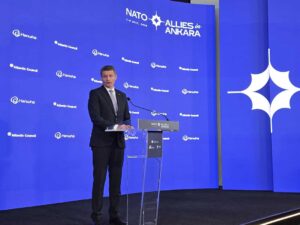
According to EDR Magazine, NATO Secretary General Mark Rutte stated in Ankara that the alliance would begin formal negotiations with Saab for up to ten GlobalEye Airborne Early Warning and Control systems. A contract has not yet been signed; Saab has not yet received an order. This limitation is important. Politically, a decision has been signaled, but institutionally, the more difficult part is just beginning.
GlobalEye combines Saab's Erieye Extended Range Radar with a sensor package and a multi-domain command-and-control system on the Bombardier Global 6500 platform. The system is intended to monitor large land, sea, and air spaces, detect low-observable targets, drones, as well as ballistic and hypersonic missiles even under electronic disruption. In NATO language, this sounds like a modernization program. In European security policy, it is the answer to an old weakness: The continent can claim a lot of airspace but cannot sufficiently see for itself.
The choice of a Swedish system is noteworthy from an industrial policy perspective. It avoids the reflexive American solution in this segment and strengthens a European provider outside the classic German-French arms axis. However, this does not imply strategic autonomy. If financing, maintenance structure, training, data architecture, and operational command remain unclear multinationally, only a European aircraft emerges within a still fragmented NATO operational logic.
The A400M Initiative Reveals the Real Problem of Operational Capability
At the same time, Belgium, Croatia, France, Poland, Spain, Türkiye, and the United Kingdom launched a High Visibility Project for a multinational Airbus A400M fleet at the NATO Summit Defence Forum. The program aims to close strategic air transport gaps of European allies and is modeled after the Multinational MRTT Fleet. Possible cooperation ranges from joint ownership and operation to maintenance, training, infrastructure, and procurement.
The A400M is not a symbolic candidate for this. Airbus points to more than 135 aircraft in operation and over 270,000 flight hours of the global fleet. The aircraft can combine tactical and operational air transport, operate on relatively short runways, support air refueling, and be used for evacuation or disaster relief. This versatility makes it politically attractive but institutionally challenging. Who pays? Who prioritizes missions? Which nation receives hour allocations when an eastern flank deployment, a medical evacuation, and a crisis operation outside Europe are simultaneously on the agenda?
The model MMF is real but limited. The Multinational MRTT Fleet includes nine participating states after Finland's accession: Netherlands, Luxembourg, Norway, Germany, Belgium, Czech Republic, Sweden, Denmark, and Finland. Nine A330 MRTT are already in operation, and twelve are on order. This fleet has supported NATO's eastern flank, accompanied evacuations from Afghanistan, and participated in exercises in the Indo-Pacific. This is European cooperation, but not magic. It works because a limited group of states has organized access to clearly defined tanker and transport capacities. The A400M pool becomes politically more complicated because more states bring national industrial interests and operational priorities.
Spain, Iran, and Greenland Show the Political Counterbalance
While the industrial announcements aimed at cooperation, the political stage in Ankara made the opposite visible. Reuters reported via Defense News that President Donald Trump labeled Spain a poor NATO partner, questioned trade relations, and reiterated claims on Greenland. The immediate dispute did not concern GlobalEye or A400M, but Spain's refusal to engage more in Washington's Iran war and accept American use of airspace or bases. Rutte defended European contributions and referred, according to Breaking Defense, to up to 5,000 US sorties from European bases.
This episode is uncomfortable for European defense policy but analytically useful. It shows that access to infrastructure remains political. Even if NATO states spend more, they can decide differently in American wars. Even if European bases enable American power projection, this does not imply automatic political allegiance. That is precisely why European enablers are so important: They do not eliminate every conflict with Washington, but they reduce vulnerability through operational dependence.
Spain is a particularly instructive case. Madrid participates in the A400M project but rejects the political line demanded by Trump in the Iran war. This is not a contradiction but the normal form of European security policy: capability cooperation yes, strategic unity only on a case-by-case basis. Those who conclude that Europe merely needs to spend more money overlook the institutional reality.
More Joint Platforms Do Not Solve the Governance Problem
The temptation is great to celebrate Ankara as an industrial policy success. Up to ten GlobalEye systems, an A400M fleet, the expansion of the MRTT structure, and new communication projects like ESSOR via OCCAR create an impressive picture. But platforms are not yet operational capability. A fleet is only multinationally useful if decision-making processes, ownership rights, spare parts supply, crew models, and operational priorities are regulated in advance.
Here lies Europe's chronic weakness. The European Defence Agency can coordinate, the EU can finance, OCCAR can manage programs, NATO can define requirements. However, none of these institutions replaces political decision-making under time pressure. If an A400M is needed on Tuesday for the eastern flank, on Wednesday for evacuations, and on Thursday for national disaster relief, it is not the brochure of the High Visibility Project that decides, but a governance contract.
GlobalEye further complicates this question. Early warning aircraft produce sensitive situational pictures. Who gets access to raw data? Who decides on priority between air defense, missile warning, and maritime surveillance? Are the data seamlessly integrated into national systems or only into NATO command structures? Without answers to these questions, the capability remains technically European but politically incomplete.
European Autonomy Begins with the Boring Capabilities
The summit in Ankara reminds us that strategic autonomy does not begin with debates about fighter aircraft. It begins with refueling, transport, sensors, maintenance, spare parts, and communication standards. These are the boring capabilities that parliaments rarely debate and with which parties hardly win elections. But without them, Leopard 2, F-35, Eurofighter, or future FCAS designs will only be expensive national symbols.
Therefore, the GlobalEye decision is correct but not sufficient. The A400M initiative makes sense but is not yet proof of European action capability. Both projects are tests for the question of whether NATO-Europe can break free from the logic of national prestige programs. The paradoxical lesson from Ankara is: Europe is approaching strategic autonomy precisely where it talks the least about it. But as long as joint aircraft are easier to procure than joint decisions, autonomy remains an operational model, not a political fact.
Sources
- EDR Magazine, NATO selects Saab's GlobalEye, July 8, 2026.
- EDR Magazine, NATO paves the way towards a Multinational A400M Fleet, July 8, 2026.
- Defense News and Reuters, Trump turns on Spain and demands Greenland as NATO summit exposes cracks, July 8, 2026.
- Breaking Defense, NATO secretary general defends allied contributions in US war against Iran, July 8, 2026.
NATO announced plans to procure ten GlobalEye systems and establish a multinational A400M fleet during the 2026 summit in Ankara, aiming to address significant capability gaps in European defense. The initiative reflects a political acknowledgment of the need for enhanced military capabilities, particularly in early warning, air transport, and tactical communication. Tensions regarding Spain's role in NATO were also evident, underscoring the complexities of European defense cooperation.
- NATO plans to procure up to ten GlobalEye systems from Saab.
- A multinational A400M fleet initiative was launched at the NATO Summit.
- The procurement aims to address European defense capability gaps.
- Political tensions regarding Spain's involvement in NATO were highlighted during the summit.
- The report emphasizes the need for strategic autonomy in European defense.