
Navy F/A-18 disables ship in Gulf of Oman with 20mm cannon
Source: Task & Purpose
Loading...ConfirmedCredibility: 81%
Report Content
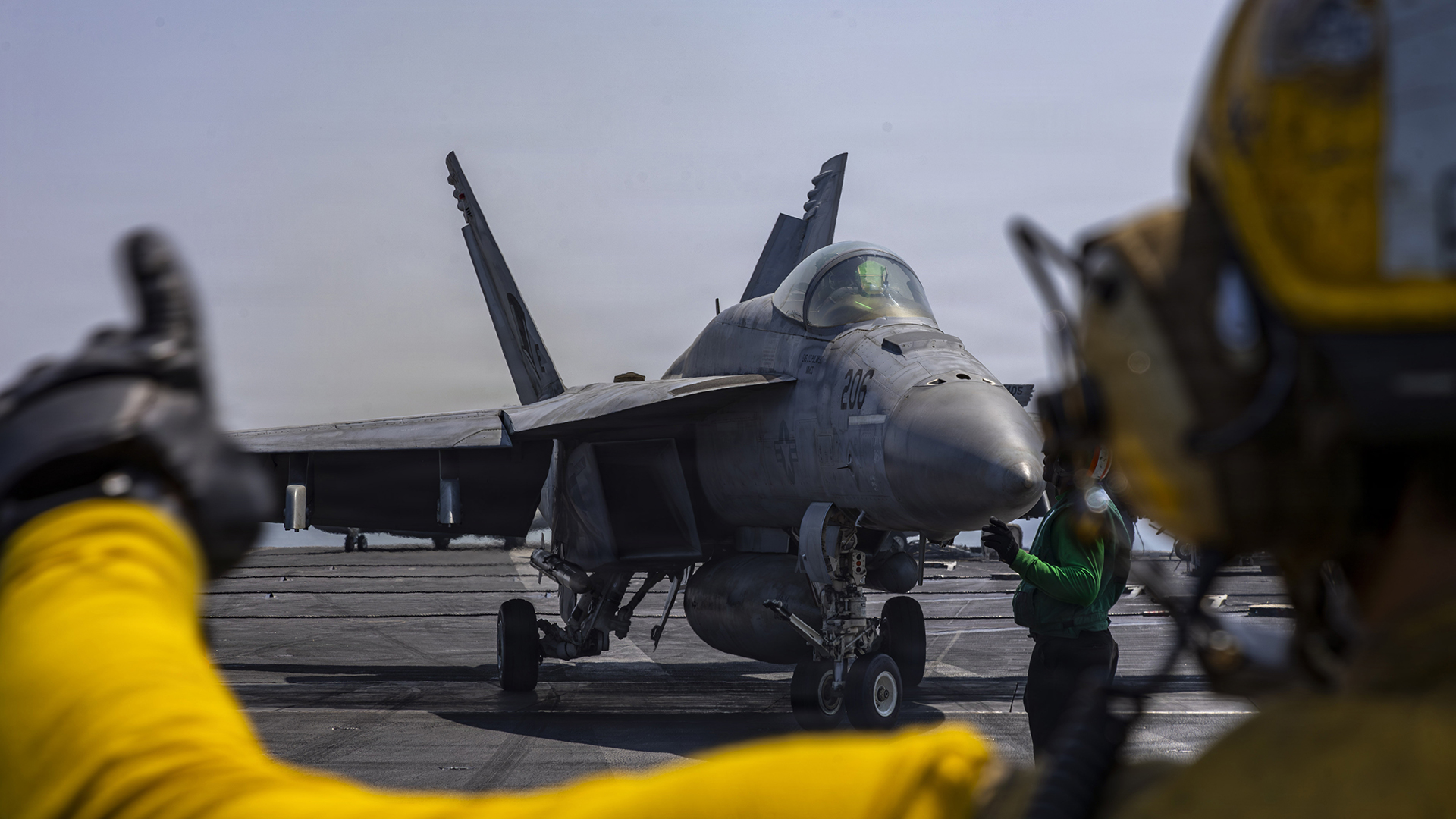
A Navy F-18 Super Hornet disabled an Iranian-flagged commercial ship in the Gulf of Oman, according to U.S. Central Command, or CENTCOM. The ship was warned to stop, said U.S. officials, as part of a U.S.-imposed blockade on Iranian ports in recent weeks, before the jet attacked.
The incident happened about 9 a.m. Eastern Time on Wednesday, a CENTCOM news release says. According to the U.S. military, the MT/Hasna, an Iranian-flagged oil tanker traveling unloaded, ignored multiple warnings from U.S. forces, the news release says.
“After Hasna’s crew failed to comply with repeated warnings, U.S. forces disabled the tanker’s rudder by firing several rounds from the 20mm cannon gun of a U.S. Navy F/A-18 Super Hornet launched from USS Abraham Lincoln (CVN 72),” CENTCOM’s release said. “Hasna is no longer transiting to Iran.”
The United Kingdom Maritime Trade Operations, a tracking organization, reported that a ship had been hit by an unknown projectile. Data collected by shipping tracking outlets indicate that the Hasna was en route to Iran from the Indian Ocean,
Top Stories This Week
Iran restricted access and transit through the Strait of Hormuz — where roughly a quarter of the planet’s oil and liquid natural gas pass through, among other important commodities — in March after the start of Israeli and U.S. military strikes against the country. The United States, in turn, enacted a blockade on top of that, specifically on ships trying to reach or leave Iranian ports. It has redirected dozens of ships since then, according to CENTCOM.
It’s the first confirmed case of U.S. aircraft firing on ships to enforce the blockade. The Navy destroyer USS Spruance fired on the M/V Touska last month, disabling its engines with its deck guns before Marines boarded it. A-10 Thunderbolt IIs and other aircraft had fired on Iranian boats during fighting in the war prior to the ceasefire. CENTCOM did not say what unit the F/A-18 was with. Both the USS Abraham Lincoln and USS George H.W. Bush are operating around the Arabian Sea and strait, and both are carrying multiple Super Hornet squadrons.
The incident comes a day after President Donald Trump announced that although the ongoing blockade of Iranian ports will remain in effect, a separate U.S. military effort to guide ships through the Strait of Hormuz had been paused just one day after it began.
During the operation, dubbed Project Freedom, U.S. AH-64 Apache and MH-60 Seahawk helicopters destroyed six Iranian small boats that were “threatening commercial shipping,” Adm. Brad Cooper, head of CENTCOM, told reporters on Monday.
“The [Islamic Revolutionary Guard Corps] has launched multiple cruise missiles, drones and small boats at ships we are protecting,” Cooper said during a media roundtable. “We have defeated each and every one of those threats through the clinical application of defensive munitions.”
The post Navy F/A-18 disables ship in Gulf of Oman with 20mm cannon appeared first on Task & Purpose.
Classification
Region
West Asia
Analytical Domain
Operational
Primary Category / Secondary Categories
Military Operations / Weapons & Equipment
Subcategory
Naval Engagement
SALUTE Report
Size
1 F/A-18 Super Hornet
Activity
Disabled an Iranian-flagged commercial ship using a 20mm cannon
Location
Gulf of Oman
Unit
U.S. Navy
Time
9 a.m. Eastern Time on Wednesday
Equipment
F/A-18 Super Hornet20mm cannon
Summary
A U.S. Navy F/A-18 Super Hornet disabled an Iranian-flagged commercial ship in the Gulf of Oman at 9 a.m. Eastern Time on Wednesday. The ship, MT/Hasna, ignored multiple warnings from U.S. forces as part of a blockade on Iranian ports. The aircraft fired several rounds from its 20mm cannon, disabling the ship's rudder. This incident marks the first confirmed use of U.S. aircraft to enforce the blockade.
Key Facts
- A U.S. Navy F/A-18 Super Hornet disabled an Iranian-flagged ship in the Gulf of Oman.
- The incident occurred at 9 a.m. Eastern Time on Wednesday.
- The ship ignored multiple warnings from U.S. forces before being attacked.
- The U.S. military enforced a blockade on Iranian ports prior to the incident.
- This is the first confirmed case of U.S. aircraft firing on ships to enforce the blockade.