
Niger after the mutiny of August 29 — the Africa Corps and Algerian Su-30s mask the fracture of the army
 Marie Dubois
Niger after the mutiny of August 29 — the Africa Corps and Algerian Su-30s mask the fracture of the army
Niamey has regained a superficial calm around Diori Hamani Airport and Air Base 101. It was here, however, that the regime of General Abdourahamane Tiani faltered during the night of August 28 to 29, when mutinous soldiers, reportedly from the special forces engaged against jihadist groups, took control of the airport area, disrupted state radio and television, and attempted to approach the presidential perimeter. On the ground, this detail matters: when units supposed to hold the axes of Tillabéri, Ouallam, or Téra return armed to the capital, the problem is no longer just political. It becomes operational.
Nigerien authorities claim to have regained control. This is true in the narrowest sense of the term. The power remains standing. But it would be misleading to conclude that the army has absorbed the shock. What the mutiny revealed is an army split between frontline units worn down by a war with no visible results, a better-protected presidential guard, and external patrons now indispensable whenever a critical point is threatened.
Base 101 becomes the center of gravity of power
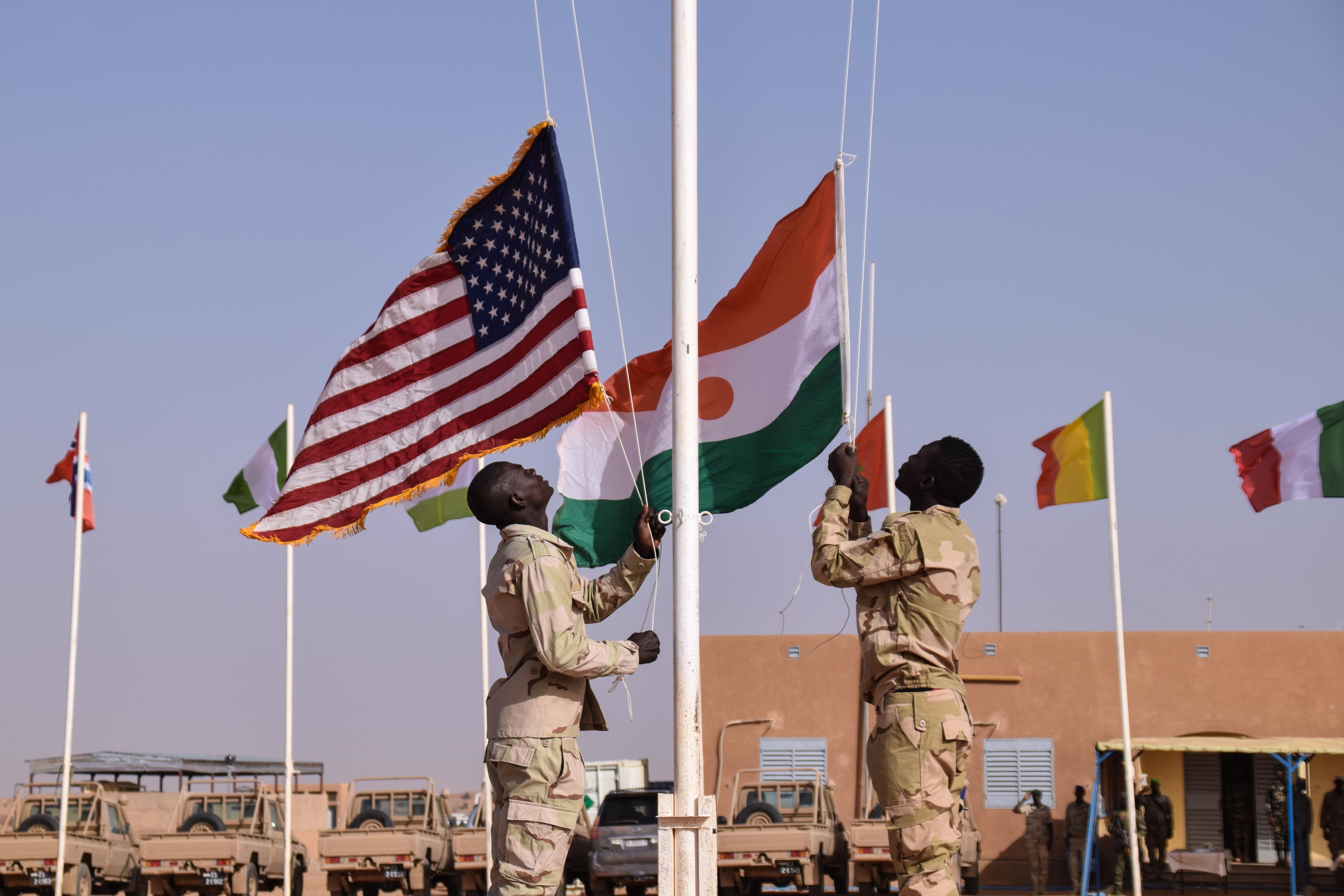
Air Base 101 is not just any site. It adjoins the international airport, hosts foreign partners, and concentrates part of the regime's security architecture. Already targeted by an attack claimed by the Islamic State in the Sahel in January and then by an operation attributed to JNIM in June, it has this time been contested from within. This is the most worrying sign of the sequence: the logistical heart of Niamey is no longer only exposed to jihadist columns or external infiltrations, but also to the distrust of armed elements supposed to defend the state.
In this type of crisis, geography often decides faster than press releases. Whoever controls Base 101 controls the runway, the arrival of reinforcements, the movement of officers, and above all, the image of sovereignty. That the mutineers were able to impose, even briefly, their presence there shows how weakened the chain of command was even before the first shots.
Moscow has saved the regime, not military cohesion
According to RFI and several reports from West African press, the presidential guard alone would probably not have been sufficient to turn the situation around. The intervention of the Africa Corps, a Russian force that succeeded Wagner under the authority of the Russian Ministry of Defense, played a role in the counter-offensive. Premium Times and AllAfrica report a joint air-ground operation that allowed for the neutralization or arrest of some of the mutineers. This assistance may flatter the sovereignist propaganda of Niamey. However, it raises a fundamental problem: a power that must call on a foreign force to regain its own central base demonstrates less its solidity than a new dependency.
The contrast with the official discourse of the Sahelian juntas is stark. For three years, they have promised that by breaking with Paris, they would regain an autonomous command capability. Yet, at the critical moment, the unified force of the Sahel States Alliance, theoretically strong with over 5,000 men, remained invisible. This is new. And it is a bad sign. A coalition designed to assist one of its members was a spectator while Russians filled the gap.
Algeria's entry changes the regional equation
The second major fact came from Algiers. According to Agenzia Fides reported by AllAfrica, Algeria has deployed four Su-30s, one Il-76 transport aircraft, and one Il-78 tanker to Niamey, marking its first known military projection abroad. Officially, this is support for a neighboring state facing an attempt at destabilization. Militarily, the message is broader. Algiers does not want either a collapse of Niger south of its border or a Russian monopoly on the security of central Sahel.
For Bamako, this movement deserves close observation. Algerian-Malian relations have been tense since the burial of the Algiers agreement and Mali's accusations of complacency towards certain armed groups. Seeing Algerian fighters appear over Niamey, right in the center of a setup where the Africa Corps is already established, means that a new neighborhood balance is being sought under the pressure of events. Niger thus becomes a theater of overlap: unfinished counter-insurgency, rivalries between juntas, and muted competition among protectors.
The real risk is in front of Niamey, not behind
The immediate danger is not the mechanical repetition of a coup in the capital, even if purges within the army are likely. The danger is the vacuum effect on the fronts. Soldiers coming from Tillabéri, Téra, or Dosso to settle scores in Niamey leave behind weakened posts, slower communications, and less covered villages. The JNIM katibas and Islamic State cells in the Sahel read this kind of moment very well. They do not need to take the capital; they just need to reopen rural corridors, cut secondary roads, and restore their freedom of movement around the Malian and Burkinabe borders.
In the absence of a detailed official report, there remains a degree of uncertainty about the exact scale of losses and the identity of all the officers involved. But the underlying logic is already visible. August 29 did not just show that a Sahelian regime could survive thanks to its allies. It showed that in Niger, the war against jihadists now weighs as much within the military apparatus as at the country's borders. If Niamey responds only with purges and communication, the next surprise may not necessarily come from a barracks. It may come, further northwest, from an axis that no one really holds anymore.
Mutinous soldiers attempted to seize control of Niamey's Diori Hamani airport and the presidential perimeter on August 29, 2023. Algeria deployed four Su-30 aircraft, an Il-76 transport, and an Il-78 refueling aircraft to support Niger against destabilization attempts. The Africa Corps, a Russian force, intervened to assist in countering the mutiny, highlighting the Nigerien military's reliance on foreign support amid internal divisions.
- Mutinous soldiers attempted to seize control of Niamey's Diori Hamani airport and presidential perimeter on August 29, 2023.
- Algeria deployed four Su-30 aircraft, an Il-76 transport, and an Il-78 refueling aircraft to Niger.
- The intervention of the Africa Corps, a Russian force, aided in countering the mutiny.
- The Nigerien military is reportedly divided and reliant on foreign support for stability.