
Northrop Grumman gets $56M to upgrade one MQ-4C Triton drone
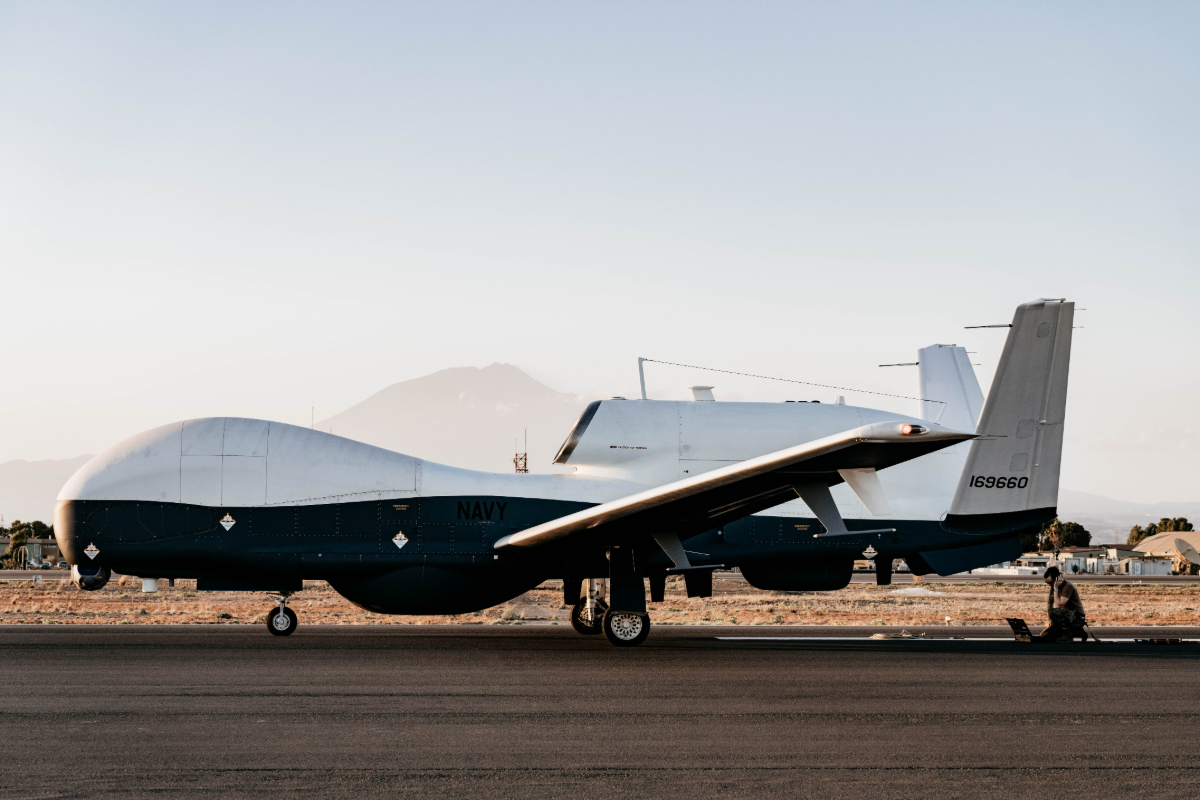
The U.S. Navy has ordered a $56 million retrofit for a single MQ-4C Triton, paying Northrop Grumman to install the B7 retrofit material kit on one of its high-altitude maritime surveillance drones. Naval Air Systems Command awarded the firm-fixed-price modification on Oct. 28, and the work is scheduled to run until May 2030.
The full $55,986,538 comes from fiscal 2027 U.S. Navy aircraft procurement funds and was obligated at award, with no competition. The award is modification P00003 to delivery order N00019-26-F-1093, placed under basic ordering agreement N00019-25-G-0003. Northrop Grumman will do 64% of the work in Palmdale, California, where the Triton is built, 34% in San Diego and the remaining 2% at other U.S. sites.
The announcement does not say which configuration the kit brings, what it changes on the aircraft or which airframe will receive it. B7 matches the construction numbers the Navy and Northrop Grumman use for individual Triton airframes, and earlier contracts used the same scheme. A 2023 order worth $83.1 million retrofitted air vehicles B9 and B10 and one main operating base to the multi-intelligence configuration known as Integrated Functional Capability 4, or IFC-4. Northrop Grumman delivered B8, the first production Triton upgraded to that standard, to Naval Air Station Patuxent River, Maryland, on Feb. 1, 2022. If B7 is an airframe, it was built just before that aircraft, but the Navy has not said the new kit is an IFC-4 upgrade.
The cost and work split closely track the retrofit of air vehicle B5. In late 2025, the U.S. Navy exercised a $45.75 million option for continued engineering, tooling and labor to complete IFC-4 change requests and engineering change proposals on B5, with completion set for June 2029 and the same 64% Palmdale, 34% San Diego and 2% elsewhere division. Retrofit kits for B5 and B11 were bought under a separate order in August 2024, and installation was awarded in May 2025, so a single airframe’s upgrade has been spread across several contract actions covering parts, engineering and labor.
IFC-4 is the configuration that gave the Triton a signals intelligence role. According to Northrop Grumman, the upgrade adds two sensors, one for electronic intelligence and one for communications intelligence, and their stricter data security requirements forced hardware and software changes across both the aircraft and its ground segment. The rest of the sensor suite centers on the AN/ZPY-3 Multi-Function Active Sensor, an X-band electronically scanned surveillance radar under the fuselage, and the Raytheon AN/DAS-3 electro-optical and infrared turret. The U.S. Navy flew the first Triton in IFC-4 configuration on July 29, 2021, and the configuration is intended to let the service retire its crewed EP-3E Aries II signals intelligence aircraft.
The Triton is a heavily reworked RQ-4 Global Hawk. Northrop Grumman strengthened the airframe and wing and added de-icing and lightning protection so the unarmed drone can descend from around 15,000 m (50,000 feet) to about 3,000 m (10,000 feet) to identify ships, then climb back to patrol altitude. The aircraft first flew on May 22, 2013, and the U.S. Navy originally planned to buy 68.
Operational use has grown since the first two baseline IFC-3 aircraft deployed to Guam in 2020 with Unmanned Patrol Squadron 19. The U.S. Navy sent a Triton to Naval Air Station Sigonella, Italy, for the first time on March 30, 2024. On April 9, 2026, one was lost: the Naval Safety Command listed it as a Class A mishap with no injuries and withheld the location for operational security. The aircraft had vanished from public flight tracking over the Persian Gulf. The Navy has not said what caused the crash, and the new contract announcement does not connect the B7 work to that loss.
Retrofits are now a steady stream of business for Northrop Grumman. Earlier in October, the U.S. Navy placed a $66 million order under the same basic ordering agreement to install 17 U.S. Navy and 16 Australian engineering changes on fielded Tritons. On Oct. 22, Naval Air Systems Command posted a notice on the federal government’s contracting website saying it intends to award Northrop Grumman a sole-source indefinite-delivery, indefinite-quantity contract for Triton engineering, software and cyber sustainment, logistics and engineering change proposals for the U.S. Navy and the Royal Australian Air Force, with award expected in the third quarter of fiscal 2027.
The customer base is widening. Australia buys its Tritons through a cooperative program with the U.S. Navy that covers development, production and sustainment. On July 7, 2026, Denmark, Finland, Germany and Norway signed a letter of intent at the NATO summit defense industry forum in Ankara to buy up to five Tritons for NATO’s own intelligence, surveillance and reconnaissance force.
Content preview only. Full article available at source. View Full Article
The U.S. Navy ordered a $56 million retrofit for a single MQ-4C Triton drone from Northrop Grumman on October 28, 2023, with work scheduled to continue until May 2030. The upgrade will enhance the drone's capabilities, including new sensors for intelligence gathering. Northrop Grumman will conduct most of the work in Palmdale, California, and the retrofit is part of ongoing efforts to modernize the Navy's surveillance capabilities.
- U.S. Navy ordered a $56 million retrofit for one MQ-4C Triton drone.
- The retrofit is scheduled to be completed by May 2030.
- Northrop Grumman will perform 64% of the work in Palmdale, California.
- The upgrade includes new sensors for electronic and communications intelligence.
- The Triton is intended to replace the crewed EP-3E Aries II aircraft.