
Northrop Grumman shows U.S. Army secretary its munitions capacity push
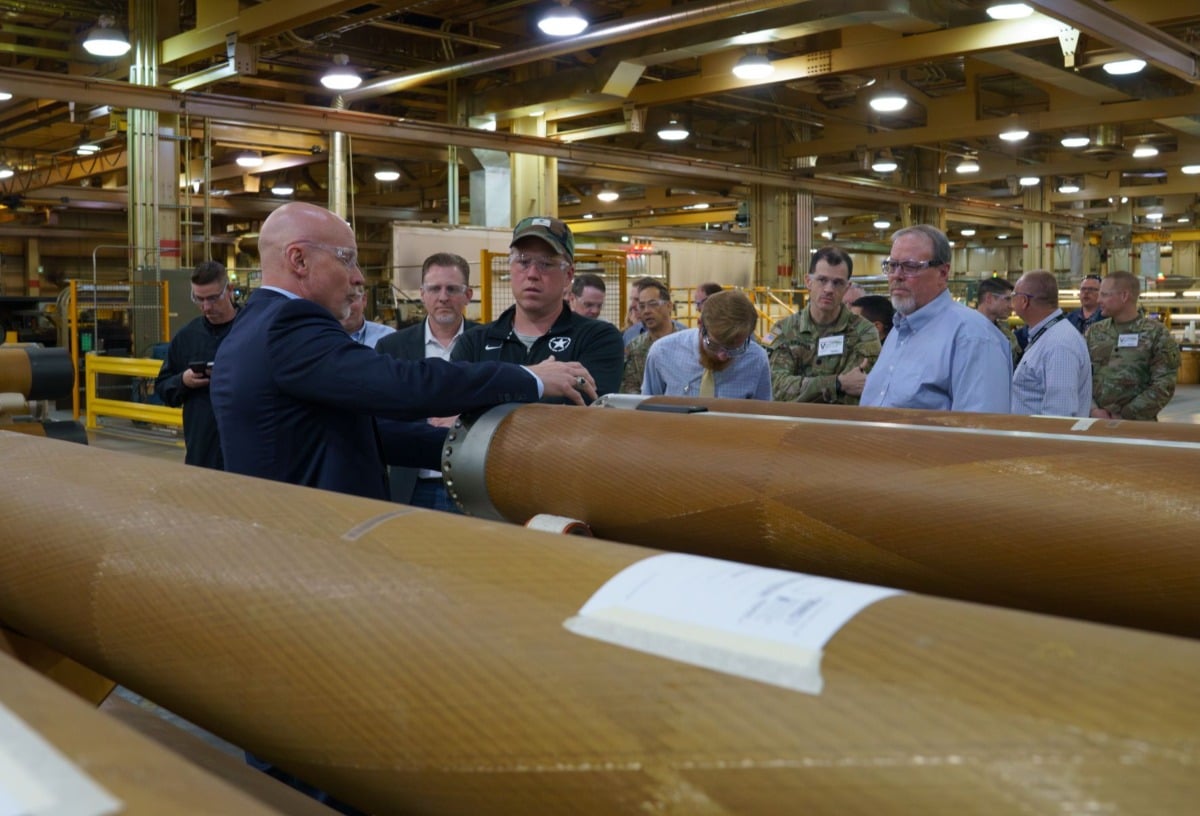
The U.S. Army’s top civilian official visited a West Virginia munitions laboratory last week to personally assess how quickly America’s defense industry can ramp up production of the rockets and propulsion systems that power the Army’s most critical weapons, as the military pushes to rebuild stockpiles depleted by years of foreign assistance and accelerating global demand.
Secretary of the Army Dan Driscoll traveled to Northrop Grumman’s Allegany Ballistics Laboratory in Rocket Center, West Virginia, where he reviewed the facility’s advanced propulsion systems work, munitions production capacity expansion, and programs supporting long-range fires, air and missile defense, and next-generation modernization. Benjamin Davies, Corporate Vice President and President of Defense Systems at Northrop Grumman, confirmed the visit in a LinkedIn post, describing the discussion as focused on “a critical national security priority: accelerating munitions production.”
The Allegany Ballistics Laboratory has operated in the mountains of West Virginia since 1945, when it was established to support rocket motor development for the U.S. military. Over eight decades it has become one of the country’s most specialized facilities for solid rocket motor design, development, and production, working across programs from tactical missiles to strategic systems. The facility employs hundreds of people in a region where it represents one of the most significant employers, and its specialized workforce represents institutional knowledge accumulated over generations that cannot be quickly rebuilt if lost. Northrop Grumman acquired the facility as part of its broader munitions and propulsion portfolio, and it sits as a critical node in the U.S. Army’s supply chain for rocket-powered weapons.
Secretary Driscoll’s visit is part of a broader pattern of senior Department of War officials conducting direct facility visits to assess industrial base readiness, a practice that has accelerated since 2022 when the scale of munitions consumption in Ukraine exposed significant gaps between Western production capacity and wartime demand. The Army in particular has been pressing its industrial partners to increase production rates across multiple munitions categories, from 155 mm artillery shells through Javelin anti-tank missiles, Patriot interceptors, and the rocket motors that power HIMARS and MLRS rockets. Each of those programs touches different industrial facilities and supply chains, but the common constraint across all of them is the specialized workforce and capital equipment required to manufacture energetic materials, the propellants and explosives at the heart of every munitions system.
Northrop Grumman has been one of the most active major defense contractors in publicly committing to munitions capacity expansion, with Davies noting the company has invested more than $2 billion in munitions-related research and development and capacity expansion across its enterprise. That figure spans multiple facilities and programs, reflecting the company’s position as a major supplier of propulsion systems, rocket motors, and munitions components across a wide range of Army, Navy, and Air Force programs. The investment is both a response to existing contract demand and an anticipatory bet that the government will continue to prioritize munitions procurement at elevated rates for the foreseeable future.
Air and missile defense propulsion is the other major mission area Davies highlighted in connection with the Allegany Ballistics Laboratory’s work. The extraordinary demand for Patriot interceptor missiles, driven by their use in Ukraine and by procurement orders from European NATO members accelerating their own air defense investments, has created sustained pressure on every element of the Patriot supply chain. Northrop Grumman’s propulsion work feeds into that supply chain, meaning the Allegany facility’s output capacity directly affects how many interceptors reach the soldiers and allies who need them. A personal visit from the Secretary of the Army to a propulsion laboratory is not a routine event. It signals that the leadership of the Army views the production speed of rocket motors as a matter deserving direct executive attention rather than routine contract management.
“Our team is ready now and was proud to show Secretary Driscoll firsthand how we’re delivering advanced propulsion systems, expanding munitions production capacity, and supporting long-range fires, air and missile defense, and next-gen modernization efforts,” Davies wrote. “We take pride in advancing key US Army priorities and in ABL’s readiness to meet today’s demands and scale production as mission needs evolve.”
Content preview only. Full article available at source. View Full Article
U.S. Army Secretary Dan Driscoll visited Northrop Grumman's Allegany Ballistics Laboratory in Rocket Center, West Virginia, last week to evaluate the facility's munitions production capacity. The visit focused on accelerating production of rockets and propulsion systems to meet the Army's needs, particularly in light of increased global demand and stockpile depletion. Northrop Grumman has committed over $2 billion to expand its munitions capabilities, which are vital for various military programs.
- Secretary of the Army Dan Driscoll visited Northrop Grumman's Allegany Ballistics Laboratory in West Virginia.
- The visit aimed to assess the production capacity of munitions and propulsion systems.
- Northrop Grumman has invested over $2 billion in munitions-related R&D and capacity expansion.
- The facility is crucial for the U.S. Army's supply chain for rocket-powered weapons.
- The demand for munitions has increased due to foreign assistance and global military needs.