
Norway opens Patria 6x6 CAVS 2026 to pave the way for European standardization
 Dr. Klaus Weber
Norway Opens the Path to European Standardization with Patria 6x6 CAVS 2026
On May 26, 2026, Norway did not simply sign another procurement form. By joining the Framework Agreement of the Common Armoured Vehicle System, or CAVS, Oslo now gains access to the serial procurement of the Patria 6x6. This may sound like bureaucratic language, but therein lies the security policy significance: Europe does not gain combat power through grand speeches about strategic autonomy, but through repeatable processes, common variants, and industrial routines that ultimately deliver vehicles to barracks.
Patria reported the Norwegian signature as the next step following the program's accession in 2025, at that time together with the United Kingdom. The CAVS program was initiated in 2020 by Finland and Latvia and now includes Finland, Latvia, Sweden, Germany, Denmark, Norway, and the United Kingdom at various stages. Vehicles are already being delivered to several members and are also in use in Ukraine. This makes CAVS a rare case of European defense cooperation, where the technical platform is growing faster than the political rhetoric.
A 24-Ton Vehicle as a Test for Europe's Procurement Capability
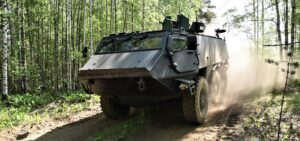
The Patria 6x6 is not a wonder weapon system. It is precisely for this reason that it is interesting. It is a protected 6x6 wheeled armored vehicle for troop transport, command, medical, support, and special roles. The common technical specifications illustrate the logic of the design: up to 24 tons total weight, around 8.5 tons payload, over 700 kilometers range, more than 100 km/h road speed, and a crew of two to three soldiers plus dismounted forces. The platform is not as heavy and expensive as an 8x8 infantry fighting vehicle, but significantly more modern and modular than the many old transport vehicles still in service in European armies.
For Norway, this category is particularly plausible. The country needs protected mobility for long distances, difficult terrain, and a defense planning that relies not on symbolic presence in the north, but on real deployability. A CAVS vehicle does not replace a main battle tank or a CV90. However, it fills the gap between unarmored transport and heavy tracked vehicles. In the European rearmament, this middle category has often been underestimated because it is less visible than air defense or combat aircraft.
Why CAVS Works Differently Than Many EU Programs
The real point lies not in the vehicle, but in the procurement model. CAVS is not a classic EU prestige project with maximum political symbolism and minimal standardization. It started small, with Finland and Latvia, and expanded based on concrete needs. Patria leads the development, while the participating countries can adapt variants nationally, but remain on a common vehicle base. This balance of national usability and common system logic is why the program appears politically more robust than many larger cooperation projects.
Germany is the crucial benchmark for this. In December 2025, Berlin signed two series contracts within the CAVS framework with a total value of over two billion euros, including firm orders and options. Deliveries are set to begin in 2026, along with technology transfer to German industrial partners such as FFG, DSL, or KNDS structures. In February 2026, a contract worth around 140 million euros followed between Patria and Kongsberg for PROTECTOR RS4 remote-controlled weapon stations for more than 300 vehicles in German and Swedish CAVS variants. This is not spectacular, but it is exactly the kind of industrial consolidation that European defense capability needs.
Here, CAVS also differs from the usual European debate about autonomy. Autonomy is often described in Brussels and Paris as a legal state. In the reality of armaments, it is a supply chain. Those who organize chassis, sensors, weapon stations, spare parts, training, and maintenance in a multinational framework create more strategic substance than a summit communiqué about a European defense union. But is that enough?
The Norwegian Signature Changes the Industrial Geometry
Norway is not an accidental participant. Patria is 50.1 percent owned by the Finnish state and 49.9 percent by Kongsberg Defence & Aerospace. This transforms a Finnish-Latvian program increasingly into a Nordic-Baltic-German industrial chain. Kongsberg not only provides political proximity but also concrete system components with its weapon stations and electronics expertise. Nammo, in which Patria is involved, enhances the ammunition and effectors logic of this Nordic defense group. For Oslo, CAVS is therefore not just a vehicle procurement but also an industrial policy in its own security space.
This is important because Europe's procurement landscape is otherwise still characterized by national special paths. Each country prefers its own radios, its own turret solutions, its own training packages, and its own maintenance logic. In peacetime, this creates jobs and political satisfaction. In wartime, it creates slow spare parts chains and incompatible stocks. CAVS cannot cure this ailment, but it shows a more practical counter-model: national variants on a common architecture, series contracts instead of individual projects, lifecycle planning instead of trade fair announcements.
Ukraine as an Uncomfortable Reality Check
That Patria points out that CAVS vehicles are also operational in Ukraine is more than just marketing. The war has shown that protected mobility is a consumable good. Wheeled armored vehicles are damaged, stripped, repaired, rearmed, and deployed in roles that no specification in Helsinki, Riga, or Berlin has fully anticipated. For European armies, this experience is uncomfortable because it reveals the shallow depth of many stocks. A dozen high-tech platforms are of little use if maintenance, spare parts, and training do not scale.
That is precisely why the Norwegian framework signature is more significant than an isolated order. It expands the demand base, increases political pressure on supply chains, and makes further industrial specialization more likely. If Germany plans hundreds of vehicles, Sweden and Finland expand their variants, Latvia produces, and Norway enters the serial logic, a European user community emerges that can jointly support upgrades and spare parts supply. This is not a substitute for NATO Article 5, but it is a material prerequisite for European land forces to act credibly within the alliance.
The Sobering Value of an Unspectacular Program
CAVS does not solve Europe's armament problems. It will neither close the ammunition gap nor eliminate dependence on American reconnaissance, air defense, and nuclear deterrence. National variants, industrial interests, and budget cycles will also remain with the Patria 6x6. Those who turn a framework agreement into a strategic revolution confuse administrative progress with power politics.
But the reverse error would be greater. Precisely because CAVS is unspectacular, it deserves attention. Europe's defense will not only be measured by FCAS, SAFE credits, or summit goals. It will be measured by whether European states can buy, maintain, modernize, and deploy common platforms in sufficient numbers within the alliance. Norway's step shows that standardization does not begin with a grand constitutional draft, but with a signed framework agreement for a 24-ton vehicle. European defense needs both: more money and less vanity. So far, CAVS primarily proves the latter point.
Norway signed a framework agreement on May 26, 2026, to procure the Patria 6x6 armored vehicle as part of the Common Armoured Vehicle System (CAVS) program. This agreement enhances European defense cooperation and standardization among participating nations, which include Finland, Latvia, Sweden, Germany, Denmark, and the United Kingdom. The Patria 6x6 is intended for troop transport and other military roles, addressing the need for protected mobility in challenging terrains.
- Norway signed a framework agreement for the Patria 6x6 armored vehicle on May 26, 2026.
- The CAVS program includes multiple European nations and aims for standardization in military procurement.
- The Patria 6x6 is designed for troop transport and various military roles, weighing up to 24 tons.