
"Notes on the Air Defense and Anti-Ship Drills of the China-Russia 'Maritime Joint-2026' Joint Exercise"
Joining Hands to Forge the "Defense Line" at Sea and Sky
—— A Record of the Air Defense and Anti-Ship Drill in the China-Russia "Maritime Joint-2026" Joint Exercise
■ PLA Daily Reporters Zhang Junsheng, Zhang Lin
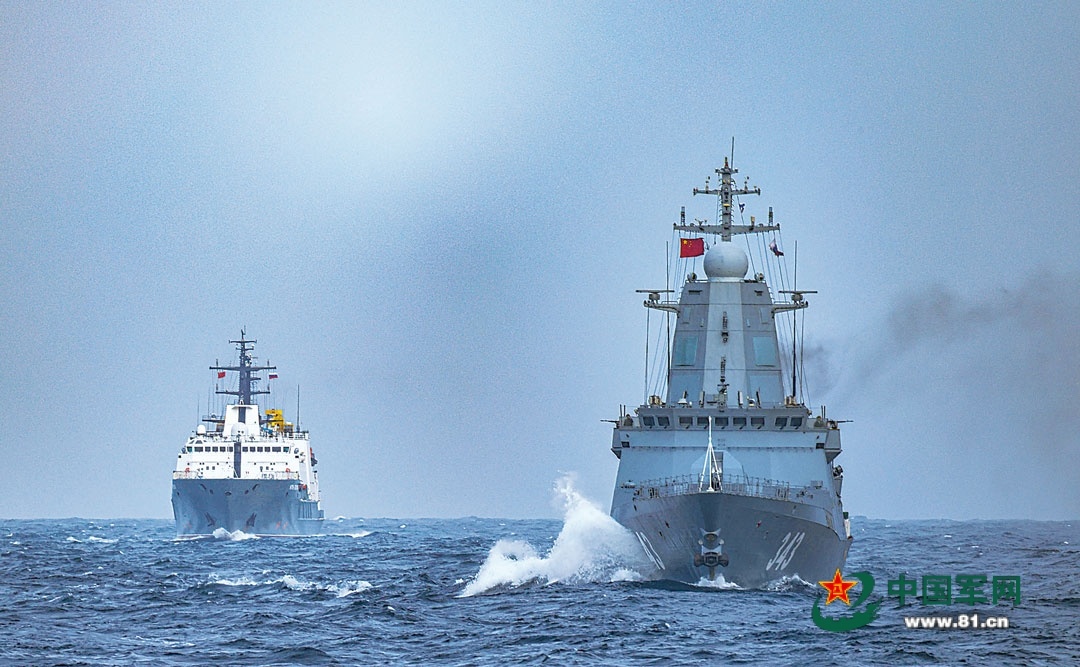
Scene of the air defense and anti-ship drill. Photo by Li Fengxiang
In a certain area of the Yellow Sea, the clouds are low and the waves are fierce. Recently, the China-Russia "Maritime Joint-2026" joint exercise has entered the maritime drill phase.
In the command room of the Kaifeng ship, bright spots are densely jumping on the radar screen. "Enemy" aerial targets are rapidly approaching. Commands are precisely issued to the Chinese and Russian ships through the data link, and the air defense and anti-ship drill begins.
Multiple fast aerial targets are approaching the formation, and the Chinese and Russian naval formations quickly change their formations, establishing a three-layer firepower network of long, medium, and short range—long-range interception by Chinese ships, medium-range support by Russian ships, and close-range defense by the close-in weapon platforms of each ship.
The crew of the Kaifeng ship holds their breath, focused on the incoming targets. At the same time, the air defense system of the Russian missile cruiser "Varyag" also responds, coordinating strikes in the shortest time possible. Multiple batches of "targets" are effectively intercepted, testing the joint operational capabilities of both sides.
During the drill, the radar systems of both China and Russia clearly detect targets in the relevant maritime and aerial areas and simultaneously share the information with all participating ships. The China-Russia maritime formation closely coordinates to effectively counter incoming targets.
"The Chinese and Russian sides closely coordinate, achieving seamless connection," said participating personnel.
Since its inception in 2012, the China-Russia "Maritime Joint" series of exercises has become an important platform for practical cooperation between the two militaries. This joint exercise focuses on "jointly responding to maritime security threats," with subjects set closer to real combat and current military development trends. Chen Ruoyu, a member of the maritime formation command post, stated that the two sides communicate and plan together, "with very high efficiency and quick consensus."
Guo Xihuan, a crew member of the Kaifeng ship, has participated in this series of exercises five times. He said that the subjects of the China-Russia "Maritime Joint" exercises are becoming increasingly rich, the pace is accelerating, the complexity is gradually deepening, and they are becoming more aligned with real combat. The level of mutual trust and tacit understanding between the participating sides is continuously improving, and their ability to closely cooperate and conduct joint actions is becoming stronger.
As the air defense and anti-ship drill concludes, the formation continues to sail towards the designated maritime area. Waves crash against the ship's hull, and between the sea and sky, radar antennas spin. The next exercise subject is about to unfold.
China and Russia conducted a joint air defense exercise in the Yellow Sea, involving multiple naval vessels from both nations. The exercise featured coordinated responses to simulated aerial threats, utilizing advanced radar and missile systems. This event aimed to strengthen military cooperation and operational capabilities between the Chinese Navy and Russian Navy.
- China and Russia conducted a joint air defense exercise in the Yellow Sea.
- Naval vessels from both countries participated in the exercise.
- The exercise involved multiple layers of air defense coordination.
- Radar systems were used to detect and intercept simulated aerial threats.
- The exercise aimed to enhance cooperation and operational efficiency between the two navies.