
October: Chinese Maritime Militia Approaches Taiwan's East Coast Within 2.7 Nautical Miles, Gray Zone Operations Practice Blockade Chain
 Li Minghui
In October, Chinese Maritime Militia Approaches Taiwan's East Coast 2.7 Nautical Miles, Conducting Gray Zone Operations to Blockade
A report disclosed on October 23 contains details that are more noteworthy than the headline. Taiwan's Coast Guard stated that on August 16, a fishing vessel identified as having characteristics of the Chinese maritime militia, named "Minfuding Yu 07902," was found operating in conjunction with Chinese Coast Guard and research vessels, at a distance of approximately 2.7 nautical miles from Taiwan's restricted waters. The key term here is not "fishing vessel," but "grouping."
From Single Vessel Harassment to Multi-Department Coordination
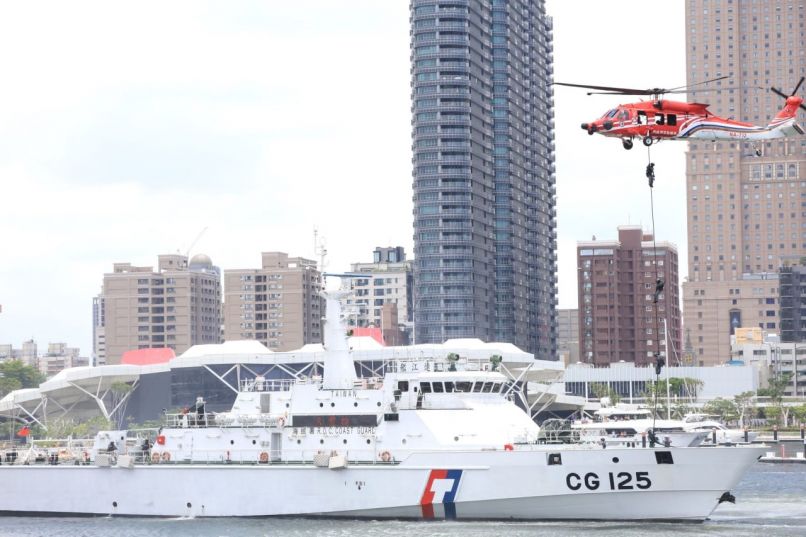
Reuters cited Taiwan's Coast Guard as saying that China has intensified its activities in the overlapping economic waters of Taiwan, Japan, and the Philippines since June. The combination of maritime militia, Coast Guard, and research vessels serves to provide numerical superiority, law enforcement cover, and reconnaissance mapping functions. They do not need to openly enter each other's territorial waters like warships, yet can continuously gather information on response times, communication methods, and Coast Guard deployment patterns.
This is a typical gray zone operation: breaking military preparations into several seemingly civilian actions, making it difficult for the opponent to decide when to respond with military means. Taiwan's Coast Guard assesses that the east coast is not only a maritime traffic line but also a potential direction for external assistance and supplies. In simple terms, the west coast is the focus of public opinion, while the east coast may be the side door for wartime logistics.
Why Push Pressure Towards Taiwan's East Side
Military activities in the narrowest part of the Taiwan Strait have become highly concentrated, and the marginal returns of increasing the number of military aircraft are declining. The eastern waters, however, are different; they are farther from Taiwan's main ports and airports, making external supply routes, underwater infrastructure, and maritime traffic easier to observe long-term by "non-military" vessels. If a crisis occurs in the future, China may not necessarily implement a traditional comprehensive blockade first, but rather create navigation risks using Coast Guard, militia, and research vessels, with the navy and long-range firepower providing a deterrent backdrop.
Data released by Taiwan's defense department from October 22 to 23 also provides a contrast: three PLA Navy vessels and seven government ships were detected around Taiwan, but no PLA military aircraft were found. This number does not directly prove a decrease in pressure; rather, it indicates that maritime and aerial pressure can operate separately. The absence of military aircraft does not mean there are no actions.
The Liaoning's High-Seas Training is Another Clue
During the same period, the Liaoning carrier group was active in the western Pacific. Public reports indicate that the Liaoning set out on October 14, with the group including large destroyers, and the training area was near Japan, Taiwan, and the Philippines; defense media assess that the Liaoning is increasingly resembling a training platform for validating carrier-based aircraft, sensors, and new tactics, rather than a frontline response force in wartime. The South China Morning Post also mentioned that this training may overlap in time and geography with the US-Japan "Sword-27" exercise.
When these two clues are viewed together, the focus becomes clear: the maritime militia is responsible for pushing situational awareness and law enforcement pressure towards Taiwan's east side, while the carrier group tests sustained presence capabilities in more distant waters. The former lowers the threshold for action, while the latter raises the upper limit for escalation, with a buffer layer composed of Coast Guard, government vessels, and research ships in between.
The author believes that the most easily misjudged aspect at this stage is not whether China has the capability to launch a blockade, but whether blockade preparations must manifest under the name of "blockade."
Of course, public information is still insufficient to prove that "Minfuding Yu 07902" is directly commanded by the PLA, nor can a single approach action be equated with a combat rehearsal. What is truly worth tracking is whether fixed routes, repeated groupings, and east coast supply nodes emerge subsequently. If these patterns continue to appear, Taiwan will no longer be facing a single fishing vessel that can be driven away, but rather a gradually forming maritime pressure chain.
References
Chinese maritime militia approached within 2.7 nautical miles of Taiwan's eastern coast in October 2023, conducting coordinated operations with coast guard and research vessels. This gray zone tactic aims to exert pressure on Taiwan while avoiding direct military confrontation. Concurrently, the Liaoning aircraft carrier was active in the western Pacific, indicating a broader military posture. Taiwan's defense reports noted increased Chinese maritime activity in the region since June.
- Chinese maritime militia approached within 2.7 nautical miles of Taiwan's eastern coast.
- The operation involved coordination between fishing vessels, coast guard, and research ships.
- Taiwan's defense department reported increased Chinese activity in overlapping economic zones since June.
- The Liaoning aircraft carrier was conducting operations in the western Pacific during the same period.
- Taiwan's defense data indicated a separation of maritime and aerial pressure tactics.